Most commonly attributed to Plato, the oft-repeated proverb “necessity is the mother of invention” is as applicable today as when it was first scribed. Case in point: Increasingly onerous, if not outright nonsensical, regulations placed upon ammunition by some state conservation agencies have effectively forced manufacturers to redesign projectiles and construct them from “environmentally friendly” materials. Moreover, modern firearms—including muzzleloaders—and their users are now placing greater demands upon projectiles than ever before; higher-than-normal velocities demand increased bullet resilience, while 200-plus-yard targeting requires a streamlined bullet for flatter trajectories and less wind deflection. Lastly, the bullet must reliably and consistently upset at the reduced velocities common at long range. Federal Premium’s new Trophy Copper Muzzleloading Bullet is up to these challenges ... and then some.
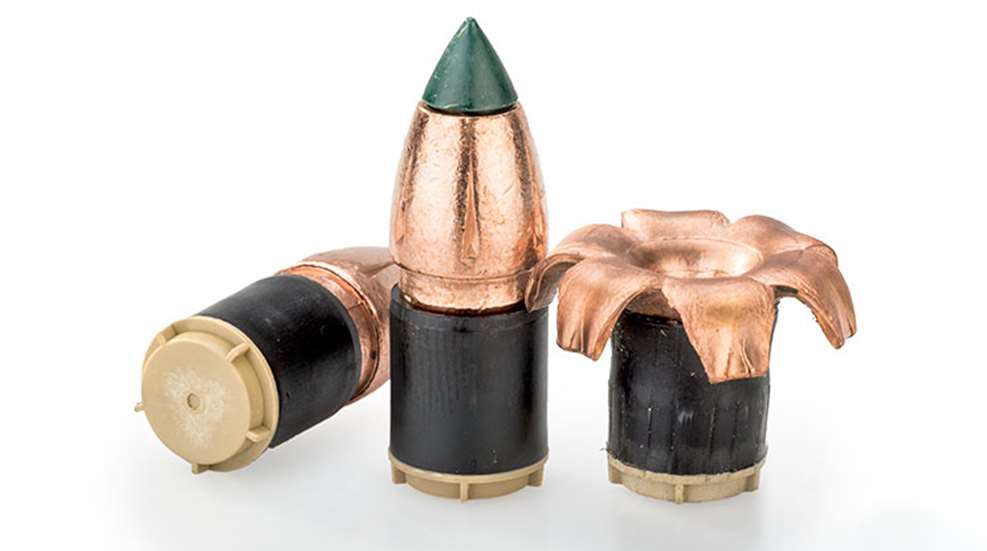
Immediately noticeable is the absence of a traditional sabot or belt surrounding the Trophy Copper bullet. Instead, it features the innovative Bullet Obturating Ramp (BOR) Lock MZ system, which has two notable deviations from the norm. First, there’s an expanding, one-piece, black polymer cup secured to the bottom of the projectile; if separation of the two occurs it happens in the target and not en route. To ease loading, the cup remains behind the forward-most obturating ramp and atop the rear one, leaving only the base in contact with the bore. Upon firing, though, the cup moves forward and over both obturating ramps, thereby swelling to create a bearing surface to engage the rifling. The expanded cup also forms a gas seal, which aids accuracy and helps increase velocity.
Next, due to its diameter, five blade-like projections and hardness, the cup’s fiberglass-reinforced base scours during loading the pronounced fouling ring left by blackpowder and blackpowder substitutes near the breech. Not only does this ease—and quicken—loading subsequent shots, but it also helps ensure the projectile is firmly seated atop the powder (or pellets). This is required for both safety and shot-to-shot consistency for maximum accuracy.
True to its moniker, the .50-caliber, 270-grain Trophy Copper bullet is made from copper alloy. Absent a separate core, the projectile maintains nearly its entire pre-expansion weight (typically only the polymer tip is shed). Such construction makes the bullet legal for hunting in areas where lead ammunition is prohibited by law. That the Trophy Copper Muzzleloading Bullet is a one-piece, non-saboted design also enables its use in those states requiring such features.
To increase the ballistic coefficient, which is important for 200-yard shots, the Trophy Copper features a polymer tip and a streamlined shape. The total length is 1.595 inches. Further, the tip, when combined with external skiving and a deep, cavernous cavity, ensures consistent expansion at a wide range of impact velocities. This is critical for shots taken at distant game, where the velocity has declined greatly. The typical expanded diameter of the bullet when it’s pushed by two pellets of blackpowder substitute is more than 1 inch, and the upset projectile has six sharp “petals.”
Propelled by two Triple Seven Magnum pellets from a CVA Accura Mountain Rifle’s 25-inch barrel during testing, the Trophy Copper bullet attained 1766 fps and produced a three-shot group at 100 yards measuring 1.88 inches. A charge of 90 grains (by volume) of Goex Olde Eynsford blackpowder propelled the bullet to 1526 fps. That load’s three-shot group measured 2.376 inches. I fully expect that, with slight load refinement, the Trophy Copper is capable of achieving minute-of-angle performance.
Additionally, whether it was the first bullet of the string or the last, loading was exceptionally easy. In fact, I cannot recall a muzzleloading projectile that was as effortless to seat. The hard base with cutting ring scrubbed powder and plastic residue from the bore; the sound and feel of it doing so was unmistakable. To observe this action, I removed the breechplug of the fouled Accura, cupped my hand beneath the breech end of the barrel, and then pushed a Trophy Copper Muzzleloading Bullet completely through. I was astonished by the amount of residue and fouling that accumulated in my hand after a single bullet had traversed the length of the bore.
As Federal Premium proves with its new Trophy Copper Muzzleloading Bullet, ingenious solutions can result from trying circumstances. Plato was correct
Technical Specifications:
• Caliber: .50
• Weight: 270 grs.
• Ballistic Coefficient: .168
• Construction: copper alloy with polymer tip; polymer cup with fiberglass-reinforced base
• MSRP: $24.95 per pack of 15