Last year Ruger melded two of its working-man rifle brands—the Ranch moniker and its American Rifle line—to offer the American Rifle Ranch. Let’s talk about what’s in this name.
We all know about Ruger’s original Ranch Rifle, the semi-automatic, .223 carbine that was perfect for whipping out of a truck window and shooting a varmint that needed killin’ on the ranch. Ruger sold a pile of these Mini-14 variants before AR-15s went mainstream, and the rifle remains a cult classic.
Meanwhile, the American line of bolt-action rifles is only a few years old but has become wildly popular for its accuracy and street price of about $400. With its venerable M77-based Hawkeye rifle’s price climbing to around $1,000, Ruger found it had nothing to compete with the new trend of economy rifles, such as Savage’s Axis and Remington’s Model 770. Like the aforementioned guns, the American looks and even feels cheap, but the dang thing shoots as well as the company’s more expensive models and so consumers buy them vigorously at nearly every Walmart in the country.
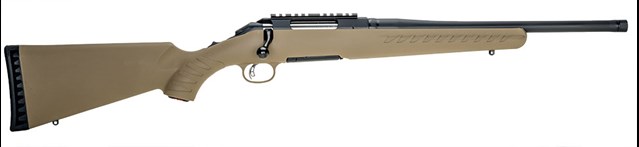
The American Ranch iteration is most similar to the Compact version, yet its barrel is even shorter at 16 inches, compared to 18 on the Compact and 22 on the standard model. Other than barrel length, the Ranch has three major differences. First, the barrel comes threaded for a suppressor and ships with a thread protector. Suppressors are now legal in 34 states for hunting and can be owned for shooting in several more. They make perfect sense for shooting vermin on a ranch where shots are often taken near livestock and from truck windows. When a coyote jumps from the brush and flees over a field, who has time to find and insert hearing protection? A suppressor eliminates the need. Even with a suppressor installed, the Ranch’s length will amount to approximately that of a rifle with a full-size barrel, so the device will not add cumbersome inches. The trade-off, of course, is velocity.
Secondly, Ruger chambers the Ranch in 5.56 NATO (.223 Rem.) and most notably .300 AAC Blackout, which has earned a reputation as a wild-hog assassin. Most .300 Blackout loads intended for hunting are supersonic, so there will be an audible crack as the bullet speeds by the sound barrier on its way to 2200 fps or higher, but they deliver up to a couple hundred foot-pounds more energy than the .223 Rem. Nonetheless, it’s slightly puzzling to me why Ruger chose the Blackout, a round that was developed to mimic the performance of the 7.62x39mm of AK-47 fame while being compatible with M4-style carbines and their .223 Rem. magazines. Since the Ranch rifle is of course a bolt-action, the .300 Blackout chambering has no real purpose here except to capitalize on this round’s popularity as a hog cartridge for suppressed AR-style rifles. I would have opined for a Ranch rifle chambered in .308 Win. or perhaps .338 Federal, but of course, the Blackout is novel and cool, and I suspect sales will be better owing to marketing buzz alone.
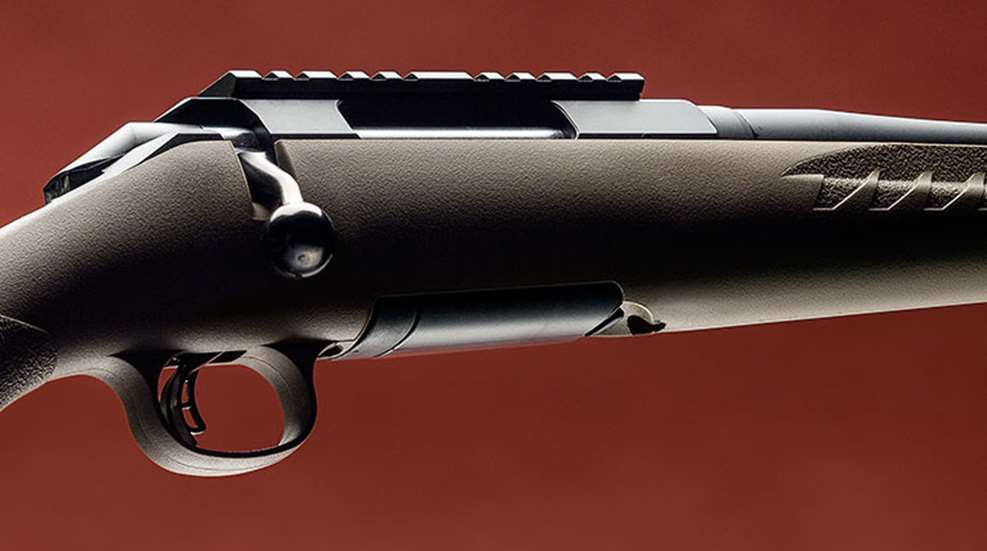
Finally, the Ranch comes with a Picatinny rail that replaces the standard American Rifle’s traditional scope-base system. With this change Ruger addressed one of Field Editor Bryce Towsley’s few complaints in his review of the American Rifle, which can be found here.
In case you didn’t read it, here are the standard American’s highlights: Foremost, this surprisingly accurate rifle retails for far less than $500, and so most of its design was intended to keep costs down while remaining accurate and reliable. Ruger accomplished this in three ways. First, the rifle’s hammer-forged barrel is quality, and it’s mated to a robust steel action via a Savage-inspired barrel-nut system that ensures perfect headspace. Secondly, it cradles this barreled action via a pair of V-notch supports that bed the action rigidly while free-floating the barrel. It’s an extremely effective—and inexpensive—system. Lastly, Ruger borrowed again from Savage for the trigger in the American. The rifle’s Marksman trigger allows the shooter to adjust the pull weight down to 3 pounds while remaining safe. It's about time! I've repeatedly complained about Ruger's lawyer triggers, but I can only praise this one. It broke at just a bit more than 3 pounds out of the box.
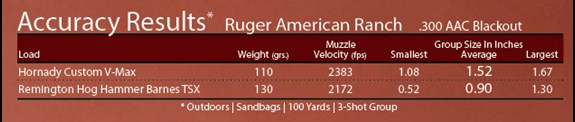
All of these things, combined with the mild recoil of the .223 Rem. and .300 Blackout cartridges, combine to make the American Ranch surprisingly accurate given its feathery 5.9-pound weight. The rifle is just about as light as centerfires get, and so I couldn't believe it turned in some sub-inch groups with Remington's Hog Hammer ammo.
The stock can be ordered in two sizes: with a 13.75-inch length of pull or what amounts to a youth-sized 12.5 inches, although it’s not called as such. The squatty stock and 16-inch barrel facilitate reaching into the passenger seat (or back seat or gun rack), drawing the rifle and shooting it out of the window. If you think I’m kidding here, think again. This is how they do it on ranches in the heartland, as crop-rooting pigs and calf-eating coyotes tend to hit another gear when Mr. Ranch Hand gets out of the truck.
The full-diameter, 70-degree-throw bolt features three lugs. Two of my favorite features are the easy-to-view tang safety and the five-round rotary magazine that fits flush with the stock belly. A flush-fitting magazine is important for a truck gun so it will not snag and so it can be rested on various parts of the truck without eating its paint.
After handling and testing the Ranch, there are several things I like about it: In and around a vehicle, I love the idea of a suppressor. The only reason they aren’t common in America is due to the ATF’s ridiculous restrictions. At any rate, a full-sized barrel plus another 8-10 inches of suppressor would simply be too much. So the rifle’s 16-inch barrel is perfect. Secondly, its short stock is über-handy. An inch doesn’t sound like much until a hog high-tails it and you begin fumbling to shoulder the rifle while in the driver’s seat. Lastly, the rifle is surprisingly accurate with its upgraded trigger despite its whippy weight. It’s tough enough, and inexpensive enough, to be left in a gun rack and forgotten until a coyote breaks from cover … or deer season arrives.
Technical Specifications:
Type: bolt-action centerfire rifle
Caliber: 5.56 NATO, .300 AAC Blackout (tested)
Barrel: 16.12"; cold-hammer-forged; 6 grooves, 1:7" H twist; threaded muzzle
Magazine: rotary, detachable box; 5-rnd. capacity
Trigger: single-stage, user-adjustable Marksman; 3.14-lb. pull weight
Sights: none
Safety: two-position, tang-mounted Stock: flat dark earth synthetic; LOP 12.5" (tested), 13.75"
Metal Finish: matte black Overall Length: 34.75"
Weight: 5.9 lbs.
Accessories: Picatinny rail for mounting optics
MSRP: $499.99