 You might be surprised—as I was—to learn there are a couple places where you can actually hunt deer in July. California, for example, offers early bow season in a couple units, and if you push that back to Aug. 1, southeast Alaska gets going on its Sitka blacktail seasons.
Or you could go to Europe, where nearly the entire continent is open throughout the summer months for roebuck, a smallish species that in some respects parallels our whitetail in that it can live just about anywhere and is highly regarded by hunters from England to Russia.
And so after Steve Hornady and I attended this year’s big CLA Game Fair near Oxford, England, we felt compelled to take advantage of this gift opportunity to do what we like best. Both of us had previously hunted roe deer elsewhere, and so we knew full well just how tricky it can be to pursue an animal perpetually on the move at a time when the cover is at its heaviest.
We hooked up with Owen Beardsmore, whose outfit, Cervus UK, runs hunts for many types of game throughout the British countryside. Owen’s prime roebuck area is in rural Hampshire, southwest of London. He and his guides manage the deer on vast estates where the hilly terrain is a mix of forest and sprawling grainfields that were being harvested during our stay. Like most of their kind, roe deer are found around edge cover, and so we stalked along tractor roads and sat in ladder stands overlooking woodland openings and secluded corners.
Owen and company are out quite often scouting and controlling the fox population, and like many of us, they use trail cams to see what’s present. Accordingly they had a pretty good idea where to hunt for mature trophies, but that in itself only goes so far on the hard-to-spot roebucks.
Fortunately the English woodsmen had another card to play. Since the rut was just then getting underway, they called the little deer, which, similar to other cervids, will respond to the right vocalizations as part of their mating behavior. Our guides from Cervus UK roused the woods with high-pitched squeals and squalls, roe deer talk for “come on.” After coming up empty the first couple times out, our luck changed and I witnessed one of the most amazing game-calling demonstrations ever.
Guide Glen Boxall, a professional forester by trade, called in several deer—bucks and does with young—using nothing more complicated than a beech leaf. Apparently Glen is something of a local legend for his ability to call deer via “organic” methods, and though he was glad to help me, he was rather secretive about how exactly he worked the magic. I think that was partly the reason he set up 25 yards away from my position in the woods, and he made it clear he’d prefer not to be the subject of any video or close-up photography. I rather liked that notion, and when a long-tined, 4-year-old buck came sneaking in to Glen’s piercing tune, it all seemed just about perfect.
For the record, though, Owen and guide John Eastick also called in great bucks using commercial calls, thus proving that with the right stuff at the right time, there’s more than one way to call in an English roebuck. Steve Hornady’s prize was a particularly old trophy with fantastic “rosettes” at its antler bases. For a better idea of how it went, check out this video.
Steve and I borrowed rifles for the hunt, sparing us a wall of red tape, and doing so allowed us to do like most British deer hunters and use suppressors. A growing number of American shooters and hunters are clamoring to give the sound-dampening devices a try, but because of federal laws that impose a lengthy and difficult licensing process, most folks remain on the sidelines. Ironically in England, where gun ownership is highly restricted, it’s fairly easy to own a suppressor, or moderator, as the Brits call it.
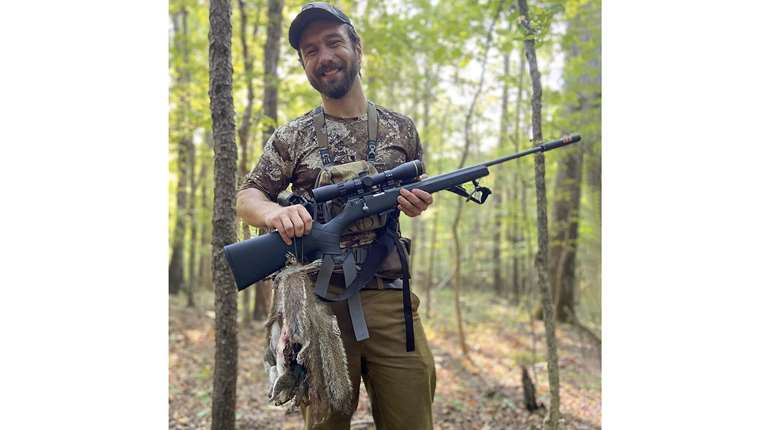
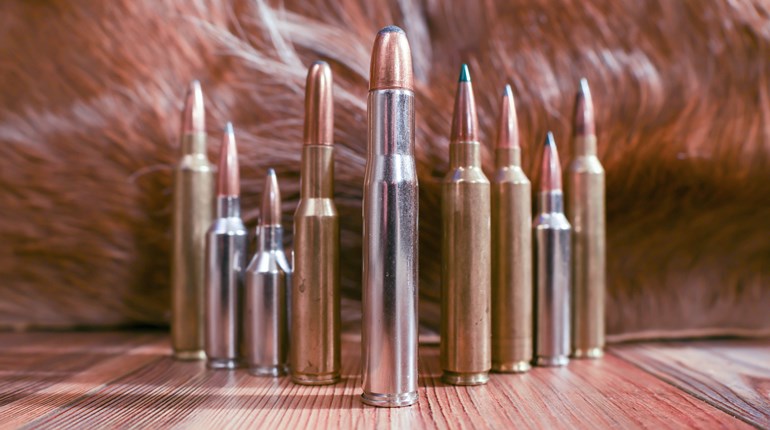
Attached to our loaner Savage Model 16s in .243 Win., the moderators were as good as advertised. Both Steve and I removed our ear muffs during the pre-hunt sight-in, and indeed, the usual piercing blast, the sound that hurts, was gone. We both noted a high-pitched snap, which I’ve since been told was the bullet breaking the sound barrier, but that was quite tolerable. It made for a welcome change when we shot our deer, too, using Hornady factory ammo with their 100-grain SST bullet. That caliber/bullet combo is likely unbeatable for the 50-pound bucks. Ours went down, practically in their tracks, always the goal in ethical hunters and especially welcome in the thick midsummer foliage where tracking would have been tricky.
Britain is a long way to go, yes, but short of introducing roe deer to the United States (both Hornady and I like to fantasize about that!), it’s a summertime fix for a deer hunter’s blues.