Every varmint hunter, whether he be targeting alfalfa-raiding ground squirrels or fawn-eating coyotes, knows what he wants in ammunition: something fast and flat with minimal recoil. Inexpensive wouldn't hurt, either.
The fast, flat and low-recoil requests are met by many centerfire cartridges from .20 caliber through .24 caliber. Winchester now proposes to take care of the expense with its new Varmint X line of ammunition. It promises premium-ammo performance at bargain-ammo prices—just $17 to $24 per box in most stores.
When it comes to performance, there are few secrets in varmint cartridges. Shooters figured out long ago that light, sleek, sharply pointed bullets pushed by cartridges like the .204 Ruger, .223 Rem., .22-250 Rem. and .243 Win. deliver trajectories that permit dead-on holds as far as 300 yards. As an example, let's take a look at Winchester's 55-grain, polymer-tipped Varmint X load in .22-250 Rem. The company rates its muzzle velocity at 3680 fps, which is within 10 fps of what Federal, Remington and Hornady claim for their 55-grain .22-250 Rem. loads. Zero that load at 240 yards, and the bullet will strike within 3.35 inches of your point of aim from muzzle to 300 yards (not including wind drift).
With a trajectory like that, you can forget about the range, hold dead-center on a coyote's 8-inch chest, and as long as you don't flinch, you've got him at any distance out to 300 yards. That covers about 90 percent of the shots most of us get at coyotes. It should work nearly as well on red foxes, bobcats and standing marmots. You still have to figure in the wind—a 10 mph breeze hitting the bullet at a right angle will blow it off course by 5.39 inches at 200 yards, 6.63 inches at 250 yards and 9.59 inches at 300 yards—but at least drop isn't much of a concern at these ranges.
Winchester's 58-grain Varmint X load in .243 Win. shoots a smidgeon flatter than the .22-250 Rem. version, and so does its 32-grain .204 Ruger load, but there isn't a half-inch difference in drop or a 1.5-inch difference in drift among them at 300 yards. The 55-grain .223 Rem. load at 3,240 fps is enough slower than the .22-250 offering to call for a 230-yard zero and a 275-yard maximum point blank range. The 40-grain .223 Rem. load, despite its claimed muzzle velocity of 3,600 fps, scribes a similar trajectory thanks to its bullet having a lower ballistic coefficient (BC), making it another 275-yard tool.
The key to Varmint X is its polymer-tipped bullets. For decades the standardbullet for varmints was a hollow-point with a thin jacket and a soft lead core. Nosler shifted the paradigm with its polymer-tipped Ballistic Tip in the late 1980s. One value of a polymer tip is increased BC. A typical 55-grain, .224-caliber hollow-point has a BC that usually falls around .180 to .210. The BC of a polymer-tip of the same weight will run .238 to .267. That's not a huge improvement, but certainly a useful incremental one. Replace the polymer-tipped Varmint X bullet in the 22-250 Rem. load above with a popular hollow-point having a BC of .190, and it drops an additional .73 inch at 300 yards and deflects in a 10 mph, full-value wind an extra 4 inches. Yes, a sharp polymer tip really helps, and each Varmint X bullet has one.
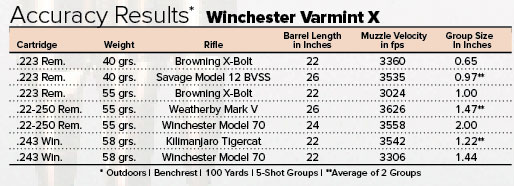
Take those muzzle velocity ratings with a grain of sale. Manufacturer claims are one thing, real-world performance another. Velocity and accuracy always vary rifle to rifle, so I tested Varmint X in several—on three days using two portable shooting benches and one anchored wood bench. I recorded velocities with three chronographs: a Shooting Chrony Beta Master, a Competition Electronics ProChrono Digital and an Oehler Model 35 Proof.
In addition to these bench tests, friends and I fired several hundred rounds of all but the .204 Ruger loads at Wyoming prairie dogs and rock chucks with satisfying results. We used Browning X-Bolt and Winchester Model 70 rifles in several configurations from Featherweights to heavy varminters. I had no function problems or misfires, and heard no reports of such from the other shooters. I did hear plenty of oohs and aahs as the rifles consistently reached out as far as 300 yards to meet their targets. Impacts, as expected, were classically explosive.
As with any factory ammunition, there is no guarantee how accurately Winchester Varmint X will shoot in your rifle. The only way to find out is to test some yourself. Be fair to yourself, your rifle and the ammunition. Start with a freshly cleaned barrel. Fire a couple of fouling shots, and then get down to some serious, precision target shooting. Your rifle might love Varmint X, and I know you'll like the price.