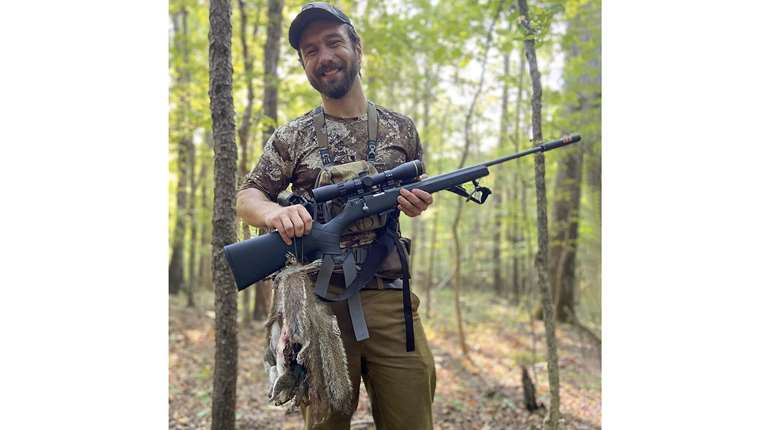
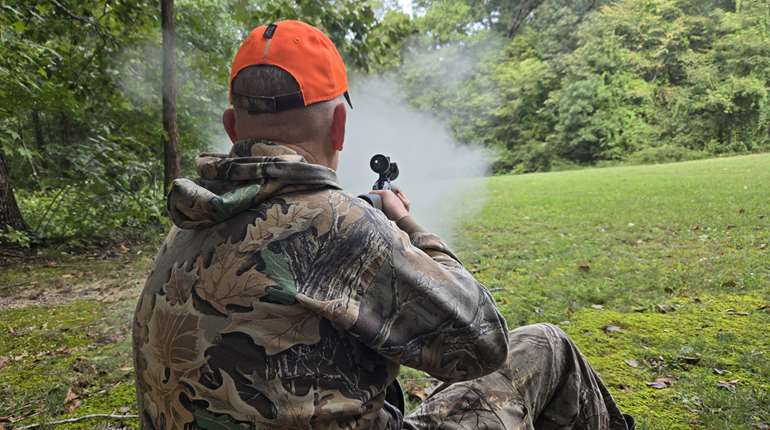
Whitetail deer and I don’t get along. See, I don’t get to hunt them much, and when I do, the critters have a nasty habit of not allowing me to shoot them. During the 2005 Kentucky blackpowder season, I had a perfect shot at a 160-class buck, but a tree jumped in front of the bullet and the deer rudely fled before I could reload. Therefore, when I got the opportunity to use a new Smith & Wesson M&P-10 on a whitetail hunt at the Chain Ranch in Oklahoma, I jumped on the chance to finally get my first buck. Because the M&P-10 is a .308 Win. AR, even an uppity tree wouldn’t stop me this time.
I’ve had fairly extensive experience with Smith & Wesson M&P-15 ARs for multiple purposes, ranging from tactical training to prairie dog hunting. The platform is an excellent example of a well-crafted AR, with most turning in accurate groups out to 100 yards and beyond. About the only thing missing in the M&P rifle lineup was a large-lower-receiver model. Enter the M&P-10.
It was designed to be an all-purpose rifle, said Paul Pluff, Smith & Wesson director of marketing communications. Its 4140 steel barrel has an “in-between” length of 18 inches—longer than a tactical rifle, but shorter than most hunting platforms. This is a sensible compromise that has a minimal effect on performance for either use, yet allows the AR to fill multiple roles better than a 16- or 20-inch barrel could. The rifle also boasts several Smith & Wesson enhancements over a plain-Jane .308 Win. AR.
A mid-length gas system with a low-profile gas block offers a couple of advantages. First, because the gas used to cycle the action is tapped farther down the barrel, it is a bit cooler, which should reduce wear and tear on the bolt-carrier assembly and also cut down on fouling. Second, the shorter gas block enabled the company to put a section of Picatinny rail atop the unit. This is an important element most AR shooters prefer, because it provides added versatility over a standard A2-style front-sight assembly. If you shoot with a magnified scope or a red-dot sight, removing that bulky unit is most appreciated, since it gets in the way of your vision through the optic. Furthermore, because the A2-style front sight is so tall, it makes it impossible to co-witness back-up iron sights with your optic. A railed gas block combined with a flattop upper receiver permits mounting an optic and aftermarket back-up iron sights, co-witnessing the sighting systems and ensuring the shooter always has a means of delivering an accurate shot even if the optic fails. Hunters will be happy to be rid of the A2-style assembly, as I was when using a variable-power Bushnell scope in Oklahoma.
The hard anodized, 7075 T6 aluminum receivers house a decent factory trigger, a chromed bolt-carrier assembly and a lightweight firing pin. Smith & Wesson designed a firing-pin spring to eliminate the potential for an unintentional discharge in the (already unlikely) event the light firing pin moves forward with the bolt when chambering a round. This spring ensures the pin stays in place until you pull the trigger.
Despite a large receiver, the M&P-10 weighs just 7 pounds, 11 ounces, making it lighter than a lot of .223 Rem. ARs. I was thankful for such a light rifle when lugging it into elevated stands; anyone planning to use the gun on a spot-and-stalk hunt should have no problem with its weight. Although it is light, recoil was substantially less jolting than a similarly sized bolt-action rifle, both in the field and at the range. Part of the explanation for the low felt recoil lies in its direct-gas-impingement system of operation, but Smith & Wesson’s patent-pending flash hider also acts as a mini muzzle brake. It has small holes at the rear that, at least in my experience, help reduce muzzle climb and make follow-up shots faster and easier to keep on target.
The morning after putting a few 10-round magazines through the M&P-10 to ensure the scope was properly zeroed, I headed out to an elevated-box stand and waited for sunrise. Within minutes of first light, the deer began to trickle into the field—first a spike buck, then a couple of does, then an absolute monster. Unfortunately, this fella clearly learned a few tricks along the way to achieving monster status, because he ran right through the field without offering me a shot. A few minutes later, another decent buck came out at about 150 yards, and it was decision time: Do I take this guy or wait for Goliath to come back? Given the guide’s advice—“If you’d shoot it on the last sit, shoot it on the first”—I flipped the ambidextrous safety lever to “fire,” and took the shot, dropping my first whitetail buck.
The hunt didn’t end there, however, as I also had a doe tag and the Chain Ranch offers opportunities to take feral pigs. While the rifle’s round, A2-style handguard doesn’t have the pizzazz of a Magpul or Samson unit, it is actually a great option for hunting. I was able to get a stable rest by putting it on the windowsill of my box stand to take an accurate shot at my buck, a doe at 175 yards and a running hog at bad-breath distance. On the last afternoon, I found it easy to hold the handguard for an offhand shot on a feral hog that scared the you-know-what out of me by coming around the rear side of the old ground box in which I was sitting. Four sits, four animals and a whole lot of meat—that’s not a bad weekend.
A few months later, I took a different M&P-10 to the range to put it through its paces. It handled multiple loads with aplomb, and I did not encounter a single failure to feed, fire or eject. I ran hunting, self-defense and target loads through the rifle, as it is indeed an all-purpose firearm that is just as capable of defending your home or having fun at the range as it is fit for hunting. With a magnified optic, group sizes at 100 yards were fairly consistent in the 1- to 1.5-MOA range, which is fine for any task short of long-range competition.
With an MSRP of $1,619, the Smith & Wesson M&P-10 with its standard 10-round magazine is actually rather inexpensive for a .308 Win. AR, particularly one with an ambidextrous safety selector, magazine release and bolt release.
Now, you’d think whitetails and I would get along just fine given my slump-buster buck, but no. As I waited in the stand for the guide to pick up me and my deer, that monster buck showed himself again and strutted, perfectly broadside inside 100 yards. He might as well have kicked back and had a coffee he stood there so long. That’s plain impolite, so I must avenge this slight by continuing to pursue whitetails. I know what gun I’ll want to use, too.
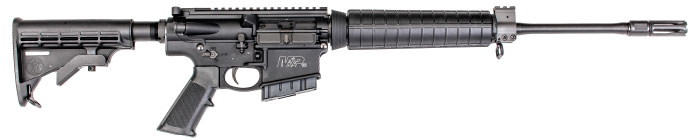
Technical Specifications:
• Type: semi-automatic centerfire rifle
• Caliber: .308 Win.
• Barrel: 18"; 5R rifling; 1:10" RH twist
• Trigger: two-stage; 6.1-lb. average pull weight
• Magazine: 10-round detachable box
• Sights: none; railed receiver, gas block for mounting optics and/or iron sights
• Safety: two-position; ambidextrous
• Stock: 6-position CAR
• Overall Length: 40.9" extended; 37.6" collapsed
• Weight: 7 lbs., 11 ozs.
• Finish: black anodized or Realtree camo
• MSRP: $1,619 (black); $1,729 (camo)