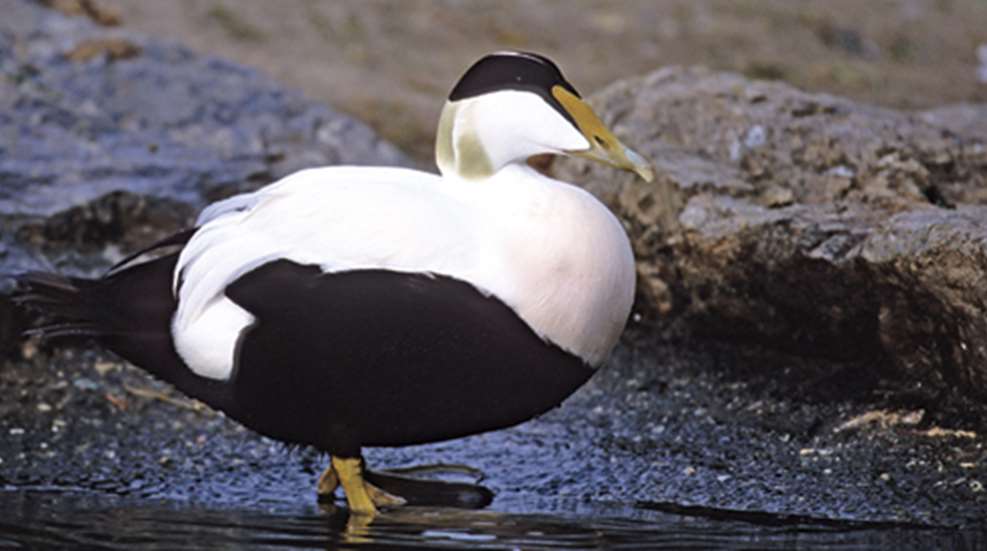
Sink your fingers into the breast plumage of a common eider and you understand instantly why eiderdown is such a prized insulator. It is warm as the densest wool, yet so much lighter. That's got to be a great adaptation for this hardy, circumpolar species that lives on some of the earth's coldest coastal waters, but which also flies long distances practically every day.
Even for avid waterfowlers, the common eider is a bit of an odd duck. At 41/2 to 6 pounds, a mature drake is the northern hemisphere's biggest duck, and with its blocky body and elongated forehead/bill it is hardly the best looking. Compared to the grace of puddlers, the eider's flight may look a bit labored, but according to a Stanford University study, these heavyweights can sustain 47 mph, making them one of the fastest birds over distance.
In flight a drake flashes like a black-and-white semaphore, its snowy torso contrasting with jet-black on the wings, head, underside and tail. Subtle coloring appears in patches of light green on the neck and beige at the chest. Female common eiders are chestnut brown with dark accents prominent on the wings and tail. Their heads have an angular profile, but are not so long as a drake's.
Common eiders typically "commute" between open-water resting sites and shallow shoals bordering coastal islands and ledges where they dive to forage for shellfish. Mussels are a favorite food, supplemented by clams, scallops, sea urchins, starfish and crabs. The shellfish are swallowed whole, and then the eider's digestive system crushes and excretes the fragmented shell. In colder months, eiders feed much of the day to meet nutritional needs. To conserve energy the big seaducks raft together in flocks numbering as many as several thousand members.
Breeding and nesting occurs mainly in the high arctic, beginning when the pack ice breaks up. Hens lay four to six eggs in nests constructed of grasses and lined with feathers plucked from their breasts.
Much of the nesting takes place on small rocky islets, and frequently large colonies form, containing hundreds of nests in close proximity. Safety in numbers helps ward off predators, most of which are avian. Great black-backed gulls are the biggest scourge of eggs and ducklings, but nesting grounds are also raided by ravens, crows, foxes and polar bears. Survival is further enhanced by the presence of many non-breeding hens, and these "aunts" will help tend the young and accompany the family groups as they move from nests to the water. Even so, common eider duckling mortality is among the highest of all waterfowl.
Common eiders may not migrate as far as many other ducks, and their movements are timed to ensure they have ready access to open water. Come spring, their retreat north is quite purposeful. Because they are such strong fliers, the migration occurs over a relatively short period. Flocks ranging from a couple dozen to several thousand can been seen flying low to the water, arriving at breeding sites shortly after the on-shore ice has begun to disperse.
The fall migration is more gradual as the eiders stop periodically to feed and rest as they follow shorelines south. Normally they fly over water, but may be driven inland by on-shore winds and winter storms. However, according to the Canadian Wildlife Service, many of the eiders that winter in the northeastern United States stage along the St. Lawrence River, then fly across southern Quebec and Maine.
For seaduck hunters in the eastern United States, the late arrival of common eiders means that December and January are the prime gunning months. Hunting the big ducks in open-and sometimes treacherous-coastal waters is high adventure, but also requires specialized skill and equipment.
The highest priority is a stout, seaworthy boat piloted by a "captain" skilled in running the rough surf, rocks and shoals. Traditionally, eider hunters set up on small islands and ledges, but alternately may hunt right from the boat. Camouflage is relied on for blending in with rocks and brush (when there is any) but blinds typically are not utilized. Even though hunters may not actually have to get in the water, insulated waders are invaluable because of the inevitable drenching of salt spray during the boat ride. To endure biting morning temperatures and the constant ocean wind, hunters must bundle up in earnest. But when the birds are coming-and in good areas this is an exceptionally predictable hunt-the hot shooting easily trumps all the discomforts.
Hunters have their work cut out for them. An eider's heavy winter plumage readily impedes shot pellets, so it is necessary to intercept the big birds with multiple hits of deep-penetrating shot to achieve a clean, quick kill. Bag limits are relatively generous (five per day in Maine; six per day for Alaska residents), and it is not unusual for hunters to limit out, especially on guided outings.
Hunting common eiders is not for everyone. Their location, along with the equipment required and the difficult conditions, limit enthusiasts to a dedicated few who live near wintering areas. But when the opportunity comes-and often that occurs when waterfowl nuts book hunts to pursue "trophy" birds-visitors experience a different brand of waterfowling and gain newfound respect for this particular odd duck.