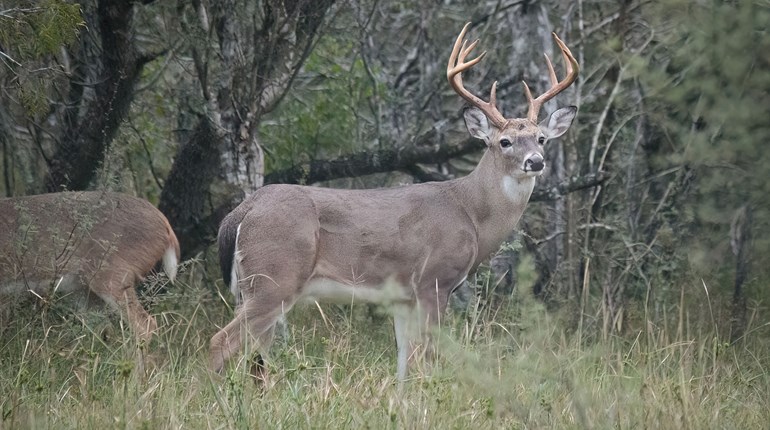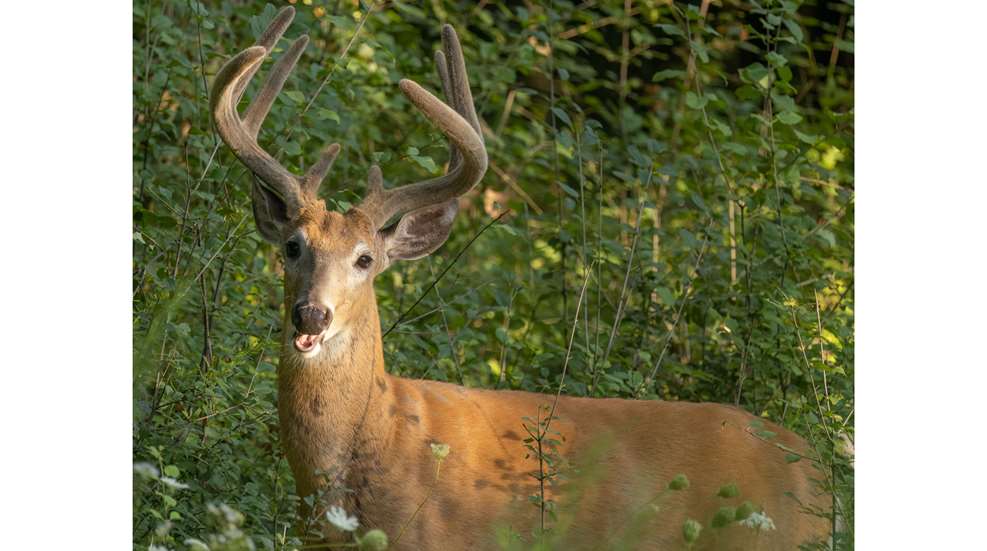
Velvet antlers seen in twilight through the distortion of summer humidity and far across a field of soybeans or alfalfa are almost dreamlike aspirations of what might step toward us through the trees in a few months.
We know, of course, that bucks seen across July fields of dreams look larger in velvet, and because they have skinnier necks before the rut, then they really are. This is especially true if we happen to see them walking or facing away, as something about the antler spread appears wider from behind.
There are other things we know, but all the questions boil down to: Where will that buck be in October and November?
There are layers of answers to that question, as hunting pressure, habitat, the phases of the rut, food sources and biological and even personality characteristics impact where a buck beds, feeds and cruises for does.
But there are basic benchmarks we can apply as parts of an equation to help answer this question.
1. Changing Food Sources
Whitetail buck movement studies (many using GPS collars) and extensive field observations document when buck most use fields and food plots and when they shift to mast crops. Typically, this occurs in late August or early September in the Northeast and Midwest, but the timing is regional. The first frost is a good indicator, but it is more complicated than this, as depends on the types of food deer are targeting. When they are focused on crop fields, daily movements are often shorter and more predictable—these are bed-to-feed trips, which typically occur at dawn and dusk. Bucks bed in cover (woods, edges) and make relatively short trips to the fields.
Studies, such as those from the Mississippi State University (MSU) Deer Lab (with GPS collars on dozens of bucks, generating hundreds of thousands of locations), document bucks selecting agricultural fields and summer food plots heavily in these seasons, as natural upland or closed-canopy forests offer less quality forage at this time.
Bucks are visible in fields more during summer, though mature bucks often move under low light or at night in pressured areas.
As summer turns to early fall (typically late August through October in the South), bucks shift to acorns and other nuts in wooded areas, especially in the evening just after they’ve left their beds. This is the time to target white oaks, which typically prefer slightly drier locations on points and ridges. White oaks located right next to thick protective cover are ideal for evening hunts in late summer or early fall.
Many GPS-collar studies show that mature bucks will shift a half mile or even several miles to take advantage of mast crops in this summer-to-fall shift; in fact, in heavy mast crop years, bucks become less and less visible in open areas, as they stay in the timber.
2. Buck Relocations
Many GPS-collar studies have found that some bucks leave one area and move to another in the pre-rut; often these bucks will return after the rut. The average distance between summer and fall core areas for whitetail bucks is typically around 0.75 miles, but some bucks move much farther away—many examples show shifts of 1-2 miles, and in extreme cases, bucks have moved 18 miles between distinct areas.
So, if that big deer you saw across a field is not showing on any trail cameras and no one is seeing the buck from stands, it could be that this buck has simply left the neighborhood. The good news is some other bucks might move in. If the habitat is good and is not over pressured, the bucks that you find during the bow or gun seasons might be just as big or bigger.
3. Catching Mature Bucks Between Does
Often when big bucks seen across July fields simply seem to disappear during the rut it is because they are locked down breeding does. A whitetail doe in estrus is typically receptive to bucks for 24-36 hours, but this can vary. In an area with few mature bucks, this can mean that during the breeding phases of the rut a dominant buck does not need to spend much time cruising (and this might happen at night) before settling down with another doe in estrus.
For this reason, hunts for mature bucks in the pre-rut and after most does have been bred can be the most productive. This, of course, is dependent on the timing of hunting seasons, pressure and the habitat/food sources. During the rut, stands placed in security cover or in bottlenecks between bedding areas are good bets to catch a mature buck that is between does.
Finding and tagging that buck spotted across a summer field in the fall is a chess game that, at times, can’t be won, as the buck might not be playing (at least on your property), but the pursuit is what gets us out there.