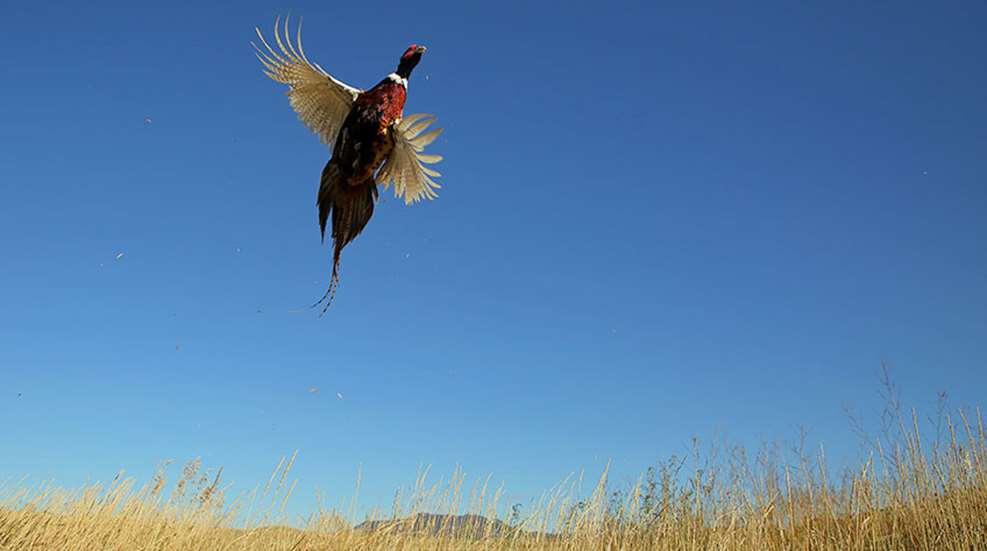
The thought of organizing a big group of hunters to march across a field and roust dozens of roosters fires up many ringneck enthusiasts. Back in the real world, the average hunter generally can gather only a buddy or two at best for a weekend pheasant hunt. Many go it alone. Don’t get discouraged; you can still be successful in bagging a limit without the masses to circle escape-artist roosters. You just need to tailor your tactics.
Keep Quiet
Regardless of how many hunters attack pheasant cover it pays to hush your approach. Pressured or public-land pheasants pack their bags when they hear approaching prowlers. Start your strategy well before stepping out of the truck. Lay out your plan the night before, or draw it on the box top of your morning doughnut bender well away from the hunt location. Hunting apps such as ScoutLook give you satellite images to plan from above. Never make your plans in a loud, boisterous manner at the field gate.
Prior to the hunt launch “air out” your dog. Take it for a long walk before the drive to the hunting locale or run it safely beside your vehicle several miles away from the hunting property. This gives the dog focus and saves you from shouting commands to an over-energized canine.
Lastly, if you’ve rounded up a hunting partner don’t forget to work out hand signals. A dog that heeds hand signals or electronic reminders is also a bonus. Your field strategy may need adjustments, and silent signals work better than a shouting match that will panic birds further.
Put on the Squeeze
Now that everyone is ready to play quietly, survey the property and see if a squeeze maneuver will bring success. Slivers of cover surrounded by bare agricultural fields are ideal. Pheasants realize a long escape flight puts them in jeopardy. Instead of making an aerial getaway they slink ahead and eventually burrow in a clump for security, hoping you’ll miss their trail.
If hunting with a partner, start at opposite ends of the field. If solo, start at the end of the field with the most cover and move toward any expansive, bare areas where birds may think twice about trying to escape. Two hunters should quietly move toward each other; a solo hunter should move toward the pheasant barrier of open ground. Zigzag and stop often, and make sure the dog zigzags in cover as well. Your and the dog’s pausing will do wonders to flush tight-sitting birds that live in a constant state of paranoia.
Even if you think you’ve done a thorough job, don’t overlook the possibility of hunting the field again. As you moved through the field the first time, birds may have shifted positions and sidestepped you. On the second pass birds could hold tighter, giving you or your dog the advantage for a close-range flush.
Tire Them Out
You may be staring at blocks of cover separated by open spaces such as harvested fields or grazed pastures. Pheasants have no qualms about flying across small open areas to reach the next cover, but they evolved for short bursts of flight, not a migratory trek. With that in mind put a plan together to tire them out.
Devise a plan to push the birds from one patch of cover to the next. Keep the pressure on so they can’t rest. On the second or third landing in heavy cover they may hold tight in hopes you’ll pass by as they labor to recover a second wind. Go back to your zigzagging advance and slow down to let the dog root them out for a finale flush.