On a recent trip to South Africa, I was still-hunting deep wooded valleys for nyala, the secretive spiral-horned antelope considered one of the continent’s most beautiful animals. From an open ridge top, I caught slight movement in the thick cover across the deep gorge below. My binoculars quickly revealed a fine bull, staring with as much focus on me as I was on him; it was clear I had precious little time before he’d disappear into the dense cover.
My professional hunter quickly set up his ever-present shooting sticks. I settled my forestock into them, found the bull’s chest, gently squeezed the trigger and secured my trophy. It all happened within seconds, but without the benefit of those shooting sticks, I’d never have attempted the 225-yard shot, much less made it.
All hunters know the value of a good rest when the time comes to take, and make, the shot. Across much of North America there’s a wealth of natural rests, from boulders to branches. Not so in open country. Whether hunting the prairies for antelope, the farmland for coyotes, the river valleys for mulies, the muskegs for moose, the mountain slopes for sheep or elk or the tundra for caribou, shots can often arise quickly and natural rests can be few and far between. That’s when you’ll learn there’s no substitute for shooting sticks.
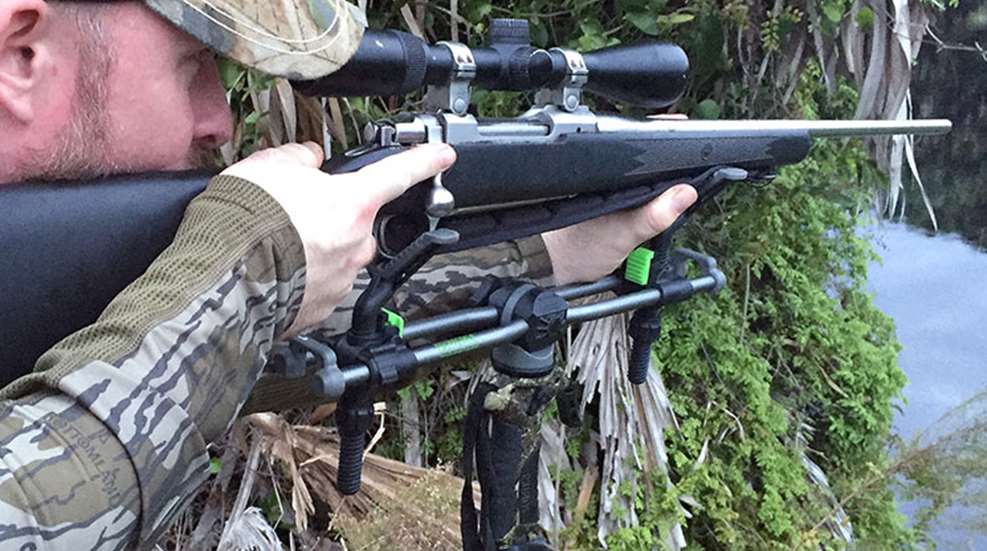
The shooting sticks commonly used by Africa’s professional hunters are simply three poles, each five to six feet long, strapped together at one end to form a tripod. Here in North America, most shooting supports are commercially made. The most common is the Harris bipod, a unique folding rest that affixes to your rifle’s front sling swivel stud. When not in use, the telescoping legs simply fold back along the rifle stock. Some Harris bipods are designed for shooting prone; others can extend for shooting while kneeling or sitting.
The Harris and other bipods that attach to your rifle are ideal in wide-open country, such as the prairies or tundra, especially when you’re likely to have to shoot while lying down. I’ve come to believe the added weight is a reasonable trade-off for an ever-present stable shooting platform. Be forewarned, however, that rifle-mounted bipods have a tendency to hang up whenever you’re walking through the brush.
When I lived on the prairies, I always had a Harris bipod attached to my rifle. Without it, I’d have enjoyed considerably fewer successful mule deer, antelope and coyote hunts. At the time it was one of the few commercial shooting rests available. Fortunately, North American hunters having borrowed best practices from Africa, and today’s hunter has considerably more choices when it comes to shooting sticks. These range from rifle-mounted bipods to freestanding monopods, bipods and tripods for use while sitting or standing There are several design options to consider when selecting the best option for where and how you’ll be hunting. Some have leg sections that screw together, for example, while others feature one-piece telescoping legs that are operated by a trigger mechanism in the handle. Still others sport sections of aluminum tubing held together with an internal bungee cord, much like a folding tent pole. There are even a few shooting sticks made from solid wood, mimicking the handcrafted originals of Africa.
Each style has both advantages and disadvantages, and it’s really a case of personal preference. As a general rule, the more legs, the steadier your rest. With additional legs, however, comes more weight and a longer set-up time, although in my experience the time needed to set up rests with multiple legs has seldom been a hindrance.
Full-length shooting sticks for standing shots can perform double-duty as hiking staffs, making them especially valuable in terrain with lots of relief. You just have to get used to having one hand continually tied up when you’re walking; for this reason some hunters find them somewhat inconvenient. Full-length sticks can also be used to help steady spotting scopes or binoculars; many have interchangeable heads with standard mounting screws for scopes and cameras.
Of course, if you’re wearing a pack, you can easily stow a collapsible model. Although this means a longer set-up time, most shooting situations allow for those extra few seconds. Alternatively, you can carry your sticks in your pack until you get to the heart of your hunting territory, then pull them out and carry them by hand from there.
Whichever type of shooting stick you choose, just remember that a stable shooting platform equals a more accurate, responsible shot and, ultimately, a more successful hunt.
When it comes to shooting sticks, there’s plenty to choose from in today’s market, with several manufacturers offering a wide variety of options. Survey what’s out there to find the set-up that best suits your needs and preferences. Following is a list of some of the more popular manufacturers of shooting sticks and bipods:
• BOGgear• Caldwell Shooting Supplies
• Harris Bipods
• Hunter’s Specialties
• Primos Hunting Calls
• Ram-Line
• Shooters Ridge
• Sporting Wood Creations
• Stoney Point
• Versa-Pod