9/22/2010
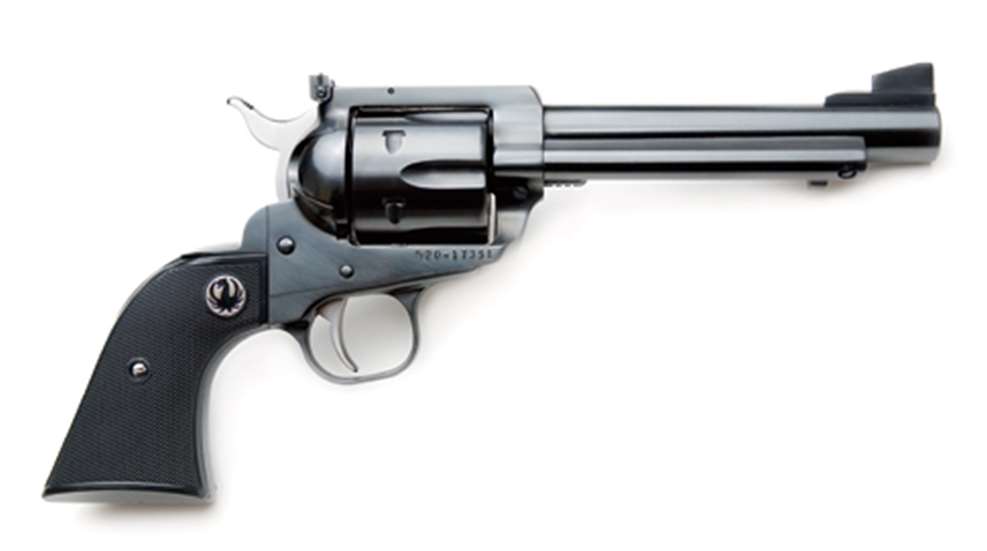
Bill Ruger introduced the Blackhawk in 1955 chambered for the .357 Remington Magnum; it became known as the “Flat-top” due to the rather distinctive flat top-strap. That same year Elmer Keith’s classic work "Sixguns" was published, and Keith opined in his discussion of the new Blackhawk that other calibers to come would include the .44 Special and .45 Colt. He also wrote, “The first production, against our wishes, is to be in .357 caliber and we expect it will be some time before we can get into production larger calibers.” Little did Keith know at the time, but the .44 Magnum would be introduced a year later, but we would have to wait another 55 years before the Ruger factory would produce the Blackhawk in .44 Special.
The New Model Blackhawk .44 Special, circa 2010, is a six-shot, single-action revolver in the Flat-top design. It’s available in blue steel (including the grip frame), and is configured with either a 4 5/8-inch or 5 1/2-inch barrel. My test gun came with the longer barrel, but I do prefer the aesthetics of the 4 5/8-inch guns even though the slightly longer barrel has a small advantage with the extra eight-tenths of an inch of sight radius. The Flat-top’s sights are Ruger’s “Micro” rear adjustable for windage and elevation and a fixed front blade that’s .115 inch wide. The Micro rear sight is a throwback to the original Flat-top design and presents a very clean look for the top-strap on these guns. I really like the flat face of the Micro sights and I consider them to be of a higher quality with a better fit and finish and more positive click adjustments when compared to the standard Ruger rear sight. My test gun does have the annoying habit of walking the rear sight-retaining pin out of its proper position during some longer firing sessions. I don’t know that it would fall out entirely, but I think the potential is there without some preventive measures.
Fortunately, fixing the problem is relatively simple by pulling the pin about halfway out and putting a slight bend in it using a small nylon-tipped gunsmith’s hammer to lightly tap the pin.
Introduced in 1907, the .44 Special was an improvement over the .44 Russian and was quite powerful in those times. The power level of the .44 Special in today’s terms pales in comparison not only to the .44 Magnum but also to more recent cartridges like the .454 Casull, .475 and .500 Linebaugh and many others. It seems to be fairly well entrenched in the classification as a personal-defense round based on what I can find in current factory loads, but then it has rarely ever been loaded to its potential with factory loads. I have no doubts about its performance for personal defense; after all, that was certainly its original intent. But unlike most personal-defense cartridges, it’s also a capable hunting round for the right game with the right load and under the right conditions. For hunting game on the order of deer and hogs you should use a load that performs near the top end of the cartridge’s capability. At the top of the performance heap in factory ammunition is the 225-grain Keith-style cast bullet from Buffalo Bore and the 260-grain WFNGC cast bullet from Grizzly Cartridge. Both these loads produce sufficient energy to take medium-sized game at relatively close ranges of 50 to 60 yards. The Buffalo Bore load has the velocity and energy advantage at 1080 fps muzzle velocity and 587 ft.-lbs. muzzle energy compared with the Grizzly at 918 fps and 486 ft.-lbs. The Buffalo Bore performed slightly above the velocity published on the box while the Grizzly loads performed slightly below the velocity published when fired from my gun. I also range-tested the Speer 200-grain Gold Dot jacketed hollow-point, but that load and others of similar power should only be used for predators such as coyotes or other varmints because it falls a bit below 350 ft.-lbs. of energy. In some places, Virginia for example, it wouldn’t become legal for hunting big game until the muzzle energy reached 350 ft.-lbs.
One of the features of the Blackhawk I appreciate most is its portability. At 3 pounds, its svelte form is hardly noticed on my belt even after a long day in the field, which is perfect if you like to carry two guns or just one that won’t feel like a boat anchor around your waist by the end of the day. If the elegance of the old-school design of the .44 Special Flat-top isn’t enough to convince you that you should own one, then let me give you another reason: For a big-bore revolver, it’s really pleasant to shoot. Even though the gun weighs only 3 pounds, the loads are not nearly as snappy as the bigger magnum .44s, and in fact, I dare say, you’ll usually run out of bullets before you get fatigued from shooting it. The characteristically light recoil of the .44 Special is conducive to lots of practice. Handgun shooting is a diminishing skill, which means if you don’t practice regularly, your proficiency will diminish, sometimes significantly, over even a relatively short period of time.
In the field I’ve never really subscribed to the notion of the handgun as a “backup gun,” unless dangerous game is on the list, and I certainly wouldn’t consider the .44 Special optimal for that situation. You can be successful handgun hunting with the .44 Special if you remember to hunt first, get close and shoot well. I consider the Special a great companion gun for handgun hunters who are perhaps also carrying a long-range rig, or for rifle hunters who haven’t yet become fully dedicated to handgun hunting and wish to test their handgun skills when a close-range opportunity presents itself. I too started out carrying a handgun and a rifle many years ago before I had developed enough confidence in my shooting abilities and my equipment to leave the rifle at home. I view hunting with the .44 Special as your primary gun to be very much like the purist pursuits of the traditional bowhunter. If you wish to scoff at hunting with a handgun with roughly a 50-yard effective range, then just think of it like bowhunting, except better, because you get to shoot guns.
Specs:
603-865-2442, www.ruger.com
Type: single-action revolver
Caliber: .44 Special
Barrel: 5.50"; 4.63” (tested); 1:20" twist
Trigger: Pull Weight: 3 lbs., 2 ozs.
Cylinder: 6-shot
Sights: Ruger Micro, click-adjustable
Grip: black, checkered, plastic grip panels
Overall Length: 11"; 10.2" (tested)
Weight: 48 ozs.
Metal Finish: blued
MSRP: $557