Coon-chasin’ guys have a lingo all their own. Clustered around endgates and dog boxes in the black of night, they talk coon-hunter talk. Headlamps throw daggers of light here and there as heads bob with laughter and chatter. Hands reach to scratch the scruff of a dog that is family.
They’re talking about check dogs, hard keepers, hide hunters and jackin’ a track, about a pressure tree dog, track saddlers and squallers. They’re talking about a changeover and a backtracker. If I wasn’t standing right here on the edge of a cornfield in New Paris, Ind., I would swear I was in a different country.
What is all this stuff? Tree dogs, they call ’em: coon hounds.
Some of these boxed-up coon dogs at first look seem a tad sleepy, demure. Kinda soft and floppy. But get the raw stink of a raccoon anywhere near ’em—whooah. Hang on! Craziness ensues.
These scrappers are heart and soul. They are going to by-gawd get to that coon, no matter 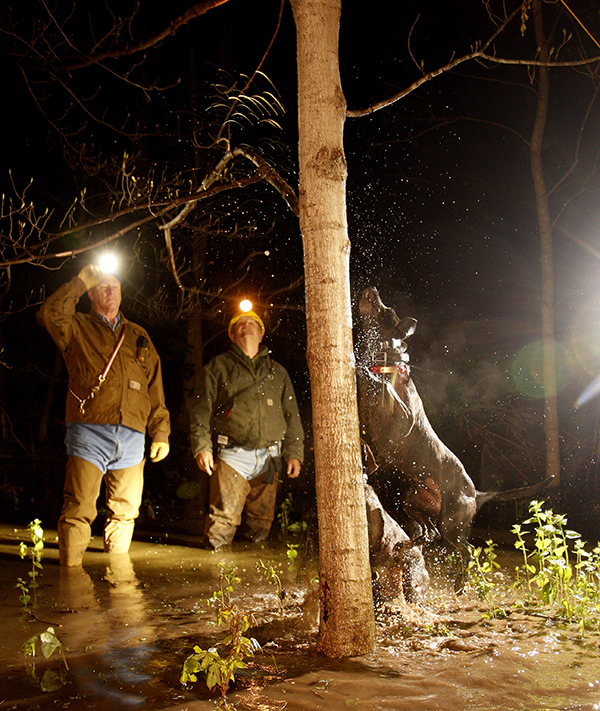 what. Cold, dark of night, sleet, snow, water, mud, brambles, briars, fences—nothing will stop their insatiable drive to scramble that coon up a tree, or better yet, get into a fur-ball tussle. It’s primal stuff.
In the warm, sticky night, the hounds are snapped off their leads. Their noses go hard to the ground. They whip past old-growth towering trees and tear down the hollow, through the brush-line, crashing into the muck of a shallow creek bed.
Their raucous baying tells us they have struck coon pay dirt mighty fast. They are whipping up water at the base of a gum tree, crawling over and over each other in the muddy spray. The frenzy, the loud barking and baying splits the quiet of the night.
His headlamp boring a hole through the dark night, Mark Zepp, a tall Indiana native, leads the charge through the brambles to investigate the ruckus in the swamp. Perched atop his broad shoulders is his son, wide-eyed 5-year-old Wyatt.
They are joined by lifelong friends Clair Hostetler and John Wick. Kirk Johnson brings up the rear, sloshing through the muddy blackness.
The coon, routed by the baying hounds from his night patrol of the woods in search of 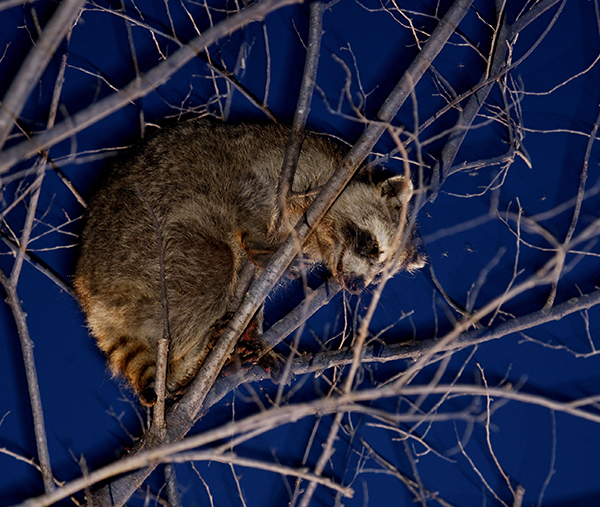 frogs and other food supplies, takes flight toward water and, usually, safety.
He seeks refuge high up a sweet gum tree. He looks down at us, his eyes bright in the reflections of the headlamps that sweep over him. He is safe tonight. This is a trial run, a fun run, in the middle of the summer. No fur needs to ride home in the back of a pickup this night. But the dogs need to be sharp. The season is coming in a couple months, and they have to be ready.
“We go out all year-round, but the season runs roughly mid-November to end of January for taking animals,” Hostetler explains. “Rest of the year, you just tree ’em and leave ’em to the trees.”
The men snap leads on the red bone, treeing Walker, Plott and leopard hounds and slog back up the hill, commenting on the performance of each.
John Wick, a lifelong friend and coon hunter from Missouri, has authored several books 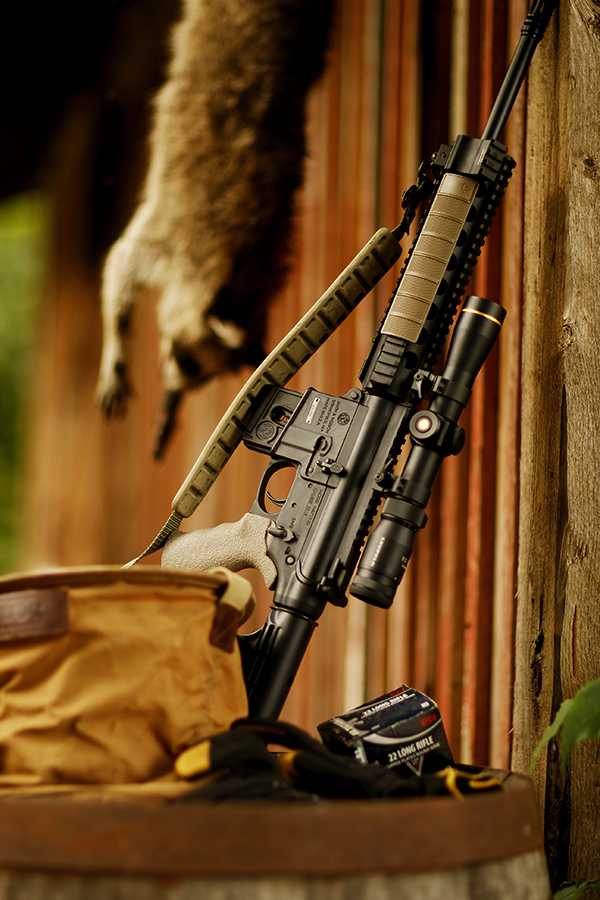 and many magazine articles on the finer points of coon hunting and coon dogs. His book, Walk With Wick: The Tree Dog Encyclopedia, is chock-full of information on everything from selecting a pup to coon-hunting tactics and stories.
“I’m not partial really to any particular breed,” he says. “Every breed has dogs of exceptional ability—natural athletes. And every breed has dogs that can’t work a track and won’t tree. They’re barely able to clean out their 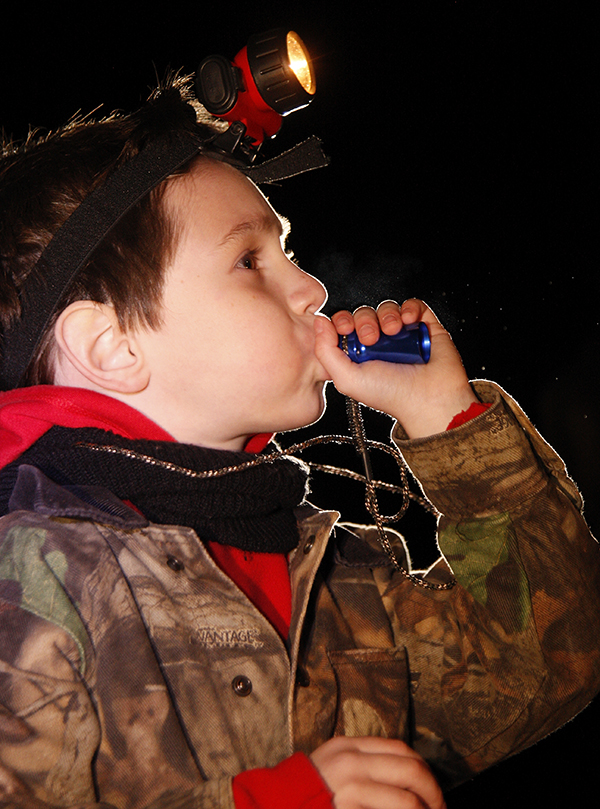 food dish.” He grins at that.
As they make their way to the trucks, there is talk of English hounds, curs and mixed breeds, how fast dogs got on the scent and who did what once they “opened up.”
There are remembrances of a “me too dog,” one that can’t think at all for himself but just does what all the other dogs are doing. There is talk about a tight-mouth dog that opens or bays very little on track, and about a loose-mouthed dog that opens or barks for no reason whatsoever.
The night is pierced by a god-awful racket coming from the endgate. Cheeks all pooched out, young Wyatt has found his dad’s Zepp’s squaller and is wailin’ away on it for all he is worth. Laughter booms. A squaller is a call used to get a coon’s attention when it’s treed to ensure accurate shot placement, usually with a .22 rifle. Sometimes, raccoons come boiling out of a tree on that call, mad as hell. “He loves that thing,” Mark grins.
The line of pickups grinds through the soft night, headlights flashing over the bumpy field roads. They head upstream a couple miles from the first encounter. Dogs, turned loose, run off into the night. Hunters gather, talking softly, waiting for the music to begin.