Practically from the start, gunsmith Keith Sipe of Kalispell, Mont., found himself expanding. After a few years performing basic repairs, he responded to demand by investing in the machinery needed to manufacture hand-lapped, match-crowned barrels. Soon it was evident he should leverage his move into barrel-making by offering his own custom hunting rifles.
Like many potential customers, the man who named his shop Montana Rifleman favored the controlled-round-feed reliability of the Mauser 98/Winchester M70-type action. But despite lots of interest, Sipe learned his timing was bad. At that time (mid-1990s) European sources for Mauser actions were dwindling, and the scant surplus released by Winchester fell far short of the demand. And so for the second time, Keith Sipe made the risky decision to tool up and build it himself.
Getting to production took a few years as Sipe worked out how to produce the action he wanted—an upgrade in safety and functioning, but one that could be relatively affordable. With the resulting Model 1999 action as its core component, the Montana Rifle Company (MRC) wasted no time carving out market share, and that prompted expansion of a different kind, as the founder's son, Jeff Sipe, joined the company. As director of sales and marketing for what is now the Montana Firearms Group, the younger Sipe has established new channels, raised the company’s profile and helped to guide product development.
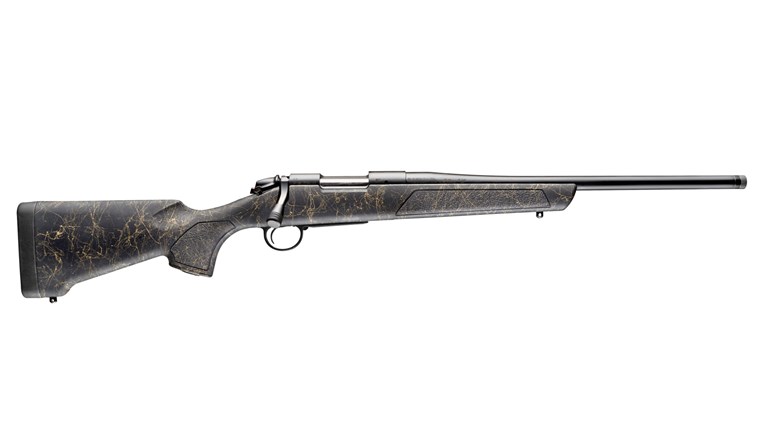
If the marketplace is any indication—and it always is—the Model 1999 scratches an itch. Fine rifles of Mauser lineage always draw attention, especially when the price is right. The ’99 is a robust, flat-sided action offered in three sizes—Short, Long and PH—to fit virtually any sporting caliber.
Telltale Mauser features like the full-length claw and cone breeching mate with a M70-like three-position safety and an adjustable trigger similar to the pre-‘64 Winchester’s. Add style and strength with a one-piece, investment-cast bolt and one-piece bottom metal. The bolt stroke is smooth as a trombone slide thanks to hand-lapped receiver raceways. More hand-lapping trues lug seating and thus ensures the bolt face is square to the receiver. High-tech tooling holds exacting tolerances in trigger and sear assemblies. Since the receiver, not the barrel, incorporates the cone-shaped collar that contains the extractor cut, the barrel/receiver union is strong and rigid. A five-point gas venting system—two vents in the receiver ring, two more in the bolt body and an old-style flanged bolt sleeve—shields shooters from ruptured-case gasses.
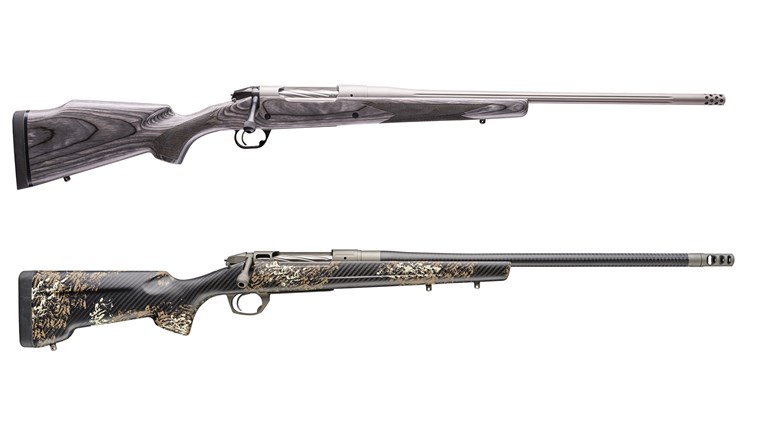
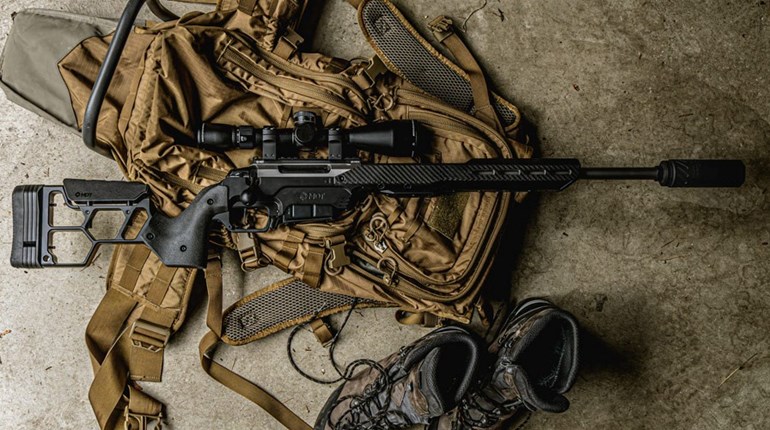
While maintaining quality and value, Montana Rifles has continually stretched its product line and now offers an array spanning both production and custom categories. Apart from a new tactical gun, the selection addresses just about every hunting purpose and owner’s taste. Three different action sizes are available—Short, Long and Professional Hunter, all housed in various wood and synthetic stock options. Add three lightweight mountain versions and two heavy dangerous-game rifles, plus specialists for Alaska and other harsh-weather climates. There are now 212 different production-rifle variants, including many left-hand offerings.
My first hands-on trial came during an outing for nilgai on the Yturrias Ranch in South Texas. It was also my intro to Jeff Sipe, as we partnered to chase the big introduced antelope with a reputation for being exceedingly wary and tough to bring down. As such, Jeff and I weren’t going in undergunned. We chose rifles built on the firm's beefy PH action, which is also used in Montana's rendering of the iconic double-square-bridge Mauser. It can handle some of the largest and most powerful rounds used in sport hunting. Our rifles actually were chambered for the least of the offered calibers, the plenty-potent .338 Lapua Mag., but if the quarry is bigger and particularly treacherous, one can opt for such stompers as .460 Wby. Mag. or .505 Gibbs.
South Texas guides often tell about nilgai running off with boiler-room hits from .30-06s and .300 magnums, and the lengthy follow-ups required to finish the hunt. Almost never, I’ve been told, is there a visual knockdown. We heard some of that at the Yturrias, but in the end, gave our guide a different tale to tell. In both Jeff’s case and mine, the “blue bulls” tipped right over like well-struck whitetails. Given the .338 Lapua’s striking energy, our 200- to 250-yard shots hit with about 3,800 ft.-lbs., so the terminal performance was what it should be. It certainly helped that my PH-based rifle had a clean-breaking trigger and was sufficiently heavy at 9-plus pounds, to soak up recoil and steady nicely on shooting sticks. In fact, I was not bothered by the recoil dealt out during our pre-hunt sight-in or by my single shot on game, but imagine I’d sing a different tune about the .505.
More recently I’ve put an MRC American Standard in .270 Win. to work on the local test-range. It’s a fitting name. This is as close as it gets to what the last three generations of American hunters likely envision in a classic big-game rifle. The lines recall the Griffin & Howe look popular before World War II. There’s just enough arc to the pistol grip, and just enough profile to the shadow-line cheekpiece. Grip surfaces fore and aft are a bit chunkier than on my pre-’64 Winchester, and as a result they satisfy a man’s hands.
The gun’s American black walnut stock is grained enough to draw second looks, but not so fancy as to elicit worries about rough treatment. The performance matches those looks with bench groups shading an inch at 100 yards, better than my 1950s-vintage .270 has ever shot.Recently Jeff Sipe repeated what he said when we first met on the Texas flatlands: “We don’t want our customers to feel like they need to get this or that upgrade done to 'finish' one of our rifles. We don’t want them thinking they’d be better off getting a custom barrel, a trigger job, or action blueprinting. We want to make sure that we’ve already done the custom work before it ever leaves Kalispell.”
The output and customer base may have changed, but what started as a small-town gunsmith shop still is one.
MRC American Standard
Type: bolt-action rifle
Calibers: .270 Win. (tested), 22 other calibers from .22-250 to .338 Rem. Ultra Mag.
Barrel: length 24"
Trigger: single stage; pull weight 2.13 lbs.
Magazine/Capacity: hinged floorplate/5 rounds
Safety: M70-style, 3-position wing
Stock: Monte Carlo; American black walnut or synthetic; right- or left-hand; length of pull 14"
Overall Length: 45"
Weight: 7 lbs., 12 ozs.
Metal Finish: matte blue or stainless steel
MSRP: $1,099