The journey that the now-obsolete .30-03 Springfield case has made is nothing short of ballistic magic; that design has been responsible for a whole lot of happy hunters and shooters, in the many iterations up and down the bullet diameter scale.
From the .25-06 Remington to the .35 Whelen in commercial cartridges, and from the 6mm-06 to the .400 Whelen in wildcats, there is something for nearly everyone. It is those middle of the road calibers—from .270 to .30-06—which have certainly seen the majority of the fun. Among them, there are a considerable number of shooters and hunters who feel that the ’03/’06 case is at its best when mated with 7mm bullets. Remington certainly agreed, and legitimized the wildcat 7mm-06, if you will, in 1957, releasing it in their Model 740, 760, 721 and 725 rifles.
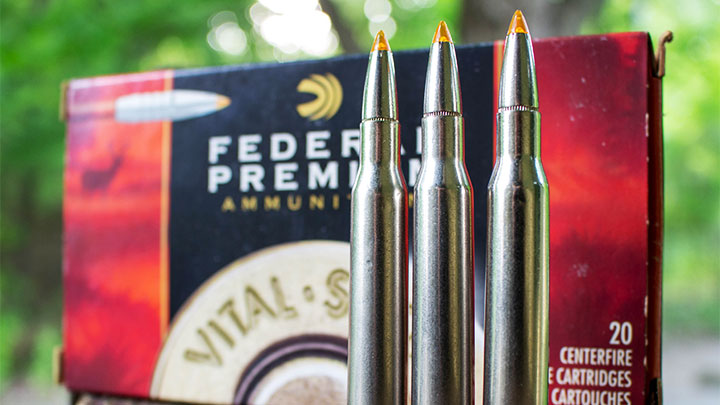
Using the 2.540-inch case length of the .30-03 Springfield (the ’06 was shortened to 2.494 inches at its conception) the .280 Remington had a wider bullet range than did the much older .270 Winchester, and while I personally feel the .280 makes much more sense than does the .270, the shooting public did not give it a warm welcome. The cartridge plodded along, staying the wake of the huge splash the 7mm Remington Magnum made in 1962, with a few very vocal fans seeing the design for what it is: probably the best 7mm cartridge developed at that time.
Remington renamed the cartridge the 7mm-06 Remington in early 1978, and then again to the 7mm Express Remington before the year’s end. This did nothing to boost sales, and only served to confuse the shooting public. By 1981, the .280 Remington name was reinstated, and life went on for the poor, unsung cartridge. I find the .280 Remington to be a fantastic cartridge, giving flat trajectories without pounding the shooters shoulder; the 140- and 150-grain bullets are great for deer and similar-sized game, while the 160- and 175-grain bullets handle the larger species very well.
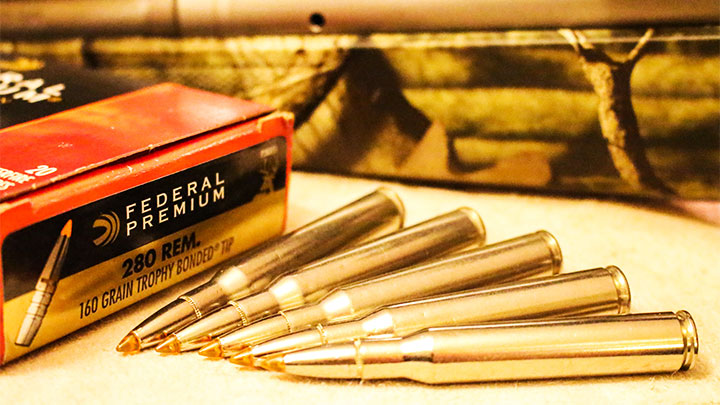
I shot my first decent New York deer—a nice, symmetrical 8-point—with the .280 Remington in a Remington automatic. The cartridge is easy to load for, as brass and bullets are readily available, though there are so many excellent factory loads that it may not be worth the handloading effort. The .280 pushes the 140-grain bullets to 2950 to 3000 fps, the 150-grain to 2890 fps and the 160-grain bullets to 2780 fps. Ammo is available from Remington, Federal, Winchester, Hornady, Norma, Nosler and more. There are an equally large number of rifles available in .280 Remington.
As is the case with so many cartridges released during the middle of the 20th century, the .280 Remington got the wildcat treatment, this time as part of Parker O. Ackley’s famous lineup. Removing nearly all of the body taper, and increasing the shoulder angle from 17.5 degrees to 40 degrees, the final and most popular iteration of the .280 Ackley Improved (there was a bit of influence from Fred Huntington) gives a definite ballistic advantage over the parent case. I first heard of the .280 Ackley Improved as a kid, when I read reviews of Kenny Jarrett’s Beanfield Rifle, and all of those reviews were positive. My curiosity was certainly piqued, but the wallet of a twenty-something-year-old hunter dictated more practical purchases.
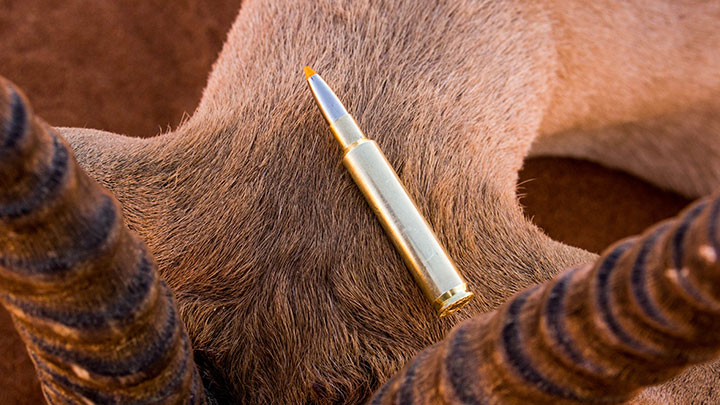
I sat back and watched the .280 Ackley Improved—a wildcat at that time—from afar, but it stuck in the back of my mind as a sensible, efficient, and logical design. It would, according to most sources, come very close to the velocities attained by the larger 7mm Remington Magnum case, with a lot less powder.
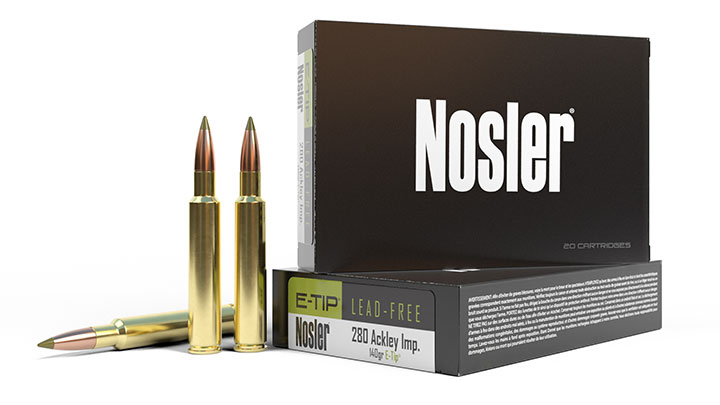
Nosler registered the .280 Ackley Improves with SAAMI in 2007, and they offer some fantastic ammunition for the now-legitimate cartridge. Looking at most of the factory loaded ammunition for both cartridges, you’ll see a velocity increase of about 150 fps for the Ackley Improved version. The 160-grain bullets, in the Nosler factory load, leaves the barrel at 2950 fps, which is knocking on the door of the 7mm Remington Magnum. My Savage 110 Long Range Hunter, chambered in .280 AI, launches 160-grain Federal Trophy Bonded Tip bullets, in Nosler brass, at 2995 fps.
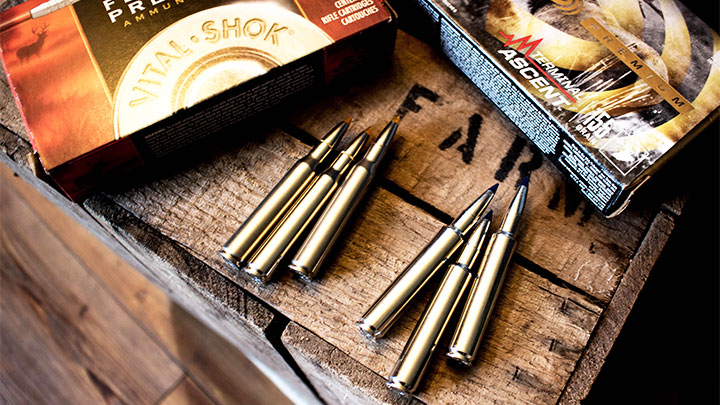
I took that combination to Namibia for a plains game safari, and between Vista’s Jake Edson (he borrowed the rifle until his gear showed up) and I, it performed flawlessly on a number of different species. I also recently tested the new Federal Terminal Ascent .280 Ackley Improved load, built around the new 155-grain Terminal Ascent bullet, at the bench with fantastic results, There’s no lack of accuracy from the .280 AI.
Which better suits a hunter? Well, the half-century head start the .280 Remington has many more ammunition and rifle choices, and is, truly, enough gun. The cartridge offers more, ballistically speaking, than the 7mm-08 Remington or 7x57mm Mauser, yet isn’t as hot as the 7mm Remington Magnum, 7mm STW or 7mm RUM. The recoil characteristics of the .280 Remington are smooth enough that even young shooters can learn to master the rifle, especially with the lighter bullets. However, the .280 Remington is, especially in comparison with the Ackley Improved case, a bit vanilla, lacking perhaps the look of long range. Is the velocity gain of the Ackley Improved worth it? Well, based on the popularity of the 7mm Remington Magnum, I’d say yes.
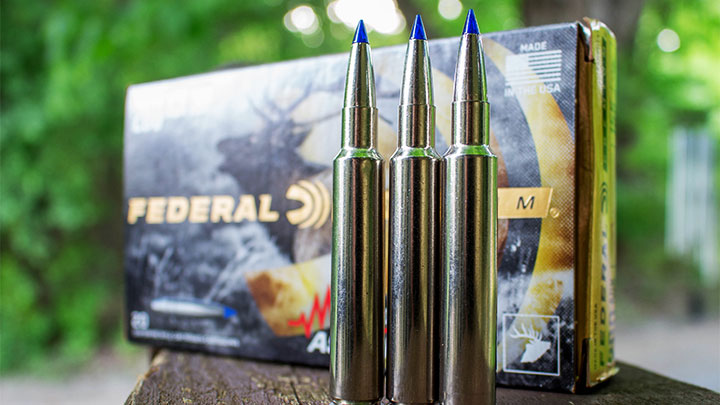
Among the two, I will give the edge to the .280 Ackley Improved, now that there are a number of sources for factory ammunition. I like the velocity boost, as it made those longer shots both Jake and I took on safari just a bit easier, yet there was no noticeable difference in felt recoil. Perhaps the best way I can put it is like this: if you have a good .280 Remington I wouldn’t rush out to swap it out for a .280 Ackley Improved. If, however, you are in the market for a rifle, and fancy a 7mm cartridge for all-around hunting, I’d look long and hard at the .280 Ackley Improved as an efficient, effective and different choice. I feel the .280 Ackley Improved may be one of, if not the best of the AI cartridges, and I really enjoy hunting with mine.
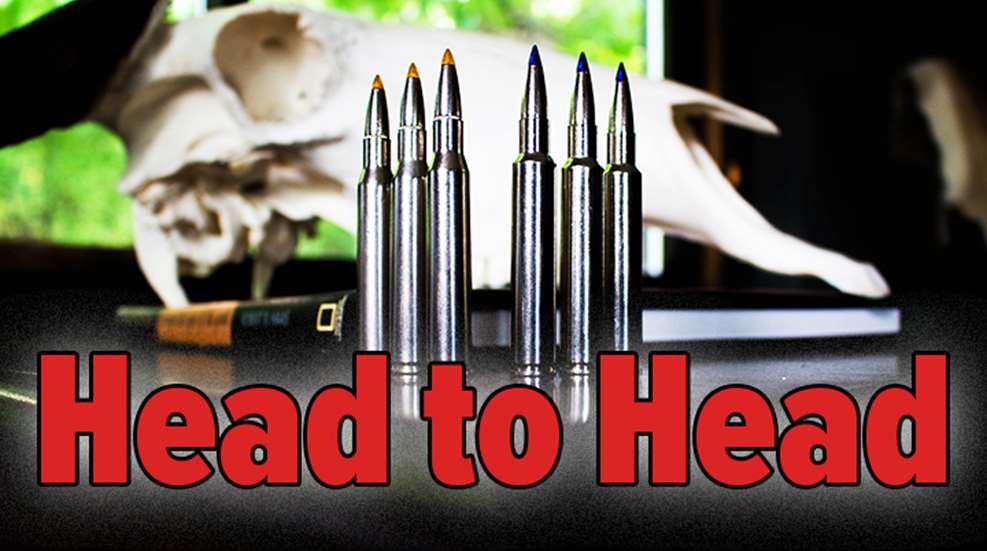
Looking for previous installments of our "Head to Head" series? We've got you covered.
• 7mm vs. .30 Caliber
• 6.5 Weatherby RPM vs. 6.5 PRC
• .338 Win. Mag. vs. .340 Wby. Mag.
• .300 RSAUM vs. .300 WSM
• .500 Jeffrey vs. .505 Gibbs
• 7mm RUM vs. .300 RUM
• .308 Winchester vs. 7mm-08 Remington
• 6.5 Creedmoor vs. .260 Remington
• .303 British vs. 8x57 Mauser
• .30-06 Springfield vs. All Other .30s
• .17 HMR vs. .17 WSM
• .450 Nitro Express vs. .470 Nitro Express
• 350 Legend vs. .35 Remington
• .280 Ackley Improved vs. 7mm Rem. Mag.
• .404 Jeffery vs. .416 Rigby
• .243 Winchester vs. 6mm Creedmoor
• .300 PRC vs. .300 Win. Mag.
• .30-06 Springfield vs. .270 Winchester
• 6.5 Creedmoor vs. 7mm-08 Remington
• 8x57 Mauser vs. .318 Westley Richards
• .358 Winchester vs. .350 Remington Magnum
• .22-250 Remington vs. .220 Swift
• .270 Winchester vs. .270 WSM
• .26 Nosler vs. 6.5-300 Weatherby Magnum
• .458 Win. Mag. vs. .458 Lott
• 7mm Rem. Mag. vs. .300 Win. Mag.
• .243 Winchester vs. 6mm Remington
• 7x57mm Mauser vs. 7mm-08 Remington
• .25-06 Remington vs. .257 Weatherby Magnum
• .338 Winchester vs. .375 H&H Magnum
• .30-30 Winchester vs. .35 Remington
• .257 Roberts vs. .250-3000 Savage
• .270 Winchester vs. .280 Remington
• .35 Whelen vs. 9.3x62mm Mauser
• .416 Rigby vs. .416 Remington Magnum
• .308 Winchester vs. .30-06 Springfield
• .22 Nosler vs. .224 Valkyrie
• .300 Win. Mag. vs. .300 WSM
• .223 Remington vs. .22-250 Remington