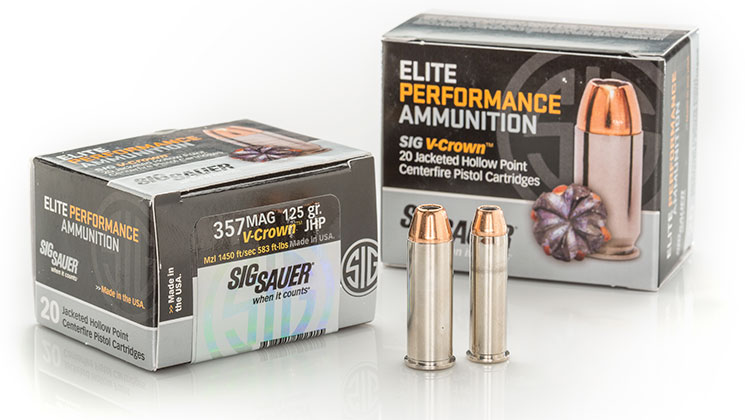
In 2014 SIG Sauer launched its Elite Performance Ammunition line. Initially made up of a few loads for defensive handguns, the line continues to expand. It now contains JHP loads for 13 handgun cartridges and FMJ loads for eight handgun cartridges, as well as hunting and match loads for the .300 AAC Blackout. Two of the latest JHP loads for the .357 Mag. and .44 Mag. stand out for hunting.
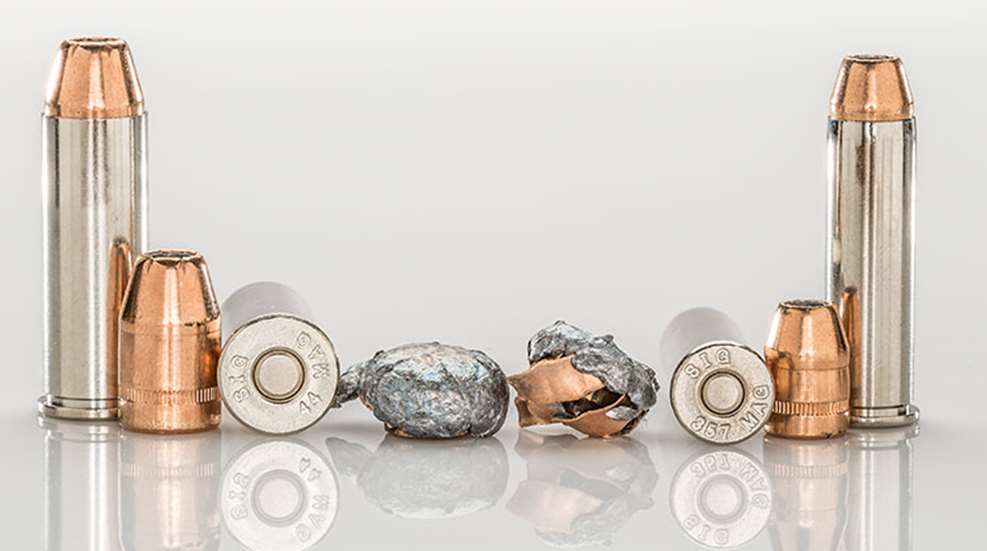
When it comes to hunting ammunition, accuracy and terminal performance are the prime considerations. The accuracy specialists at Sierra build the bullets SIG Sauer uses in the Elite Performance loads. These new V-Crown bullets have a gilding-metal jacket and a lead-alloy core. They also incorporate a stacked hollow-point design to enhance expansion, and a toothed cannelure to circumvent jacket and core separation. On average you can expect V-Crown bullets to expand at least 1.5 times their original diameters. (Handloaders can purchase V-Crown bullets direct from Sierra.)
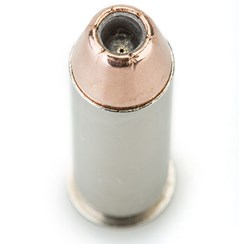 All Elite Performance Ammunition is loaded in cases coated with Ducta-Bright 7A. This is a proprietary, ductile nickel plating used to improve feeding and extraction. It also resists corrosion: Cases plated with Ducta-Bright 7A will not tarnish when stored in leather cartridge loops and pouches like common brass cases. Of special interest to handloaders, this coating makes cleaning cases for reloading easier. In addition, Ducta-Bright 7A does not cause common brass (70 percent copper/30 percent zinc) cases to become brittle like traditional plating methods can, so case life should be extended.
Since much of the Elite Performance line is built for self-defense purposes, the .357 Mag. and .44 Mag. loads utilize low-flash propellants. This means you should not see the horrendous fireball at the end of the muzzle often associated with magnum revolver cartridges. The reduction of muzzle flash can help you stay on game for follow-up shots if needed because you won’t be temporarily blinded by the fireball.
SIG Sauer provided samples of both loads for testing. Using Colt and Ruger revolvers with 5.5-inch barrels, I chronographed 10 shots to establish muzzle velocities and variances. Then, I fired five, five-shot groups with each load from a sandbag rest at 25 yards. Lastly, I shot each load into 10 percent ordnance gelatin from a distance of 15 feet to evaluate bullet penetration and expansion.
The .357 Mag. load had an average velocity of 1456 fps. In the gel, the 125-grain V-Crown bullet drove to 16 inches and expanded to slightly more than .5 inch in diameter, even after passing through an old deer hide. How does this compare to a common big-game bullet? A 130-grain Remington Core-Lokt fired from a .270 Win. will penetrate about 15 inches in 10 percent ordnance gelatin at 100 yards.
The 240-grain .44 Mag. V-Crown bullet averaged 1288 fps. The performance of this load in the gelatin was impressively wicked, with a wide wound cavity that stretched for the first 8 inches of penetration. Total penetration after passing through the deer hide was 19 inches, and the bullet expanded to a diameter of .65 inch. That’s almost identical to the penetration and expansion you can expect from a 150-grain Remington Core-Lokt bullet fired from a .308 Win.
Without question, the low-flash powders worked. I fired both loads indoors and didn’t see any muzzle flash. Five-shot groups averaged about 1.75 inches with both loads, which is nearly at the limit of my ability with iron-sighted handguns and well within acceptable handgun hunting parameters. In total, I fired 100 rounds of each load and there were no performance issues of any sort.
Both the .357 Mag. and .44 Mag. Elite Performance loads are more than sufficient for deer and hogs out to reasonable handgun ranges. Given their penetration and expansion, larger game is not out of the question. From a kinetic-energy standpoint both might seem “light” for elk-size critters; however, when compared to the terminal performance of the referenced rifle loads, they’ll drive just as deep and make a hole just as big.
In lever-action rifles or in Ruger’s 77/357 and 77/44 bolt guns, you can expect a velocity increase of about 200 fps. This means the terminal performance recorded at 15 feet in my tests with the handguns would be carried out to about 100 yards. All told, both SIG Sauer Elite Performance loads should be great for hunting.
Technical Specifications:
• Caliber: .357 Mag. (tested), .44 Mag. (tested); other handgun calibers available
• Bullet Type: V-Crown JHP
• Bullet Weight (grs.): 125 (.357 Mag.), 240 (.44 Mag.)
• Ballistic Coefficient: .140 (.357 Mag.), .175 (.44 Mag.)
• Muzzle Velocity (fps): 1450 (.357 Mag.), 1300 (.44 Mag.)
• Muzzle Energy (in ft.-lbs.): 584 (.357 Mag.), 901 (.44 Mag.)
• MSRP: $23.95 (.357 Mag.), $30 (.44 Mag.) per 20-rnd. box