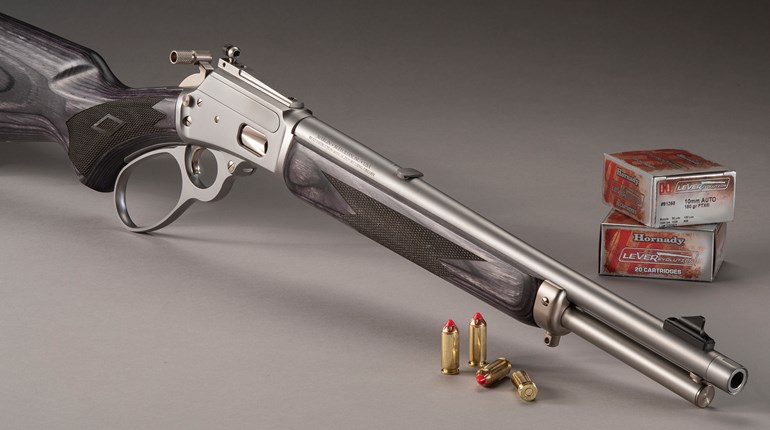
Best known for their large-bore lever actions, Big Horn Armory of Cody, Wyo., adds to their .50 caliber arsenal with the new Model 89 Take Down (TD) Carbine. Chambered in the mighty .500 Smith & Wesson Magnum, the Model 89 TD, as the name implies, comes apart for easy storage and transport.
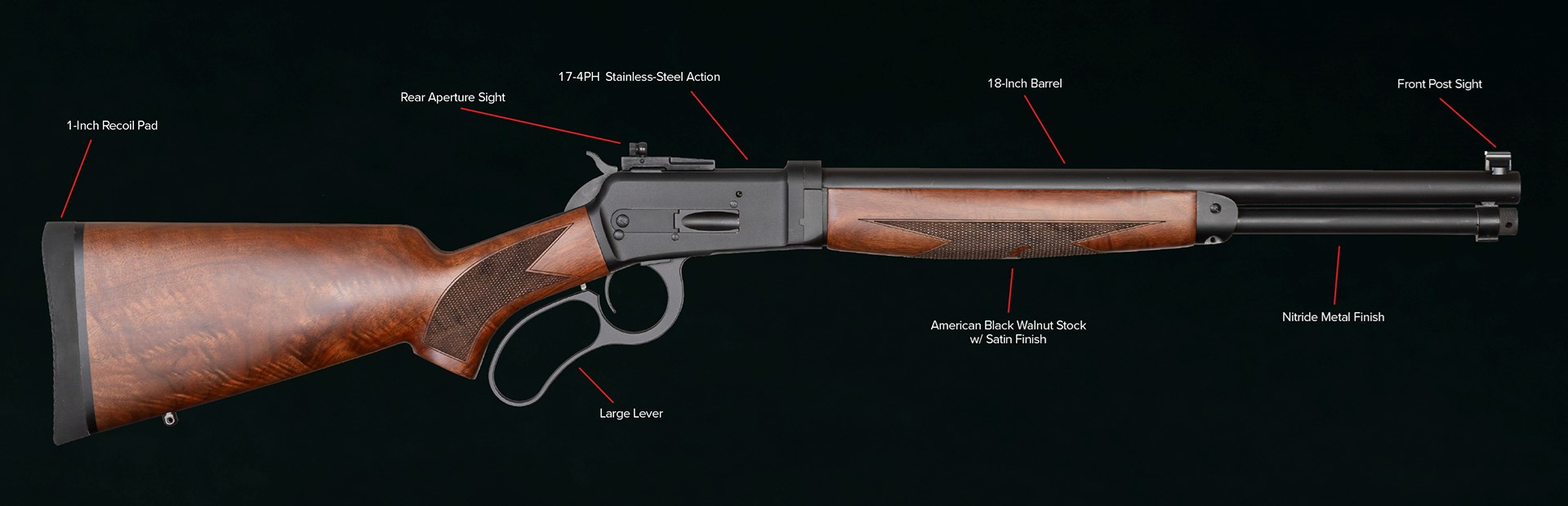
First, though, this is one solid rifle. The 18-inch barrel is made from 416 stainless steel, the action of high-strength 17-4PH stainless. The barrel, magazine tube, receiver and many other parts are subject to a special nitriding process that hardens the surface to Rockwell C 82, which Big Horn notes is harder than most machine tooling. So, those black nitride surfaces should shrug off scraping branches and banging around in UTVs without much of a mark, if any.
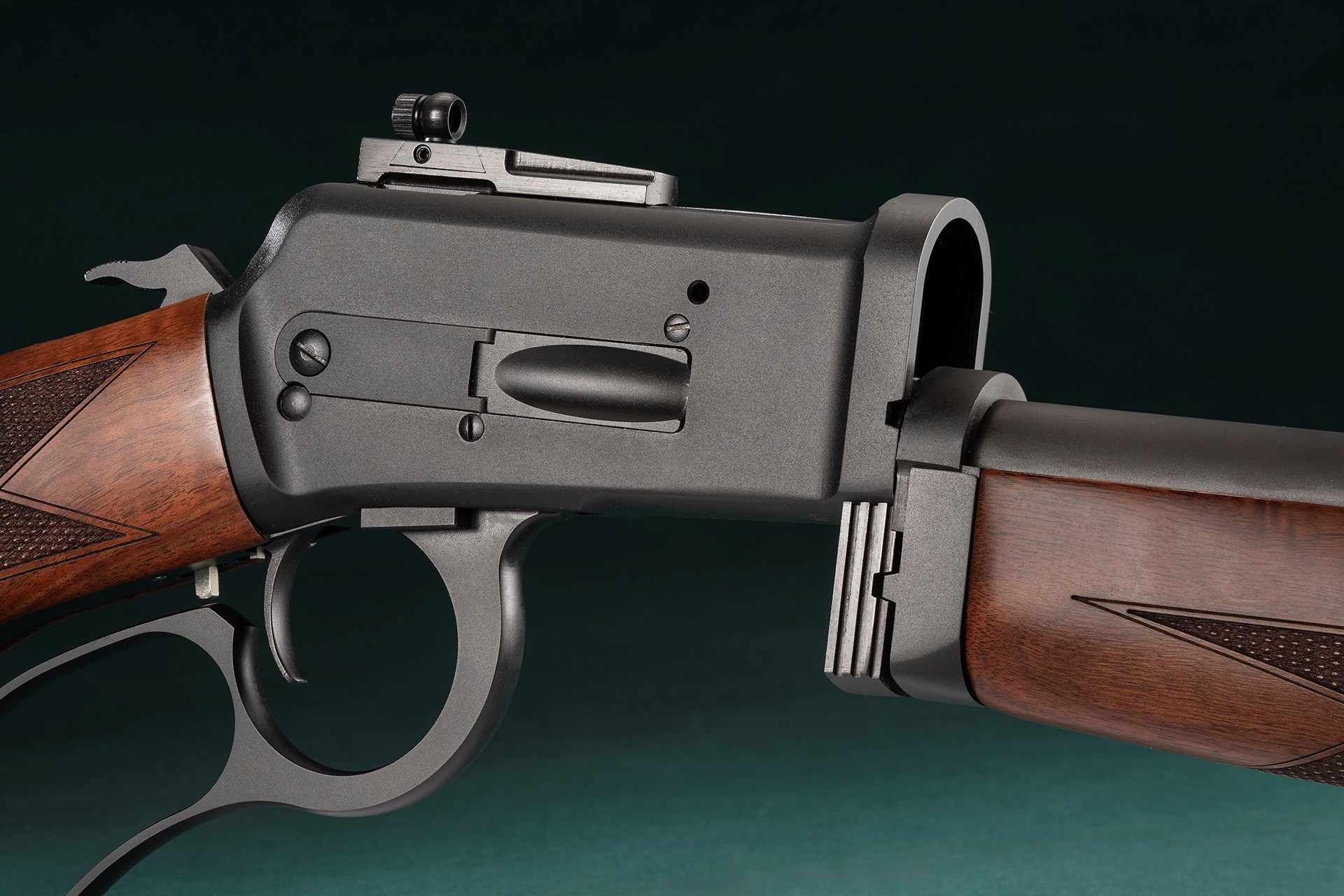
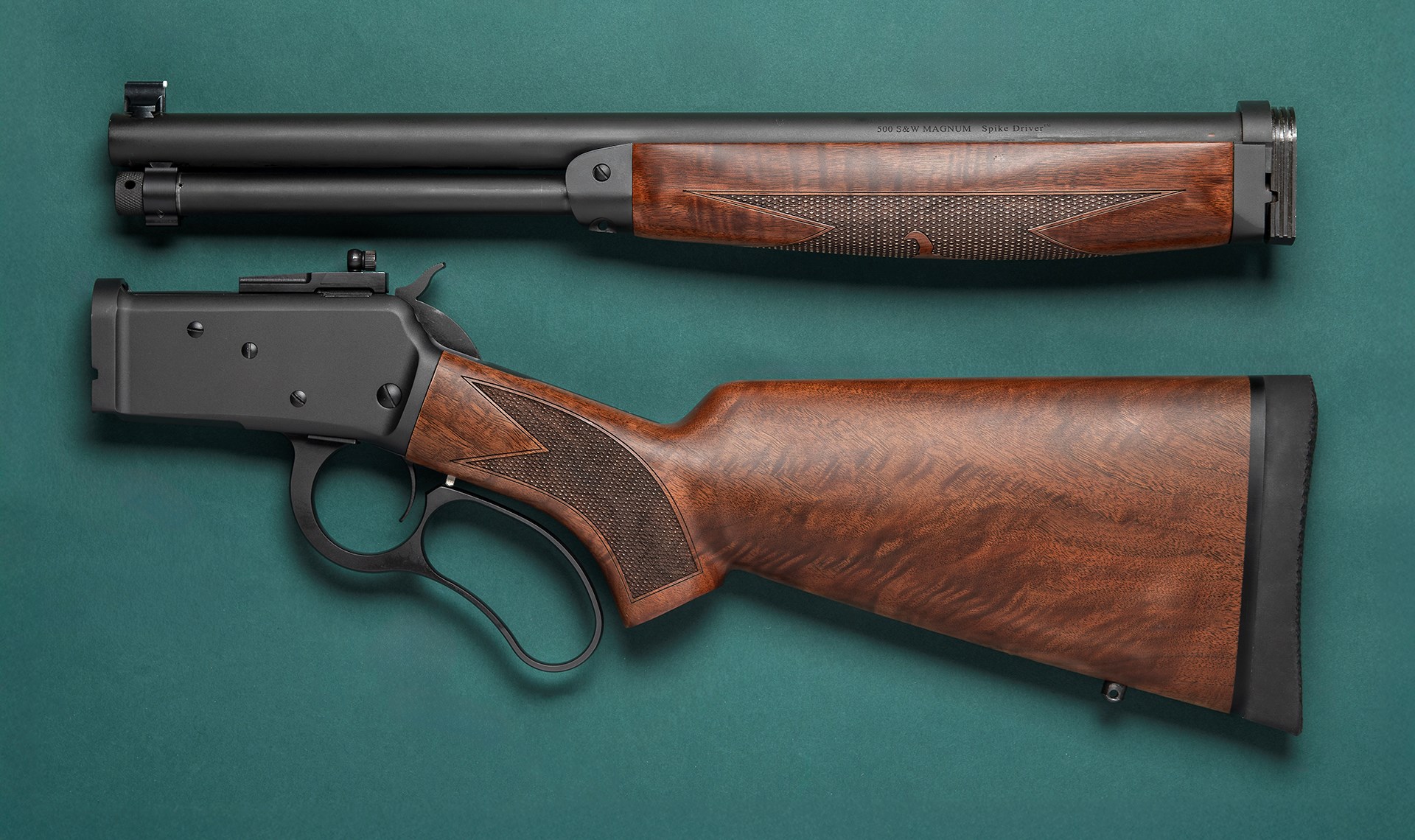
The rifle’s takedown system is based on the Stevens 520 Takedown Shotgun designed by John Browning, which employed metal “teeth” to connect/disconnect barrel to receiver. These teeth (or splines) run to the full height of the receiver to resist movement in all directions. Big Horn fired multiple proof loads in the rifles and found no change in headspace or any other barrel and receiver dimensions.
To disassemble, I first opened the action about halfway. Then, I reached up to unscrew, clockwise, the knurled end of the magazine tube. As I unscrewed, the locking plate pulled away from and out of the recess in the receiver. At that point, I slid the barrel and fore-end assembly down and off the receiver. The whole process took less than 10 seconds. This disassembly not only created two very packable pieces, it also allowed cleaning the barrel from the breech end (no dirt pushed into the action) and provided easy access to cleaning the inside of the receiver. Brilliant.
The rifle’s curved lever is somewhat larger than a standard lever—great for gloved hands and fingers—but it’s not big-loop huge. The action on my test Model 89 TD started off a little rough but definitely smoothed out with use. Lubrication applied to the various recommended points on the bolt and lever action helped, too.
The rifle’s magazine tube holds seven rounds, and those rounds loaded easily through the rifle’s side gate.
The Model 89 TD features a stock and fore-end made from beautiful American black walnut, with deep checkering at the grip and along the sides of the fore-end. The stock and fore-end are fitted with integral front and stud rear sling swivel mounts. A 1-inch Pachmayr Decelerator recoil pad covers the butt of the stock, and the pad did take the edge off the .500 S&W’s significant recoil.
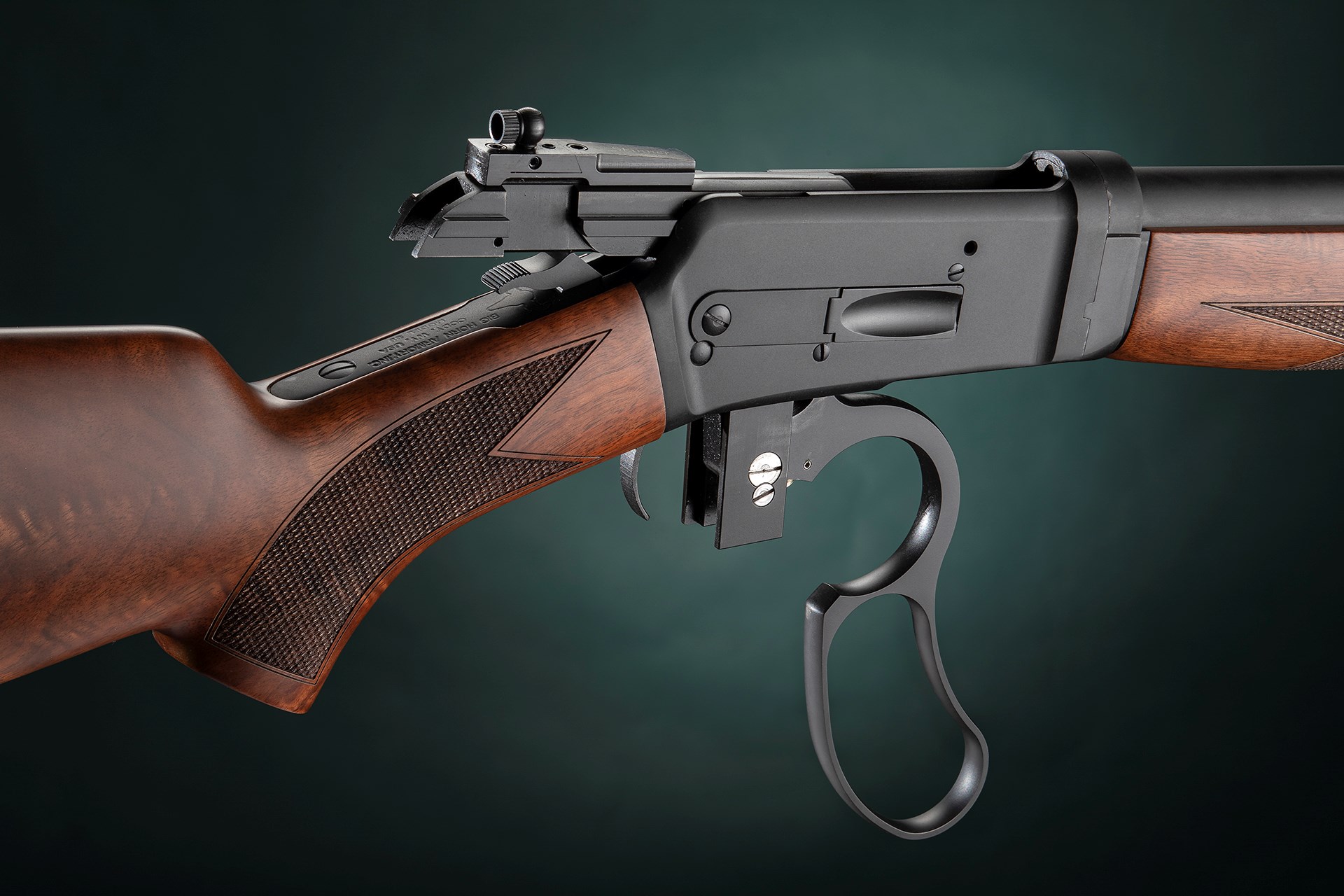
The Big Horn 89 TD utilizes a Skinner Ghost Ring rear sight and a white pearl bead out front. Unfortunately, rear aperture sights no longer work well for this reviewer’s eyes. So, I removed the rear sight and installed a Vortex StrikeFire II 4-MOA green-dot optic. The StrikeFire II features a 30mm objective lens, easy to use brightness and zeroing controls and runs on a single CR2 battery. Of note: For an additional charge, Big Horn will install a Picatinny rail atop the barrel so a Scout-style scope can be mounted.
At my outdoor range, I zeroed the Model 89 at 50 yards using Big Horn’s internal testing .500 S&W rounds. The Vortex got me on target within a half-dozen rounds, and I began shooting the other loads I had for accuracy, plus chronographed them using a Caldwell VelociRadar unit.
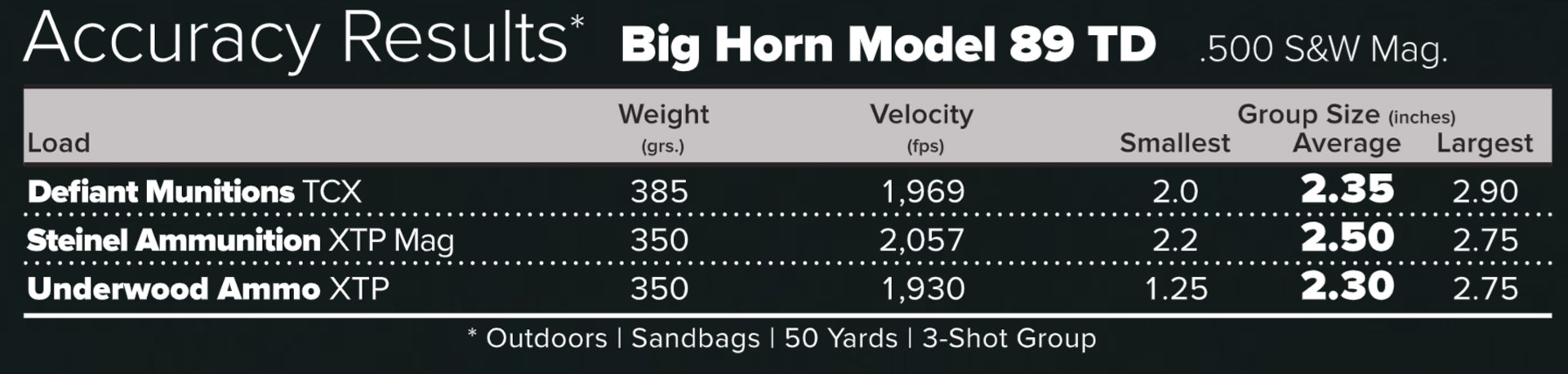
My accuracy testing was done at 50 yards from a rest shooing five, three-round groups. My .500 S&W loads were: Defiant Munitions, 385-grain TCX bullet; Steinel Ammunition, 350-grain XTP jacketed hollow point bullet; and Underwood Ammo’s 350-grain XTP jacketed hollow point bullet.
I was able to punch 2- to 2.25-inch, three-round groups with all three ammunition brands. I don’t doubt I could’ve made smaller groups with a magnified optic, but certainly the groups I shot with the Vortex would’ve dropped a big game animal.
Of the three ammo brands I tested, Underwood’s 350-grain XTP was the most accurate in my shooting, with 1.25- and a 1.75-inch groups.
My eyes aside, the Model 89 TD is easily a 100-yard rifle—and better. Consider the rounds rom Defiant Munitions, which left the rifle’s muzzle at 1969 fps and generated a whopping 3,000 ft.-lbs. of energy. With my 50-yard zero, the Defiant bullet will drop 1.2 inches at 100 yards and deliver 2,158 ft.-lbs. of energy. At 150 yards, the drop is approximately 5.5 inches, and the 350-grain bullet still packs 1,819 ft.-lbs. of big-game dropping power.
That bullet drops 13.5 inches at 200 yards, which isn’t terrible, but the energy has dropped to fully half of what it was at the muzzle. I’d need to do some serious range time at this distance, the Model 89 rigged with a magnified optic, to see what this rifle and I are capable of accuracy-wise.
While the weight of the rifle and the aforementioned Pachmayr Decelerator did tone down the recoil, this isn’t a rifle for the recoil sensitive. Recoil isn’t punishing, but it delivered a very stout thump to my shoulder. I’d rate it similar to the recoil from a 12-gauge pump shotgun firing 3-inch turkey loads.
The Model 89 TD is one big boy able to take down most anything roaming the North American continent. And the rifle will handle just about any environmental conditions it’s thrown into. Not many rifles, levers or not, can live up to those twin realities.
Big Horn Armory Model 89 Take Down Carbine
- bighornarmory.com
- Type: lever-action, centerfire rifle
- Caliber: .500 S&W Mag.
- Magazine: tubular, 7-rnd. capacity
- Barrel: 18"; button rifled; 1:24" RH twist
- Trigger: single stage; 2 lbs., 4 ozs. pull weight
- Sights: Skinner rear aperture; marble white bead front
- Safety: none
- Stock: straight comb, American black walnut; satin finish; 13.75" LOP
- Metal Finish: nitride, Hunter Black
- Overall Length: 36"
- Weight: 7 lbs., 12 ozs.
- MSRP: $3,799