The 300 Precision Rifle Cartridge (PRC), like many cartridges born in Grand Island, Neb. (.17 HMR, Ruger Compact Magnums, 6.5 Creedmoor, 6.5 PRC), is the product of years of thinking and tinkering by Hornady. But more importantly for hunters and long-distance shooters, it represents a paradigm shift.
Rest assured the cartridge lives up to such high praise.
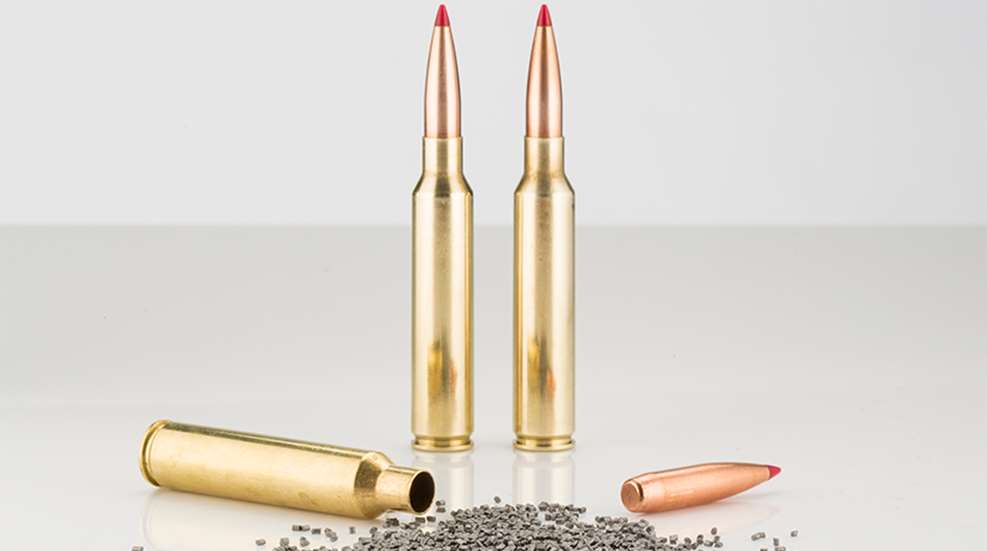
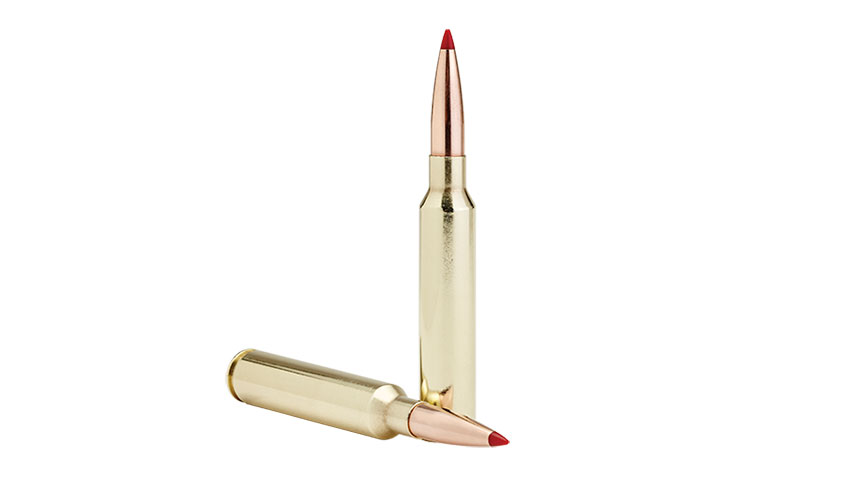
The 300 PRC is based on the .375 Ruger; call it a .30-375. Maximum cartridge overall length (COAL) is 3.7 inches. A 2.58-inch-long case creates capacity for 75-80 grains of powder to push big .30-caliber bullets at high velocity. So the cartridge has the capacity to kill not only most big game but also many existing .30-caliber magnums.
Does the shooting world need another .30-caliber magnum? “We needed it,” said Jayden Quinlan, ballistician at Hornady.
To understand what he means, it’s important to remember Hornady has been re-thinking its approach to cartridge and bullet design ever since it began to use Doppler radar to better understand external ballistics. In 2014, when the company purchased its radar and began measuring bullet-flight dynamics, Hornady personnel quickly realized whatever they thought about external ballistics was off—by a wide margin, considering ballisticians work in increments of .001 inch. That led to a better understanding of external and internal ballistics, and a recalculation of every bullet in the Hornady library.
“Gun guys build actions,” Quinlan said to a small group of gunwriters at a pre-release field-test of the cartridge in Texas last September. To cover the most bases, to be sure a rifle model will fill many wants and needs, he explained, gunmakers design actions to incorporate the most cartridges. So existing actions are based around old cartridge and bullet design. “Ammo guys build ammo to spec,” Quinlan continued. “They build ammo based on fit in existing actions. This creates a limited design cycle. So we thought, ‘This is not working. Let’s do what we want. Let’s do what we need.’”
In short, Doppler radar revealed much thinking about what constituted sound cartridge design was flawed. That led to new designs such as the 6.5 PRC and, now, the .300 PRC. The big brother of this precision duo hits the market as a complete package, as a cartridge and chamber designed for accuracy.
The cartridge’s overall length allows bullets to be seated farther out from its case body as compared to other .30-caliber magnums, while chamber specs ensure proper throat length. So the 300 PRC may accommodate not only traditional bullets but also modern, long-range designs trending today. Its head diameter of .532 inch (same as the .300 Win. Mag.) fits within a standard magnum bolt face (unlike the .300 Norma or .338 Lapua Mag.). That, combined with a COAL of 3.7 inches, ensures it will fit, feed and function in existing long actions. Its case is beltless; it headspaces off a 30-degree shoulder for optimal chamber alignment. Its bullet-over-chamber tolerance is tight. Unlike other .30-caliber magnums that headspace on, and are thus supported only at, a rear belt, the 300 PRC is supported fore and aft so its bullets leap from the case to the rifling of the barrel with more precision.
Thus the .300 PRC gives its heavy-for-caliber bullets a good start in life. To explain it in layman’s terms, Quinlan asks us to imagine holding an orange road cone by the black flange at its base and trying to push an elevator button. “With a belted magnum case,” he explains, “you’re trying to hold your arms out straight and hold a road cone straight—it’s not going to happen.” Indeed, an unfired, factory-spec .300 Win. Mag. case’s shoulder never touches the chamber walls. But with the beltless 300 PRC, supported fore and aft, “you’re not trying to hold something straight by only holding the back of it.”
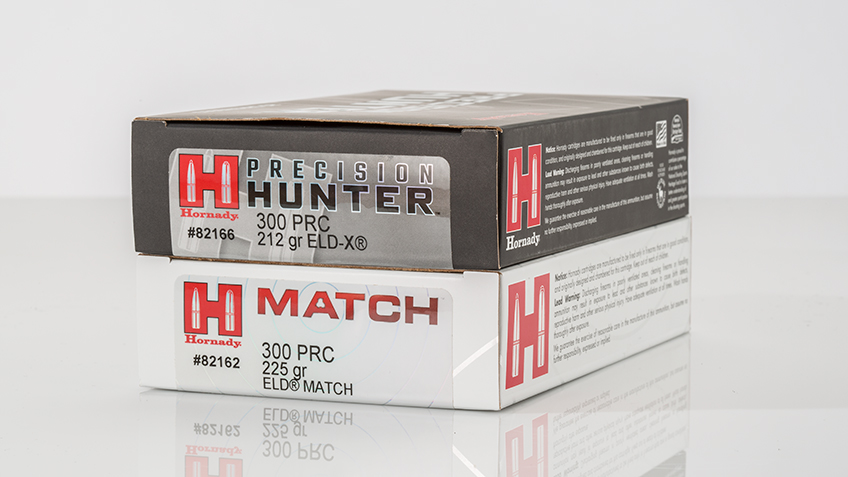
Hornady factory offerings use two modern, long-range bullets, one for hunters and one for shooters: the company’s 212-grain ELD-X and 225-grain ELD Match. The former carries a G7 ballistic coefficient of .336 (G1 of .673) and in a 24-inch barrel reaches an advertised muzzle velocity of 2860 fps from the Precision Hunter factory load. At that speed, as calculated by the Hornady 4DOF ballistic calculator, at 1,000 yards velocity is still 1551 fps. Energy is a whopping 1,132 ft.-lbs. at that range. Time of flight is a mere 1.465 seconds. The latter’s G7 BC is .391; Hornady’s Match load produces an advertised muzzle velocity of 2810 fps. My real-world results equaled the hypotheticals. In Texas, I fired the 225-grain ELD Match at a pig 433 yards distant. In Colorado, I fired an expanding 212-grain ELD-X at a bull elk 479 yards distant. In both cases, there were no surprises.
If there is any surprise here, it might be the recoil. This cartridge kicks—not horribly, but significantly. I’d say recoil is stouter than a .300 Win. Mag., a bit less than a .300 Wby. Mag. In Texas I carried a rifle built by GA Precision; in Colorado I carried a rig by HS Precision. Honestly, I didn’t like either as they were built for precision shooting, not hunting. Other gunmakers currently chambering the .300 PRC include Bergara, Fierce, the Remington Custom Shop, Seekins Precision, Gunwerks, Proof Research, Barrett and Stuteville Precision. When I buy a rig for this cartridge it will be practical, one I’d like to carry all day.
Regardless what kind of rifle one may choose, understand the 300 PRC acts like magic so long as the shooter does his part. And because of that, here’s betting it will find wide acceptance in the shooting and hunting world.
Technical Specifications
• Caliber: .30
• Bullet: 212-gr. Hornady ELD-X (Precision Hunter), 225-gr. Hornady ELD Match (Match)
• Ballistic Coefficient (G1): .673 ELD-X, .777 ELD Match
• Muzzle Velocity (advertised fps w/24″ barrel): 2860 Precision Hunter, 2810 Match
• Muzzle Energy (advertised ft.-lbs.): 3,850 Precision Hunter; 3,945 Match
• MSRP: $56.17 per 20-rnd. box; hornady.com