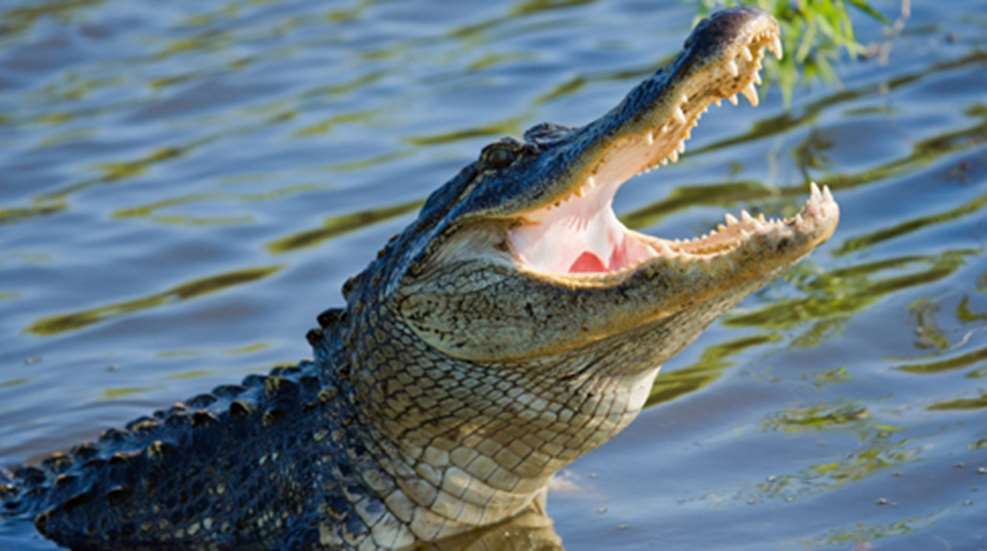
In the lower 48, there are very few opportunities to hunt animals that may bite back. Encountering grizzlies or mountain lions during a hunt can be spooky and downright dangerous, but there’s only one true man-eater that’s hunted close-in with primitive weapons, on his own turf and often in the darkness: the American Alligator. Florida provides plenty of opportunities for gator hunting to residents and non-residents alike.
Alligator Mississippiensis thrives in nearly all of Florida’s varied habitats, from the Everglades’ sea of grass to the black waters of panhandle swamps, and crystal clear rivers and springs and even in man-made suburban ponds. Though not nearly as aggressive or deadly as their crocodile cousins, alligators can be extremely dangerous—especially at night, when they are often hunted. According to the Florida Fish and Wildlife Conservation Commission, gators have attacked humans an average of 16 times per year since 2000 with 12 total fatalities. As a Florida native, I can recall two boys killed by alligators in my hometown alone and grew up hearing the story of a family member who survived a moonlight gator attack on the banks of Lake Placid.
A classic conservation success story, Florida’s modern gator season began in 1988 when the population was determined to have rebounded from the toll taken by unregulated commercial hunting and habitat loss throughout the first half of the 20th century. Since then, seasons have been expanded and bag limits increased to reflect a population of approximately 1.3 million that continues to thrive despite human encroachment. In 2010, 7,672 alligators were taken by licensed hunters during the eleven-week season.
In 2010, FWC issued 6,044 non-transferable permits, each of which allows the taking of two alligators. Permits are made available in three phases: Phase one is a random drawing that takes place in May and gives winners the option of purchasing their permit by June 5. The second phase allows individuals who did not draw in phase one to purchase permits on a first-come, first-serve basis. Phase three allows anyone, including those who were successful in phase one, to purchase any remaining permits. Permit fees are $272 for Floridians and $1,022 for non-residents. If those prices are out of your reach, you can buy a $52 “Agent License,” which allows you to legally assist a licensee or nuisance alligator trapper in the taking of gators. Traditionally hunting gator was done in the dark of night but, recently, hours have been expanded with legal hunting hours from 5 p.m. to 10 a.m. All hunting takes place during four short seasons that occur throughout August and September. Successful hunters can have gator meat and hides processed for personal use or sold through licensed processing facilities and fur and hide dealers.
Perhaps the most interesting and sporting thing about hunting alligators in Florida is the highly restrictive means by which they must be taken. You may have seen videos of hunters shooting crocodiles in Africa with rifles from blinds on dry land, but that’s not how it’s done in the Sunshine State. Alligators must be taken by a lure and hand line, hand-held snare, harpoon, gig, snatch hook, spear, spear gun, bow or crossbow with a restraining line: this means you have to get up close and personal to get your gator. The method that I am most familiar with involves spotting the gator with a light and closing the distance in a boat. A large “treble hook” is cast past the gator and “snatched” to catch in the gator’s thick dinosaur-like skin. The gator is “reeled in” which can takes extreme effort, until you are close enough to use a spear, harpoon or bow to get a line on the giant reptile. Only then, secured by a strong line, can the gator be dispatched using a “bang stick” device—there is no “catch and release” allowed by law. In case you’re wondering, gators don’t take kindly to all of this, so you are faced with an angry, thrashing beast weighing hundreds of pounds with strong jaws, plenty of teeth and a tail like a wrecking ball. No one who has ever hunted alligators in Florida will tell you that there’s no sport in it.
When you’re in a boat in the darkness with a gator on the line, things can go bad quickly. My best friend was on Lake Okeechobee, a mile or more from shore, when the airboat capsized with a monster gator on a hand line. He found himself underwater with one end of the line around his ankle and the other end in the mouth of an angry alligator that he estimated at over 12 feet. He freed his leg but still faced a half-hour swim fully-clothed in complete darkness in waters totally infested with alligators. That event didn’t put an end to his gator hunting but, these days, he’s more careful about who is driving the boat.
Florida’s alligator hunting is an experience like none other: it combines the adventure and danger of being in close-quarters with a large predator and the opportunity to be among the nation’s most unique habitats.
Most Popular