Light shotguns can be a double-edged sword. They are great to carry, but often suffer from poor balance, making hitting a bird or clay more difficult. Benelli has found the answer with its 5-pound, 28-gauge Legacy. For the upland hunter who carries his shotgun for miles, young shooters and those of us whose maturity might dictate a lightweight shotgun, the Legacy is an excellent choice.
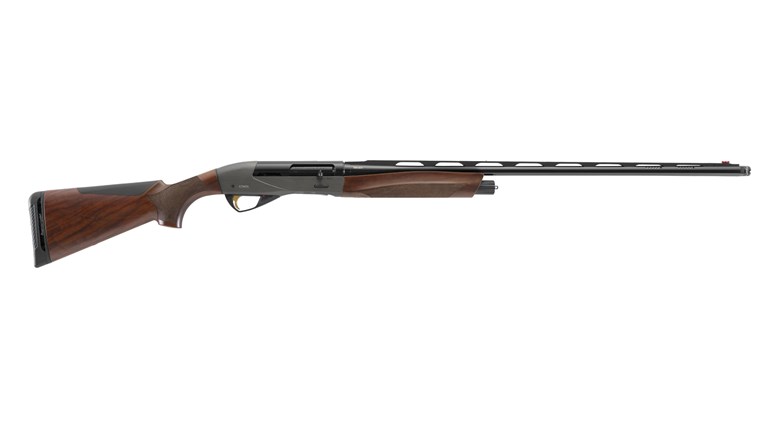
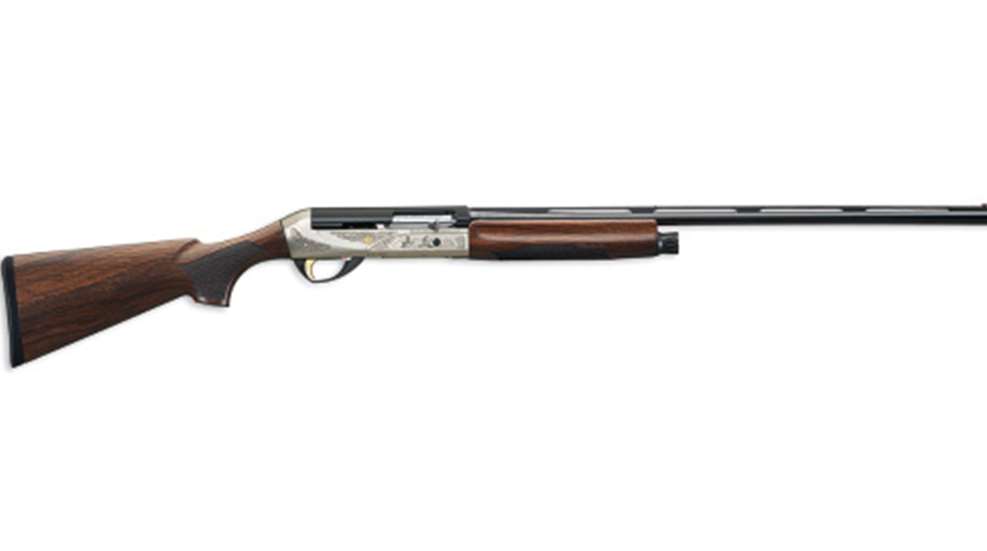
Like the beautiful woman on Benelli’s website who describes the Legacy, the gun is, indeed, beautiful. The brushed-silver lower receiver is engraved with leaf and scroll, quail in flight and the number “28” is set off in a gold-colored oval. The barrel is deeply blued and the stock and fore-end are oil-finished walnut. Looks aside, lots of thought went into this shotgun.
First, the gauge: The 28-gauge is an excellent upland round. The payload is only an eighth-ounce less than the 20-gauge. Yes, there is a 1-ounce 28-gauge load, and if it patterns well, then the 28 yields no advantage to the 16 or 20. I prefer the ¾-ounce shot charge, as I feel there is no advantage gained by the 1-ounce charge. The velocity is a solid 1200 fps, and although the small-bore shell defies all conventional wisdom regarding patterning, I’ve found the 28 to be a consistent performer on the patterning board, and better yet, in the field.
Benelli was highly successful in adapting its familiar “Inertia-Driven” operating system to the 28-gauge. This system operates by using the forces of recoil working against a carefully calibrated spring. When fired, the gun begins to recoil, but the spring resists the rearward motion and pushes the rotating bolt even tighter into battery. About the time the shot charge exits the muzzle the spring is overcome and the stored energy in the bolt assembly drives it rearward, ejecting the fired hull along the way, until it impacts the rear of the receiver and returns forward, pushing a new shell into the chamber.
The Benelli inertia operating system is very clean compared to gas-operated shotguns. Because the shot is clear of the barrel when the bolt opens, very little carbon and unburned powder enters the action. I ran a bunch of shells through the test gun and there was very little residue in the action to clean later.
When the guns were first announced at the January 2010 SHOT Show production was just beginning. I received a Legacy to test in May, long after even the game farms had closed. Therefore, I took it to the club and shot skeet. Because it is a simple straightaway target, I always begin at skeet station low seven. If a gun doesn’t shoot straight, you’ll quickly discover it on No. 7. I brought along my 13mm deep-socket wrench in case I needed to employ the supplied shims to bring the stock to my dimensions.
Frankly, the Legacy shot right where I looked, and no adjustment was necessary. Shooting low gun, I smoked target after target from the low house, and it felt very comfortable. Next, I shot crossing targets from station four, and then some doubles on the same peg. Again the Legacy handled very well. I did notice it was slightly butt-heavy, but considering it is advertised as being 4.9 pounds with a walnut stock (the test gun weighed 5.2 pounds on my digital postal scale, the difference being attributable to the varying density of walnut) there would be a little more heft in the butt, but not enough to make it whippy to point. Oddly, Benelli has equipped the Legacy 28 with a soft rubber recoil pad, which would seem unnecessary with light recoiling 28-gauge loads. Perhaps a plastic buttplate would weigh less and move the balance a trifle more forward from its point of about an inch behind the operating handle.
The trigger pull, measured on my Lyman digital gauge, averaged 5 pounds, 15 ounces, which is heavy for such a light shotgun; however, the trigger had no preliminary take up.
For a shotgun for the uplands and dove, the Legacy 28 would be excellent. I took it along to a shooting lesson with top-rated sporting clays shot Bruce Ney, and he instantly said he could use one as a range gun for youngsters and beginning shooters at his teaching facility. All come with three screw-in choke tubes (IC, Mod and full).
Following my work on the skeet range, I shot a series of patterns at 30 yards. The IC choke that measured .0010-inch constriction averaged 53 percent with No. 8 Winchester target loads. (I chose target loads as they use harder shot and best reflect choke performance. Promotional loads such as those labeled “Dove and Quail” will often shoot more open patterns due to their softer pellets.) At 30 yards the tube marked modified, which measured .0375, which actually made it a full choke, shot very tight, with a 92 percent average with heavy center thickening—too tight for quail and grouse, but about right for pheasant and dove.
As a further test, I shot some clay targets using No. 7½ Holland & Holland fiber-wad-loaded shells. They are loaded at a low breech pressure for use in older double guns. They were too light to function in another gas-operated semi-auto I tried, but I had nary a hiccup shooting them in the Legacy.
All in all, I really enjoyed shooting the Legacy 28. It would be a first choice for any game-farm hunting, certainly for chasing grouse in the alder thickets or quail behind good dogs, and a great little shotgun for starting young shooters. It should be on your dealer’s rack by the time you read this.