When the .308 Winchester arrived on the scene in 1952, it made quite a splash, as it had the audacity to challenge the heralded .30-06 Springfield in both the military and civilian realms. Immediately, the wildcatters got to tinkering with the short case, necking it both up and down. Winchester released their .243 and the .358 within three years of the parent case, but it would be a while until the fourth child would come along, at least with a commercial pedigree.
Those wildcatters took the case from .22-caliber up to .375—and maybe beyond—but one of the best-performing wildcats was the 7mm/.308, developed in 1958. Simply the .308 Winchester case necked down to hold .284-inch bullets, and offering an excellent balance of bore diameter to case capacity, the 7mm/.308 would have to hang around for over two decades until Remington made it an honest cartridge by giving it their last name. Released in 1980, the 7mm-08 Remington would go on to be considered not only an excellent target cartridge, but one of the best deer cartridges ever conceived.
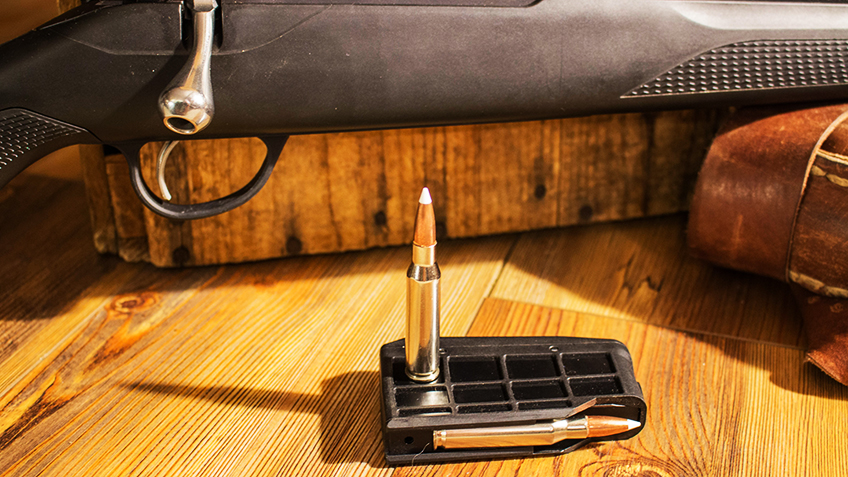
The 7mm-08 uses the same shoulder angle as its parent cartridge (20 degrees) to assure both smooth feeding and good headspacing from the rimless cartridge. The 7mm-08 uses a case measuring 2.035 inches—0.020-inch longer than the .308 Winchester—making it a perfect fit in a short-action receiver, and the 7mm-08 is fully capable of being housed in just about any action type.
The gamut of 7mm bullets makes the 7mm-08 very flexible, though much like its parent, bullets on the heavier end of spectrum tend to see velocities drop off, but not so much as to be unusable. Most of the factory loads for the 7mm-08 Remington are built around the 120-, 140- and 150-grain bullets, though there are some heavier loads available, using 160-grain and sometimes heavier bullets. For the handloader, there is a wide world available as far as bullet choices go, and the 7mm-08 case has proven to be a very efficient design, giving a whole lot of performance while burning very little powder.
The lighter 120-grain bullets, which work so wonderful for deer, usually run at a muzzle velocity of 3000 fps, giving a flat trajectory and generating a good amount of hydraulic shock. The 140-grain loads usually run at 2800 to 2850 fps, depending on the manufacturer and your barrel length, and represent an excellent middle-of-the-road choice, being capable of taking deer, black bear and other similar-sized game species.
The 150- and 160-grain bullets, while running at an average velocity of just about 2650 fps, offer a higher sectional density, and therefore should give better penetration on the larger game species like elk and moose. The 7mm-08 Remington, like the .308 Winchester, gives an excellent balance of flat trajectory, minimal report and recoil, and effective killing power. While most people think of it as a deer cartridge—and among the myriad choices for deer, it’s hard to deny the capability of the 7mm-08—with premium bullets of sensible weight, the 7mm-08 Remington makes a good all-around choice for North America. In my opinion, for a hunter who spends most of his or her time hunting whitetails, and only occasionally hunts larger game, the 7mm-08 Remington makes a better choice than does the bigger 7mm Remington Magnum.
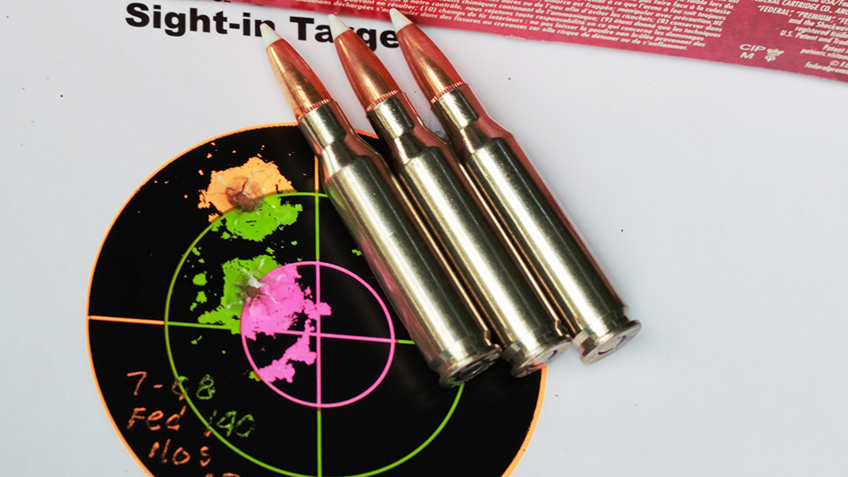
In comparison to the larger 7mm cartridges, the 7mm-08 (as well as the older 7x57mm Mauser) falls into the category of ‘sweet shooting’, as the recoil characteristics are easily managed by nearly any shooter; the same cannot be said for any of the 7mm magnums. My own 7mm-08 is in a Tikka T3x Lite rifle, and it is as accurate as it is easy to carry. Like the .308 Winchester, the 7mm-08 can be seriously accurate, with most rifles at or inside of 1-MOA, and .5-MOA is not out of the question. Rifles for the 7mm-08 are usually short, light and handy, and the cartridge makes a great choice for a mountain rifle.
For the handloader, the 7mm-08 will run on powders with a medium to medium-slow burn rate, say from IMR4064/VARGET/RL-15 up to IMR4350/RL-19. A standard large rifle primer will handle the efficient powder column. The 7mm-08 case has a capacity of between 52 and 55 grains of water, depending on the brand, which usually results in a powder charge that fills the case well. Combine that with the short/fat conformation of the powder column, and you have the recipe for what many refer to as ‘inherent accuracy’, though that term is debatable. I do know that almost all the 7mm-08 rifles I’ve spent time with have been very accurate.
I think the 7mm-08 Remington still suffers from the ‘new-kid’ syndrome; it has some serious competition in the 7x57mm Mauser—which has been with us sine the 19th century and has a nostalgic quality to it—as well as Remington’s other two extremely popular 7mms: the .280 Remington and 7mm Remington Magnum. As if that wasn't enough of a challenge, the barrage of 6.5mm cartridges—including the .260 Remington and 6.5 Creedmoor—has surely had an effect on the popularity of the 7mm-08.
Nonetheless, the 7mm-08 remains an excellent choice as a hunting cartridge, and a decent choice for a target cartridge for those who stay inside of 1,000 yards, maybe a bit more. It is the equal of the 7x57mm Mauser, with the possible exception of the heaviest bullets, it is a cartridge capable of taking almost all species in North America, save the large bears and the bison, and it is a cartridge that allows a hunter/shooter to become proficient as a marksman without punishment. The 7mm-08 Remington sits—rather comfortably—between the 6.5 Creedmoor/.260 Remington and the .308 Winchester; and that’s not a bad place to be at all.
Looking for previous installments of our "Behind the Bullet" series? We've got you covered.
• 8mm Remington Magnum
• .338 Federal
• .224 Valkyrie
• .338-06 A-Square
• 9.3x62mm Mauser
• .257 Weatherby Magnum
• .45-70 Government
• .300 H&H Magnum
• .25-06 Remington
• .30-06 Springfield
• 6.5 Creedmoor
• .300 Remington Ultra Magnum
• 7mm Remington Magnum
• .470 Nitro Express
• .280 Remington
• .300 Winchester Magnum
• .270 Winchester
• .222 Remington
• .45 ACP
• .404 Jeffery
• .44 Remington Magnum
• .41 Remington Magnum
• .243 Winchester
• .338 Winchester Magnum
• .357 S&W Magnum
• 6.5-284 Norma
• 8x57 Mauser
• .38 Smith & Wesson Special
• 7x57mm Mauser
• 9 mm Luger
• .35 Whelen
• .454 Casull
• .375 H&H Magnum
• .45 Colt
• .22-250 Remington
• 10mm Auto
• .308 Winchester