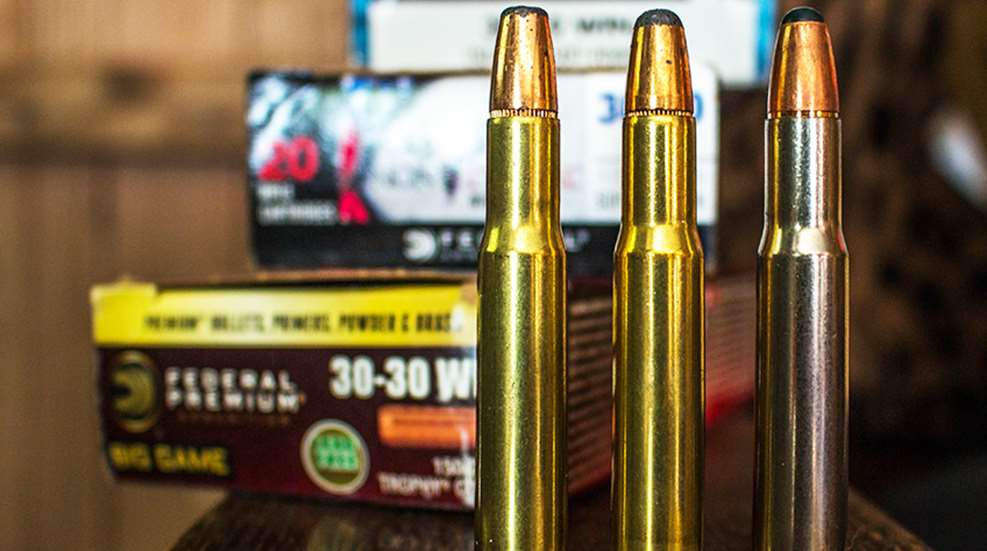
Among the most successful of John Moses Browning’s designs—and perhaps one of the most successful hunting rifles—is the Winchester 1894 lever-action rifle. Just one year later, that slim, trim, handy rifle would be chambered for one of the most popular cartridges of the 20th century: the .30-30 Winchester.
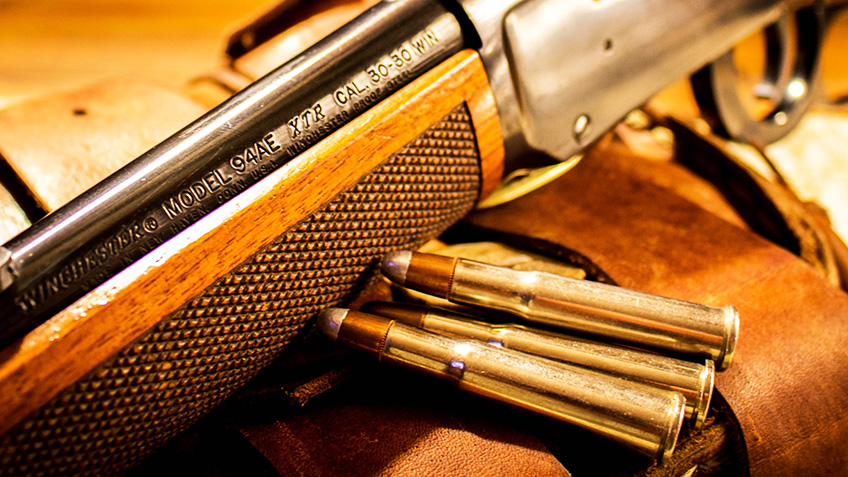
It has been known by many names—including .30 Winchester Center Fire, .30 WCF, .30 Winchester Smokeless, .30/30 and .30-30—but what it did was set the hunting world on its ear, and kindled an American love affair with .30-caliber cartridges that burns brightly to this day. The rimmed and bottlenecked .30-30 is based on the straight-walled .38-55 Winchester, necked down to hold .308-inch-diameter bullets. The original loading of a 160-grain jacketed bullet and 30 grains of smokeless powder (the .30-30 Winchester was the first American small-bore cartridge designed for use with smokeless powder) gave a muzzle velocity of 1970 fps, and was a great choice for hunting within 150 yards. Mind you, this was an era when the riflescope was a rarity at best, and the vast majority of hunters relied upon iron sights to make meat.
Union Metallic Cartridge Company (UMC) released a 170-grain load a year after introduction, and that would replace the 160 and go on to be the standard, go-to load, at 2200 fps or so, with a 150-grain loading moving at 2350 to 2400 fps following close behind. Those slim, trim Winchester Model 1894s (both rifle and carbine versions) as well as the Marlin Model 1893s made an easy-to-carry choice of hunting rifle, and the ‘new-fangled’ .30-30 was certainly more than effective on deer and deer-sized game, with hunters testing the limits of the cartridge by taking both elk and moose with it. The cartridge would go on to be recognized as the deer cartridge for the majority of the 20th century, despite the amount of wonderful cartridges developed. The Winchester Model 1894 morphed into the Model 94, and between the two of them—though not all were chambered for the .30-30, but a good majority were—over 7,000,000 were sold.
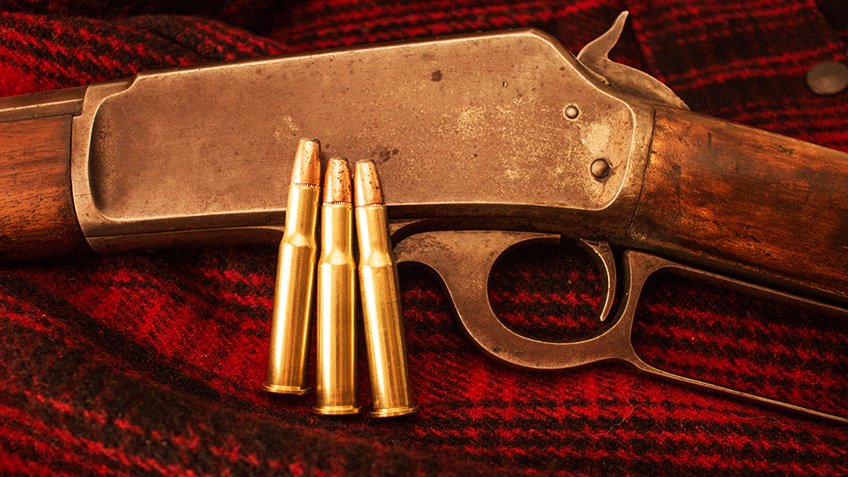
The .30-30 Winchester is a simple design, easy on the shoulder (having just about half the recoil of the .30-06 Springfield) and the wallet, and very effective inside of 200 yards. Due to the design of the rifles—traditionally equipped with a tubular magazine that lines the cartridges up nose to tail—the great majority of the ammunition has been loaded with either flat or round nosed bullets, to prevent detonation within the magazine. This obviously reduces the ballistic coefficient (BC) of the bullet, and as the .30-30 starts out mild, both energy and velocity figures drop off quickly. But, as modern long-range shooting was nearly incomprehensible to the average hunter of a century ago, the .30-30 was ‘enough gun’ for those in pursuit of whitetail deer and black bear. Zeroed at 100-yards, the classic 170-grain load prints .3-inch high at 50 yards and 8.5 inches low at 200 yards; as most shots were inside 125 yards, hold-over wasn’t much of an issue.
With a rim diameter of .506-inch, a gently tapering body, 15˚-40′ shoulder and good, long neck measuring .478-inch, .30-30 ammunition is compact enough to throw a handful of cartridges in a pocket and head to the hills. With its moderate velocity, sloping shoulder and pronounced rim, I have personally thought the .30-30 Winchester resembles a miniaturized Nitro Express cartridge; sharing the rim, sloping shoulder and long neck which so many of those classic big-bores have. If there is any complaint about the .30-30 case design, it is the fact that the case walls are traditionally rather thin—not unlike the .45-70 Government—and attempts to drive it to higher pressures usually end poorly. It’s been chambered in many lever-action rifles, like the Marlin 336, Winchester 64, Savage 99, several Mossberg models (as well as those marketed under the Western Field brand), and many single shot rifles like the H&R Model 58 and the famous Ruger No. 1.
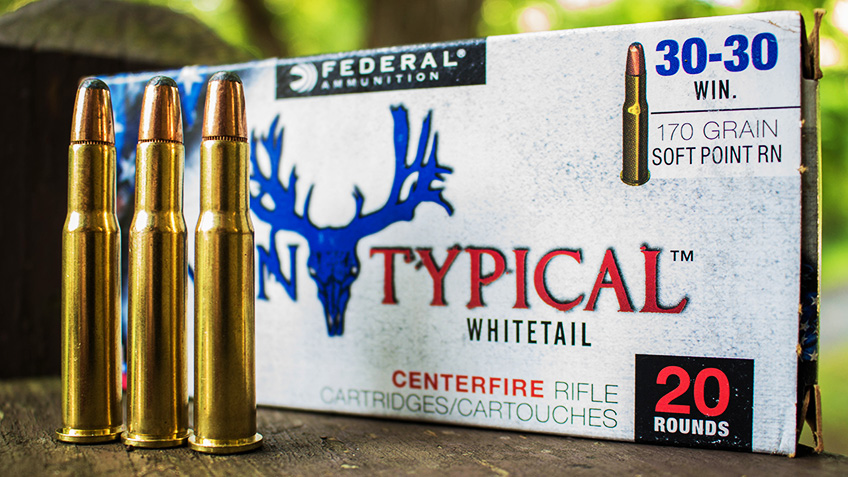
Being such a popular cartridge, there are plenty of ammunition choices, from reliable plain-Jane stuff to boutique choices. To be honest, with velocities ranging between 2200 and 2400 fps, any jacketed bullet of decent construction should get the job done, as the bullet isn’t under the stresses that a magnum cartridge can generate. Federal’s Power-Shok, Hornady’s InterLock, Remington’s Core-Lokt and Winchester’s Power Point ammo have put an exorbitant amount of venison in the freezer, and an equally large number of smiles on hunters’ faces. The lead-free options are there, such as Federal’s Trophy Copper and Barnes’ VOR-TX, and there are premium bullet choices as well. Federal loads the 170-grain Nosler Partition—and that bullet is a favorite of mine in the .30-30 Winchester—and Winchester loads the 150- and 170-grain Power Max Bonded. Should you want to give your .30-30 a face-lift, look to Hornady’s LeveRevolution ammo, built around a 160-grain spitzer boat tail at 2400 fps, with a specialized flexible tip which eliminates any danger of magazine detonation. Striking 3-inches high at 100-yards will yield a 200-yard zero, giving those with a scoped .30-30 (or those well-accustomed to shooting iron sights) a new lease on life.
Handloading the .30-30 is no difficult task; I’ve had my best results with a 170-grain bullet (either Hornady InterLock round nose or Nosler Partition) and a charge of—wait for it—30.0 grains of IMR-4064, sparked by a large rifle primer. I like a good roll crimp on the case mouth if the bullet has a cannelure, especially if loading for a tubular magazine rifle; you’ll use the nose of the bullet you’re loading into the magazine to push the previous one forward, and over time I’ve seen some bullets get pushed deeper into the case mouth.
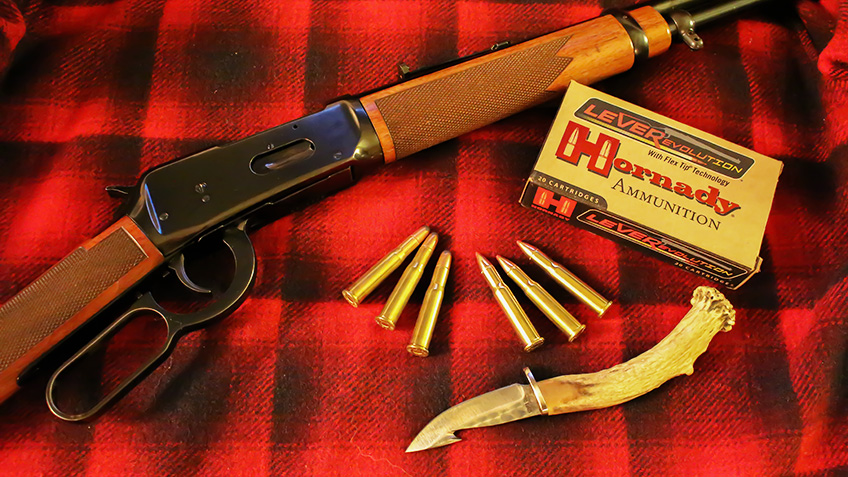
In a world of seriously flat-shooting rifles and cartridges, topped with crystal clear optics with magnification levels high enough to detect life on other planets, taking an octagon-barreled lever gun equipped with good iron sights is a wonderful throwback, letting you rely on your hunting skills to get a bit closer. I’m not trading in my .300 Winchester, but I do like the connection the old, rimmed cartridge provides.
Looking for previous installments of our "Behind the Bullet" series? We've got you covered.
• .416 Rigby
• .358 Norma Magnum
• .22 LR
• 7mm-08 Remington
• 8mm Remington Magnum
• .338 Federal
• .224 Valkyrie
• .338-06 A-Square
• 9.3x62mm Mauser
• .257 Weatherby Magnum
• .45-70 Government
• .300 H&H Magnum
• .25-06 Remington
• .30-06 Springfield
• 6.5 Creedmoor
• .300 Remington Ultra Magnum
• 7mm Remington Magnum
• .470 Nitro Express
• .280 Remington
• .300 Winchester Magnum
• .270 Winchester
• .222 Remington
• .45 ACP
• .404 Jeffery
• .44 Remington Magnum
• .41 Remington Magnum
• .243 Winchester
• .338 Winchester Magnum
• .357 S&W Magnum
• 6.5-284 Norma
• 8x57 Mauser
• .38 Smith & Wesson Special
• 7x57mm Mauser
• 9 mm Luger
• .35 Whelen
• .454 Casull
• .375 H&H Magnum
• .45 Colt
• .22-250 Remington
• 10mm Auto
• .308 Winchester