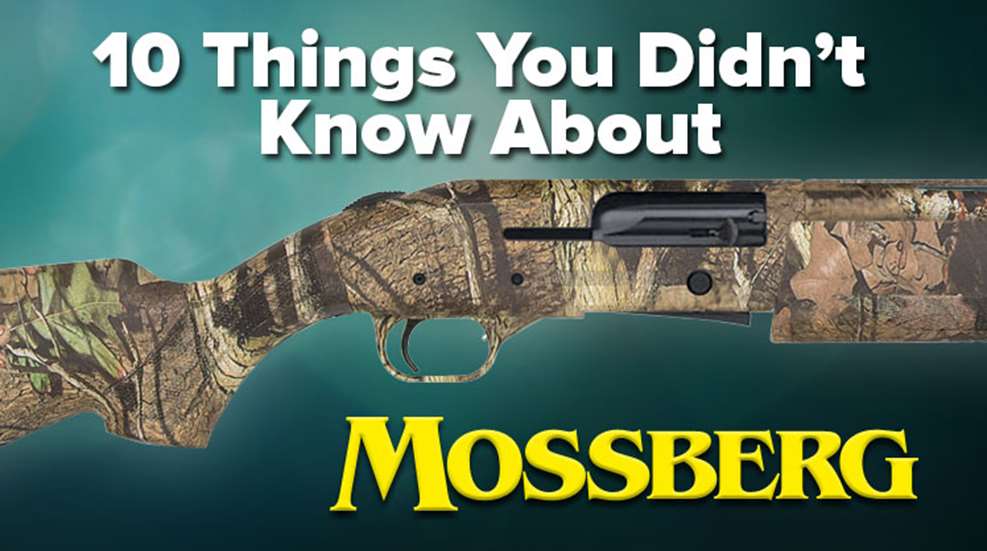
Few firearms companies have the demographic reach of O.F. Mossberg & Sons. The North Haven, Connecticut-based firm hasn’t yet reached its centennial (that’ll come in 2019), but its stamp can be found on the firearms carried into battle by our armed forces, in the hands of law enforcement personnel nationwide, slung over the backs of big game hunters and gently resting in the corner of duck blinds north and south. If you own firearms, there’s a very good chance you own a Mossberg.
There’s no shortage of things to be said about a company that began its history producing .22-caliber pocket pistols (known as Brownies), so let’s get started. Here are 10 things you might not have known about Mossberg.
1. As you’ve undoubtedly noticed, the company’s official name remains O.F. Mossberg & Sons—it’s named after one Oscar Frederick Mossberg, a Swedish immigrant who started the company in 1919 at the age of 53. Oscar was no newcomer to the firearms industry—he had previously worked for J. Stevens Arms & Tool Co. and C.S. Shack Arms Co., among others.
 2. Mossberg got its start in a corner of the industry that the modern-day company has largely remained detached from: pistols. The very first firearm to carry the Mossberg name was a .22-caliber pocket pistol known as the Brownie (which is a fantastic name, I must say). It was marketed predominantly to hunters and trappers for use dispatching wounded or trapped game.
3. The Brownie, by the way, launched in 1920 and carried a retail price around $6. It remained in production for 12 years. Adjusted for inflation, that $6 would become about $72 today. Not bad.
4. Mossberg firmly remains a family-owned and operated company. The CEO is A. Iver Mossberg, great grandson of Oscar Frederick.
5. Though the company didn’t produce a combat weapon for the United States Armed Forces during World War II, it very much contributed to the war effort. Mossberg made parts for the Browning M2 .50-caliber heavy machine gun. Further, Mossberg produced the 44US target trainer for U.S. Army and Navy forces.
6. Beginning around the WWII era and running through the early '70s, Mossberg employed one Carl Benson, who served as one of the company’s chief firearm designers. A self-taught engineer of sorts, Benson had been in the industry since the mid-1920s. Benson’s name is important to Mossberg lore for a number of reasons, none more important than that of a shotgun he helped develop: the Model 500.
7. The Model 500, famous as it is now, was originally designed to look and feel like the competition in 1962. Mossberg decided that, in order to run with the likes of Remington, Winchester and Ithaca, it needed a shotgun that consumers would feel familiar with. And so the Model 500 was born. Mossberg did try to set it apart, though, by claiming in advertisements that the 500 was “the only 12-gauge pump with the feature that every shooter wants.” That feature, though rare to come by in the 1960s, is now synonymous with the Mossberg brand: the tang safety.
8. Honestly, I could put together an entire “10 Things You Didn’t Know” on the Model 500 itself. The iconic scattergun features no shortage of fun facts, all its own. For now, though, I’ll limit the 500 to two entries on this list. Nowadays, the 500 is old hat among military and police organizations. Its first foray into law enforcement, however, came among private security companies. In 1965, Mossberg offered a 500A 12-gauge model with a shorter barrel that was meant for police use only. The first orders for the model wound up being sold to companies that staffed armored car personnel, making the Model 500 a modern coach gun, of sorts, I suppose.
9. In 2016, you’d be hard pressed to find a waterfowl hunter that doesn’t own at least one shotgun with a 3½-inch chamber. Prior to the Mossberg Model 835 Ulti-Mag, though, such an option didn’t exist. As soon as waterfowlers began converting to steel shot, they started howling for larger payloads. At first, shotgun manufacturers throughout the industry considered reviving the beefy 10 gauge. Mossberg, though, wanted to go a different direction, and found a willing partner in Federal Ammunition, which had previously toyed with the idea of a 3½-inch shell—but couldn’t justify producing it until a company rolled out a corresponding shotgun. The two industry veterans quietly worked together on the project, and a new era of scatterguns unfolded.
10. Most companies in the firearm industry have, at one point or another, dabbled in producing other products. When your expertise is machining, it’s hard not to at least consider the possibility. Over the years, Mossberg has had its name stamped on a number of other products, including campers, bicycles, sailboards and canoes. The side ventures all came and went, naturally. Now, Mossberg tends to stick to its guns—pun intended—and remains one of the industry’s standard-bearers. Hey, it’s even got the NRA Golden Bullseye Awards to prove it.
Looking for past installments of our "10 Things You Didn't Know" series? Hit the links below!
• 10 Things You Didn't Know About Trijicon
• 10 Things You Didn't Know About Aguila Ammunition
• 10 Things You Didn't Know About SilencerCo
• 10 Things You Didn't Know About Nikon
• 10 Things You Didn't Know About Hornady
• 10 Things You Didn't Know About Mossy Oak
• 10 Things You Didn't Know About TriStar Arms
• 10 Things You Didn't Know About Can-Am
• 10 Things You Didn't Know About Winchester Ammo
• 10 Things You Didn't Know About Benelli
• 10 Things You Didn't Know About Beretta
• 10 Things You Didn't Know About Remington
• 10 Things You Didn't Know About Ruger
• 10 Things You Didn't Know About Smith & Wesson
• 10 Things You Didn't Know About Weatherby
• 10 Things You Didn't Know About Federal Premium
• 10 Things You Didn't Know About Taurus USA
• 10 Things You Didn't Know About Leupold