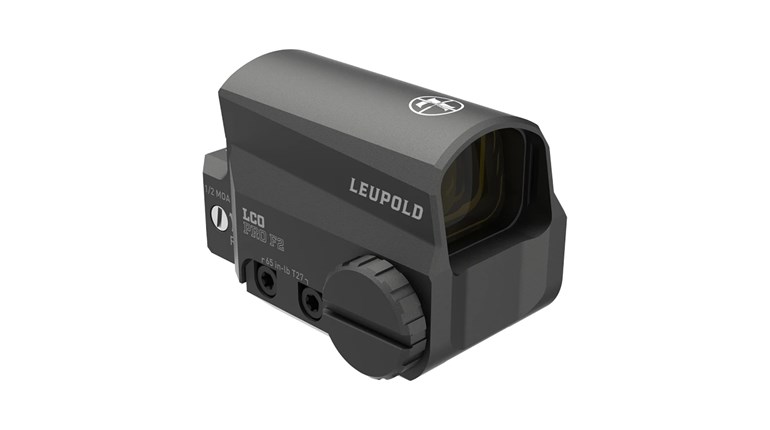
It's not uncommon to hear hunters and shooters recommend "German glass" when asked about optics, so I suppose it's no coincidence that the Oregon-based Leupold & Stevens brand has found such success. Founded by German immigrant Markus Friedrich (Fred) Leupold and his brother-in-law Adam Voelpel in 1907, the company has become one of the most respected names in the optics industry, and its history is rich with the themes of an old fashioned American success story.
In the century or so since its founding—not as an optics company, mind you, but we'll get to that in a minute—Leupold & Stevens, often referred to simply as Leupold, has provided riflescopes to hunters, shooters and the entirety of the United States military. There's no real shortage of things to say about Leupold's long history. With that in mind, I've dug up 10 (possibly) little-known facts about the Beaverton, Ore., staple. You can find them listed below.
The information was put together with a little help from the team at Leupold, among other sources. Feel free to post any little known facts that I may have missed in the comments section at the bottom of the page.
10. At its inception, Leupold didn't have a thing to do with firearms or optics. That's actually not at all uncommon in this industry, but it's worth noting. Instead, Fred Leupold and his brother-in-law Adam Voelpel specialized in the repair of survey equipment, and established Leupold & Voelpel in 1907. In 1911, Leupold & Voelpel was contracted by J.C. Stevens to manufacture a water level recorder. He was eventually made partner in 1914, and the company was renamed Leupold, Voelpel, and Co.
9. It wasn't until 1942 that the company would change its name to Leupold & Stevens, Inc., and not until 1947 that the company would begin selling its first riflescope, the Plainsman. At the time, surveying equipment and riflescopes were sold under the Leupold name, while water monitoring instrumentation was sold under the Stevens name.
8. As you might imagine, that first riflescope has a story all its own. As the story goes, Marcus Leupold—son of Fred—missed a shot on a deer because the scope on his rifle fogged up. In his frustration, Marcus declared: "Hell! I could build a better scope than this!" And so he did.
7. The company, which largely hadn't dabbled in optics to that point, called upon the knowledge and experience it had garnered during World War II. During the conflict, Leupold had worked with the United States Army on a riflescope and the Navy on optics for use aboard ships. While working on those projects, company engineers had cracked the code to waterproofing optics. The secret to producing that very first fogproof scope? Evacuating the air out of the scope’s interior and filling it with pure nitrogen, which doesn’t react to sudden changes in temperature.
6. Leupold manufactures 440 different mount bases, representing upwards of 380 firearms. The company has more than 40,000 base and ring combinations. Odds are, if you’ve got a firearm, Leupold can put a scope on it.
5. Leupold’s products are guaranteed for life. The company’s a full-fledged, American-based manufacturer—not an importer. It controls the entire manufacturing process from start to finish, and happily guarantees its scopes for the lifetime of the product, to any owner. Leupold is largely believed to be the first optic company to offer such a guarantee.
4. There are more Leupold long-range optics in service with the United States military than any other brand. The U.S. Army, U.S. Navy, Navy SEALS, Marine Corps and Secret Service are among the company’s customers.
3. If you’ve used a scope, you’ve seen a Duplex reticle. It’s ubiquitous with riflescopes. Well, in 1962, Leupold invented it. The company wanted a reticle that would be visible even in thick cover and twilight, and in creating one, revolutionized the industry.
2. Changing the game became something of a Leupold tradition. In 1974, the company introduced the industry’s first lightweight, high-power target scope. In 1978, it rolled out the first line of compact riflescopes. Decades later, it's a trend that hasn't ceased.
1. It’s not necessarily a secret that spider webs have been used to create fine reticles for optics. There’s a little more to it, though. Leupold originally called upon the webs of black widows to create reticles. There was a spider expert on staff, who had the unenviable job of tending to the arachnids and harvesting the web. I hope he got hazard pay.
Looking for past installments of our "10 Things You Didn't Know" series? Hit the links below!
• 10 Things You Didn't Know About Benelli
• 10 Things You Didn't Know About Beretta
• 10 Things You Didn't Know About Remington
• 10 Things You Didn't Know About Ruger
• 10 Things You Didn't Know About Smith & Wesson
• 10 Things You Didn't Know About Weatherby
• 10 Things You Didn't Know About Federal Premium
• 10 Things You Didn't Know About Taurus USA