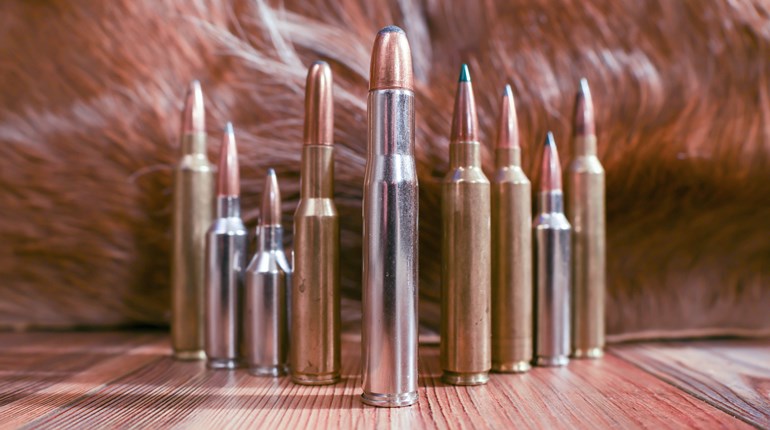
The .404 Jeffery probably ranks at the top of the list when it comes to a cartridge designed for truly big game, as it feeds like a dream, has enough power for anything that walks and is relatively easy on the shoulder. Released around 1905 (sources vary), the big slope-shouldered case stood in the shadows of the more popular, or perhaps I should say the more celebrated, .375 H&H Magnum and .416 Rigby. You see, the .404 Jeffery quietly handled the game control work, as it was both economical and easy to shoot, while the others stood in the limelight.
The .375 H&H case was responsible for almost all of the magnum cartridges of the 20th century, being shortened, blown out, necked down, necked up and twisted into a whole lot of different configurations. Simply put, no self-respecting magnum cartridge of the 1900s would be caught dead without that belt of brass, in spite of the fact that only a handful of them actually use it.
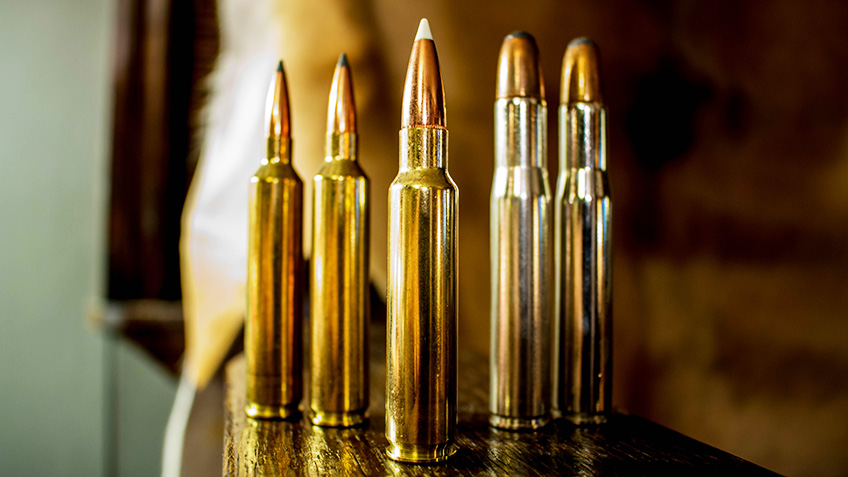
But it was at the end of the 1990s that we saw the release of the .300 Remington Ultra Magnum, based on a blown-out and necked-down .404 Jeffery case (with the rim turned down a bit), producing some serious velocity. With a case measuring 2.850 inches, the .300 RUM requires a magnum action. Shortly after, the .300 Winchester Short Magnum came on the scene, again based on the .404 case, but this time fashioned to fit in a short-action receiver, and mimicking the .300 Winchester Magnum’s performance. Both of these were necked up and down, and for a bit, were the newest, coolest thing. The velocity—and correlative recoil—of the Ultra Magnum family proved to be a bit too much for barrels and shooters alike, and while the .300 WSM seems to be hanging on, the short, stubby cartridge and its family have their fair share of feeding issues.
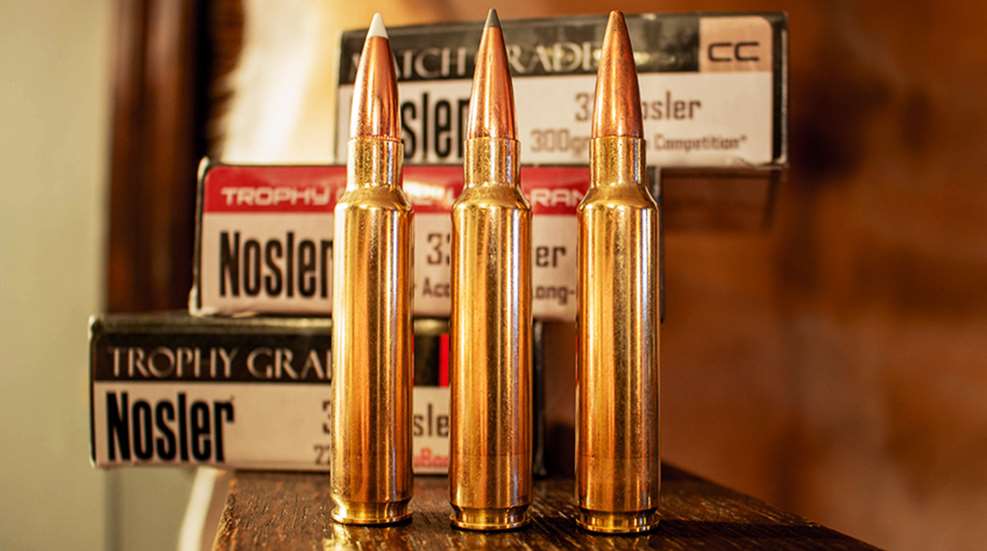
Flash forward to 2014, and you’d see the first of the Nosler family of cartridges released at the SHOT Show: the .26 Nosler. The folks that brought us the Nosler Partition and AccuBond developed a flat-shooting cartridge with magnum performance, based on the .404 Jeffery, with a case length of 2.590 inches, perfectly suited to a long (.30-06-length) action. In the subsequent years, Nosler would release the 28 Nosler (7mm bore diameter), and the 30 Nosler; these two are popular as all-around hunting choices. In 2017, Nosler announced the largest of the family: the 33 Nosler. Maintaining the same 35-degree shoulder and 3.340-inch overall length as its siblings, the 33 Nosler is a serious piece of kit, fully capable of taking all North American game and all but the biggest African game.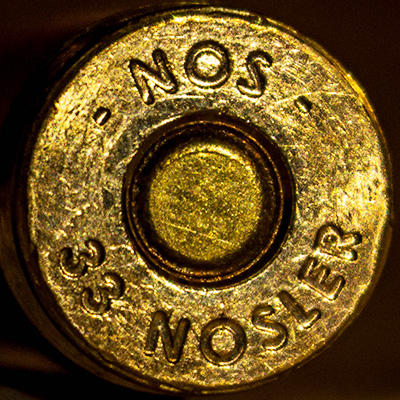
The 33 Nosler sits just ahead of the .338 Winchester Magnum—a fine cartridge in itself—and just behind the big .338 RUM, .338-378 Weatherby Magnum and the .338 Lapua, though there are claims that they are on par. Comparing the .338 Winchester to the 33 Nosler, you’ll see the .338 driving a 225-grain bullet at a muzzle velocity between 2750 fps, whereas the Nosler case will push the same bullet to 3025 fps, a significant increase for certain. With the 225-grain AccuBond the 33 Nosler will deliver the same trajectory as the .300 Winchester Magnum with a 180-grain bullet. Nosler’s case will maintain that 250-275 fps gain over the Winchester case, in spite of sharing the same length. Nosler’s factory ammunition is offered with the 225-grain AccuBond, the 265-grain AccuBond Long Range and their 300-grain Custom Competition. The 265 ABLR leaves the muzzle at 2775 fps and the big 300 is travelling at 2550 fps. Comparing this to Nosler’s load for the larger-cased .338 Lapua, you’ll see the latter showing an advantage of 100 fps, which makes perfect sense considering the difference in case capacity. Does this mean the 33 Nosler is inferior? Not at all, and especially not from a hunter’s point of view.
Over the last 60 years, we’ve proved the effectiveness of the .338 Winchester; it’s more than suitable for big game of all varieties, and has been used for buffalo, hippo and even elephant in Africa. Logic dictates that the 33 Nosler—especially with premium bullets—will be equally, if not more effective, as the striking energy will be greater and the trajectory a bit flatter. The 33 Nosler doesn’t require the heavier, more expensive magnum-length action, and the beltless design should demonstrate longer case life. On the flip side of that coin, the velocities generated by the 33 Nosler can be, well, hellacious. I consider the .338 Winchester Magnum to be one of the snottier cartridges to shoot from the bench, and the 33 Nosler is faster and snottier, unless you mitigate the recoil with a muzzle brake. I tested a Nosler M48 Mountain Carbon—a light, carbon-fiber-barreled gun perfect for the backcountry—and at just over 6 pounds, the recoil was severe before I installed the muzzle brake.
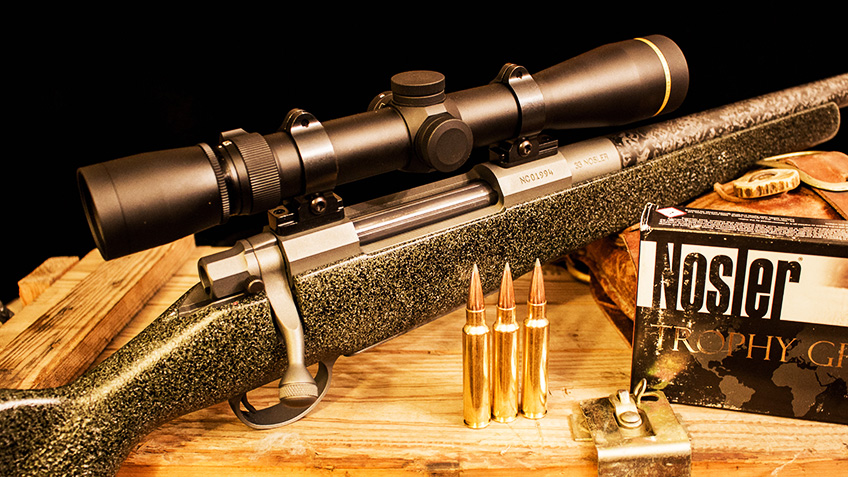
I can happily tell you that the 33 Nosler is an accurate cartridge, with all three loads giving sub-MOA groups from the Nosler rifle. I think the .33 Nosler is the least overbore of the family, and that for the hunter who plans on having a cartridge bigger than the 7mms or .30s, for use on the biggest North American game, it makes a sound choice. As of this writing, Nosler is the only supplier of factory loaded ammunition—though I’m sure you could get some of the boutique companies to load it for you—but that’s not a bad thing, as the two hunting loads will cover quite a bit of ground.
Do I see the 33 Nosler replacing the .338 Winchester Magnum? Probably not, but there is room for both. I’m seeing a definite shift in cartridge design, moving away from belted cartridges, and perhaps that’s not all bad. I feel pretty comfortable saying that among the fast .33s, those faster than the benchmark .338 Winchester, I like the 33 Nosler better than the RUM or the Weatherbys. If you like to hunt North America’s biggest game—including bison—take a long look at the 33 Nosler; it puts an exclamation point on the end of the sentence.
Looking for previous installments of our "Behind the Bullet" series? We've got you covered.
• .260 Remington
• .30-30 Winchester
• .416 Rigby
• .358 Norma Magnum
• .22 LR
• 7mm-08 Remington
• 8mm Remington Magnum
• .338 Federal
• .224 Valkyrie
• .338-06 A-Square
• 9.3x62mm Mauser
• .257 Weatherby Magnum
• .45-70 Government
• .300 H&H Magnum
• .25-06 Remington
• .30-06 Springfield
• 6.5 Creedmoor
• .300 Remington Ultra Magnum
• 7mm Remington Magnum
• .470 Nitro Express
• .280 Remington
• .300 Winchester Magnum
• .270 Winchester
• .222 Remington
• .45 ACP
• .404 Jeffery
• .44 Remington Magnum
• .41 Remington Magnum
• .243 Winchester
• .338 Winchester Magnum
• .357 S&W Magnum
• 6.5-284 Norma
• 8x57 Mauser
• .38 Smith & Wesson Special
• 7x57mm Mauser
• 9 mm Luger
• .35 Whelen
• .454 Casull
• .375 H&H Magnum
• .45 Colt
• .22-250 Remington
• 10mm Auto
• .308 Winchester