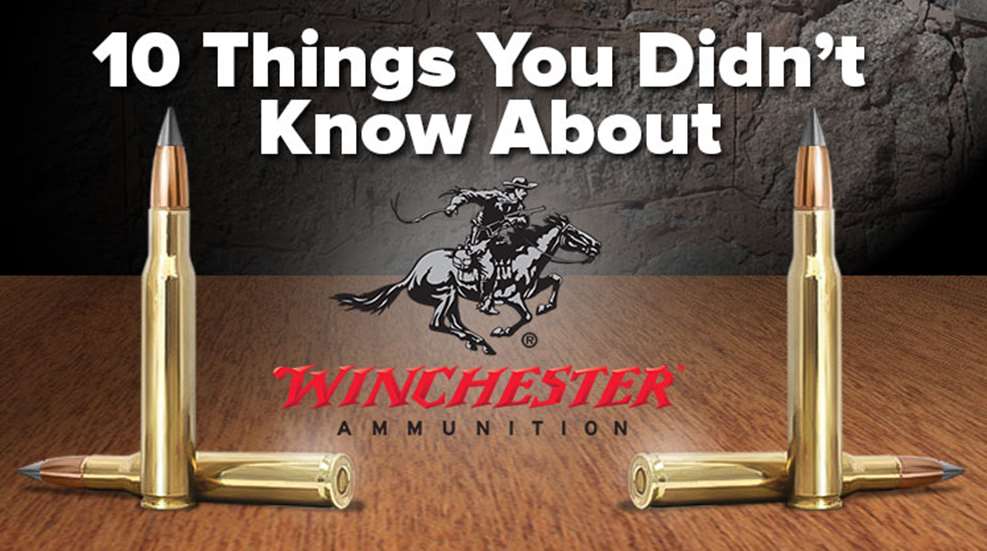
Earlier this year, at SHOT Show, the Winchester brand as a whole announced that it would be using 2016 to celebrate 150 years of success. And, indeed, a century and a half has come and gone since Oliver F. Winchester introduced his now legendary brand to the world in 1866. And though the company has changed hands and reinvented itself a handful of times in that span, it remains one of the single most iconic names in the firearms industry. To celebrate Winchester's anniversary, I've assembled 10 facts about the company's long history that may surprise you.
A few quick notes before we begin. First: As you'd imagine, 150 years is an awful lot of history to wade through. So if I miss something particularly intriguing, I apologize. Please do share it with us in the comments. Second: Given the breadth of Winchester's timeline, we're splitting this into two parts. First up is a list that will deal strictly with Winchester Ammunition. A second "10 Things" piece, focusing on Winchester Repeating Arms, will appear later this year.
And now, on with the show.
10. OK, I know I'm starting with an easy one, but any list regarding the history of Winchester's ammunition manufacturing would be remiss without it. In 1873, Winchester Repeating Arms released its first self-manufactured metallic centerfire cartridge, at the time known as the .44 Winchester. It was designed to go hand-in-hand with the famous Model 1873 (aka the “Gun that Won the West”).
9. As you're probably aware, the .44 Winchester is now more commonly known as the .44-40. But that designation didn't come from the folks at Winchester. A rival company began producing its own slightly modified version of the .44 Win. and wanted to differentiate their product from Winchester. So they tweaked the name. The name "44-40" actually wound up resonating a bit more with consumers, and decades later, Winchester adopted the designation.
8. Sometime later on, in 1893, Winchester began loading sporting cartridges with what, at the time, was the latest and greatest innovation in ammunition: smokeless powder. By 1895, Winchester would introduce the first commercial smokeless centerfire cartridges. Among them was the .30-30 Winchester, the future bane of countless whitetails.
7. Speaking of smokeless powder ... In 1932, Dr. Fred Olsen patented a method for making smokeless powder underwater in small spherical grains. The new Ball Powder gave Winchester an immediate competitive advantage in the market.
6. In 1918, the United States was at war. Every major manufacturer at the time participated in the war effort in some fashion, Winchester among them. One of the company’s numerous contributions was a collaboration with John M. Browning that lead to the birth of the .50-caliber machine gun cartridge. Before all was said and done, Winchester supplied the military with over 870 million various rounds during World War I.
5. It was in 1931 that Franklin Olin's Western Cartridge Company, which had made a mint producing brass for the military during World War I, purchased the then struggling Winchester Company. By the 40s, both companies were under the umbrella of the Olin Corporation, where they remain today.
4. Shooters have been pouring AA shotshells through their favorite scatterguns since 1965—just last year, in fact, Winchester celebrated the 50th anniversary of the AA’s introduction. What some folks may not know, though, is that a lot of those shotshells came from “Down Under.” In 1967, Winchester opened its Geelong, Australia manufacturing facility, where it would produce many of its famous AA compression form shotshells.
3. Though most folks tend to use their primers strictly for reloading purposes, the little buggers have found other uses over the years. In 1981, NASA selected the Winchester 209 shotshell primers to initiate the separation and parachute recovery systems on the solid rocket booster engines of our nation’s space shuttles.
2. In December, 1980, the Olin Corporation's board of directors authorized the restructuring of the Winchester Group. It's here that the conjoined history of Winchester Repeating Arms and Winchester Ammo begins to split. We'll deal with that a little bit more in the Repeating Arms installment.
1. Ever wondered where the famous horse and rider logo came from? Artist Phillip R. Goodwin created an illustration that would soon become synonymous with the company in 1919. In 1965, Winchester officially trademarked the logo. Goodwin also illustrated Jack London’s The Call of the Wild and provided cover art for a number of outdoor magazines over the course of his career.
Looking for past installments of our "10 Things You Didn't Know" series? Hit the links below!
• 10 Things You Didn't Know About Benelli
• 10 Things You Didn't Know About Beretta
• 10 Things You Didn't Know About Remington
• 10 Things You Didn't Know About Ruger
• 10 Things You Didn't Know About Smith & Wesson
• 10 Things You Didn't Know About Weatherby
• 10 Things You Didn't Know About Federal Premium
• 10 Things You Didn't Know About Taurus USA
• 10 Things You Didn't Know About Leupold