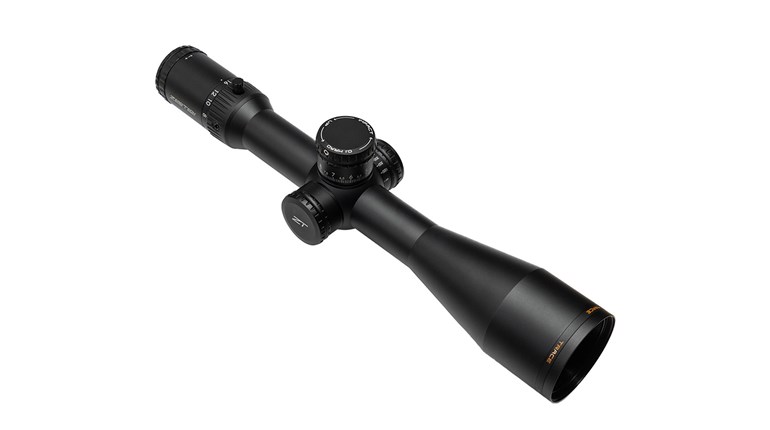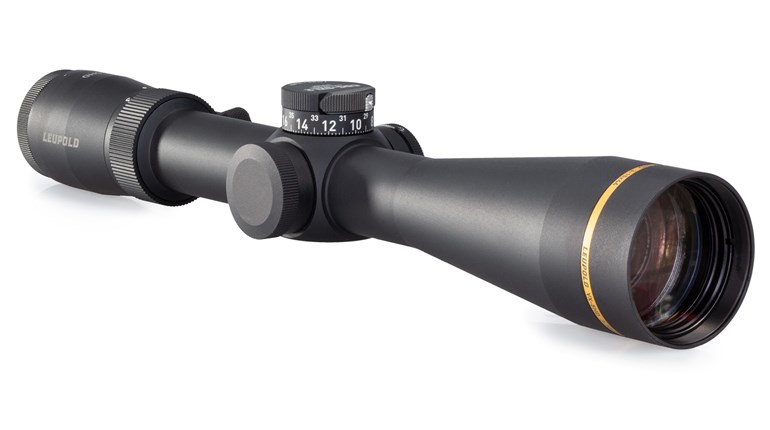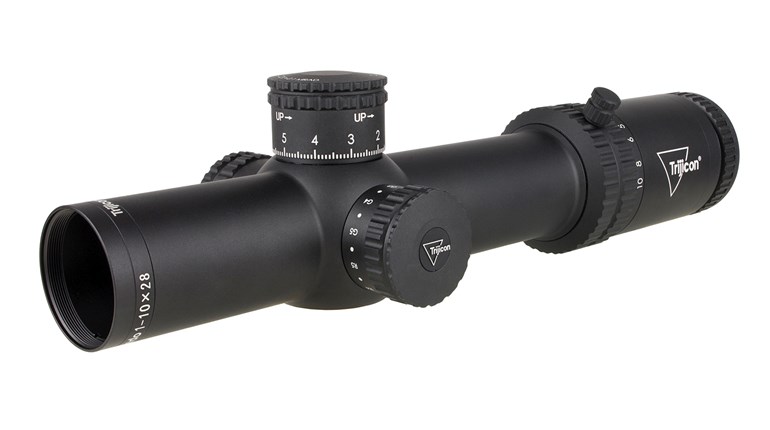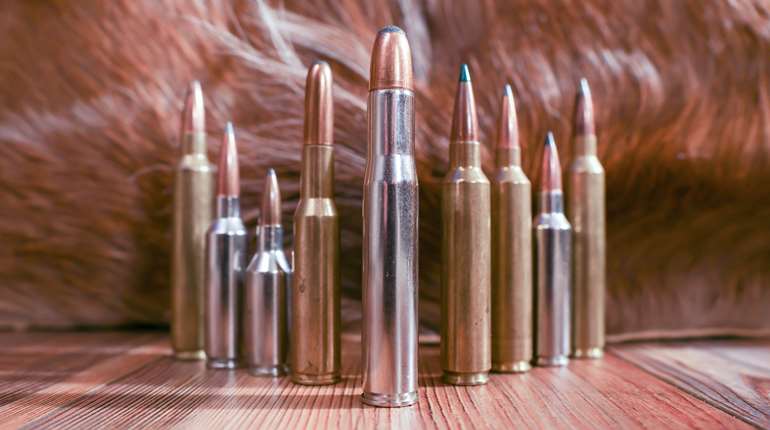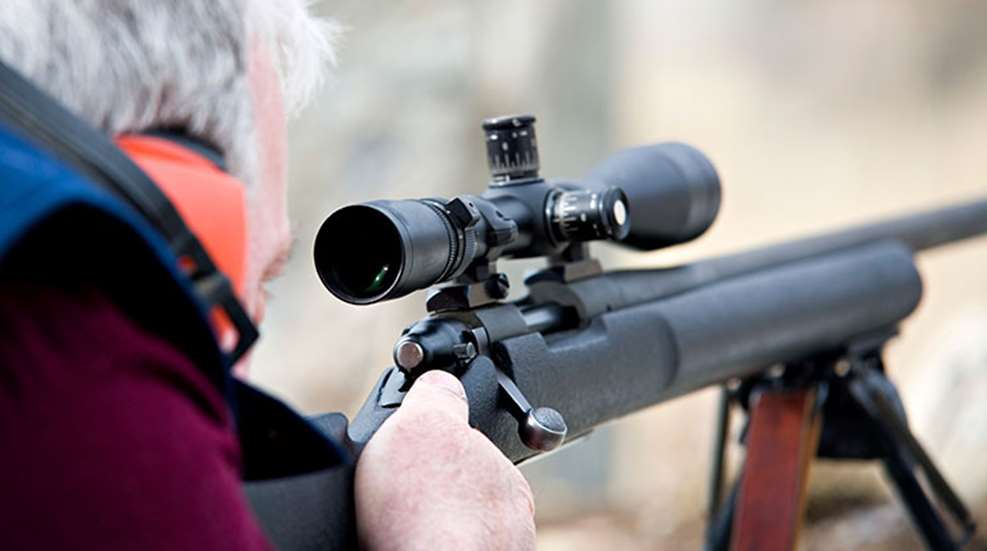
It’s extremely important to zero your scope or the sights on your rifle before going hunting. If your sights are not properly adjusted, the gun will not put the bullet where you are aiming and, trust me, that’s a bad thing.
It’s important to note that the path of the bullet is much different than your line of sight. Your eye sees in a straight line while the bullet is subject to the laws of gravity. As soon as a bullet leaves the barrel it starts dropping to the ground at a rate of acceleration of 32 feet per second—per second. That means to hit a distant object you must tilt the bore of the gun up relative to the line of sight. As a result, the bullet’s path will arch above the line of sight. At some point down range, gravity will cause it to drop back through the line of sight and from that point on, the bullet’s path will always be below the line of sight. The longer the distance, the faster the bullet is dropping and the further below the line of sight it becomes. The key is to adjust the scope (or sights) to set the distance you want the bullet to cross the line of sight, so it will “hit where you are looking.”
The most common distance to use for making the adjustments is 100 yards as most ranges are set up for this distance. However, that doesn’t mean you need to adjust so the bullet will hit exactly where the crosshairs are on the target at 100 yards. You may want to adjust the point of impact to a different location depending on your cartridge, bullet and the type of hunting you plan to do.
There are three common ways to zero hunting guns and I have found that where you hunt makes a huge difference in which option you choose.
Dead on for the Thick Stuff
I grew up hunting in the thick New England woods and I still spend a lot of time prowling the brush. In fact, in a lot of places throughout the world, the thick stuff is where the game lives. No matter if it’s whitetails in Mississippi, eland in South Africa or elk in the coastal Pacific Northwest, a lot of hunting is done in thick brush.
That often means you must shoot through a hole in the brush at part of the critter. If the bullet path is much different than the line of sight you may think you have a clear shot while the bullet can impact a branch that is above or below where you are looking.
Forget all you heard about “brush guns.” If any bullet hits brush, it will deflect. The best approach is not to hit anything except the animal you are shooting at and if you can see the animal, there is a hole in the brush big enough to get a bullet through.
Two things are important. First, have your scope set low and as close as possible to the bore of the rifle. This keeps the bullet path closer to the line of sight. Set the zero on your rifle so the point of impact is dead on at 100 yards. With this setting, the bullet path for a modern bottle-necked cartridge usually will not vary more than an inch from the line of sight from about 25 yards out to about 150 yards, give or take. As a result, the odds are much higher for threading the bullet through a hole in the brush.
For longer shots, learn the bullet’s drop and compensate as needed, although little change is necessary out to 200+ yards with most modern cartridges. For example, a Fusion 180-grain load in the .30-06 with a 100 yard zero will impact 2.56 inches low at 200 yards.
When in Doubt, Set it High
But not too high. When hunting in mixed country shots can be close or far, a popular approach is to set the zero for dead on at 200 yards. With most modern cartridges this translates to about 1.5 to two inches high at 100 yards and about six to eight inches low at 300 yards.
The truth is, most of us have no business shooting at unwounded game beyond an honest 300 yards anyway. This is probably the most useful all around sight in approach. It works best with bottle necked cartridges generating at least 2,800 feet per second and with pointed bullets with a high ballistic coefficient.
Point Blank Range
If you are hunting open country where the shots are almost always long you might consider a “point blank range” approach to your zero. This works best with rifles with a muzzle velocity over 3,000 fps and bullets with a high ballistic coefficient. Most of the better computer or on-line ballistic programs can give you information on MPBR for your load including where to set the point of impact at 100 yards.
Point blank range adjusts the sights so that the bullet will not rise above or fall below a certain distance from the line of sight. Think of it as shooting through a pipe. Suppose you had a six inch diameter pipe from the gun to the game. The line of sight is exactly down the center of the pipe and the sights are adjusted so that the bullet’s path will never rise higher than the top of the pipe or fall below the bottom edge of the pipe until it reaches the maximum point blank range.
The theory behind this is that you can hold dead center on the animal and expect to hit the kill zone out to the maximum point blank range. For example, with a six inch zone and shooting Hornady’s 165-grain Interbond Superformance load for the .300 Winchester, set the point of impact at 100 yard for 2.42-inches high. At 150 yards it is 3-inches high. The MPBR, where the bullet’s path is three inches below the line of sight, is 318.5 yards.