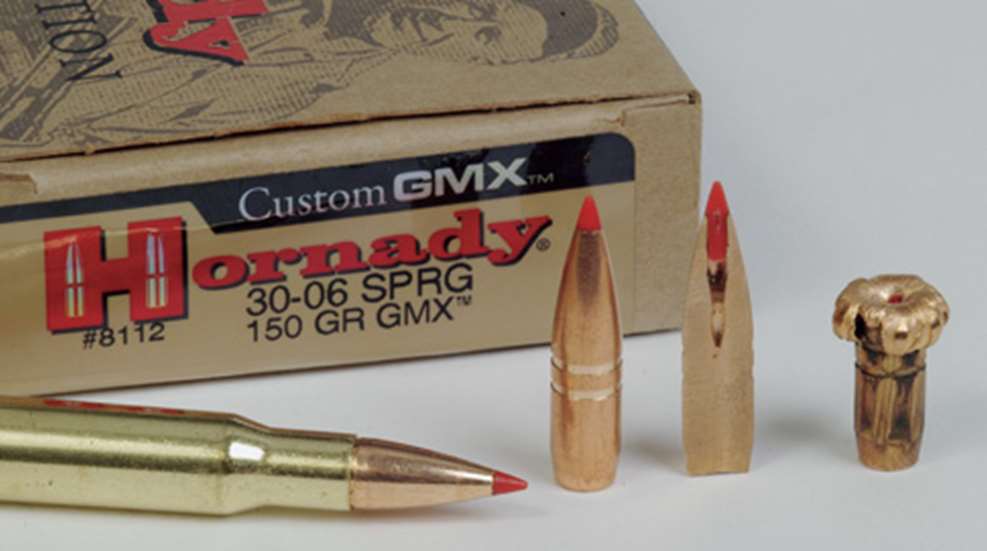
The boattail-style bullet has a polymer tip. There are two rings cut into the forward portion of the bearing surface of the shank. These allow the displaced metal to flow when engaging the rifling, which can improve accuracy and reduce metal fouling. The front ring also serves as a crimping groove, or cannelure.
The GMX is a sleek bullet with a high BC. It has proved to be accurate in the two rifles in which I tested it. This bullet is designed to expand into a round mushroom similar to conventional lead-core bullets, which increases the frontal area over some other expanding solid bullets.
A well designed monolithic bullet like the GMX or X-Bullet will expand very quickly, usually in the first inch or two, but once the expansion reaches the solid shank below the hollow cavity in the nose, it is stopped. They also exhibit very high weight retention, which aids in penetration. The metal used is much tougher and far less malleable than lead so the bullet tends to retain its expanded form better and resists further change. In comparison, traditional lead-core bullets will often continue to change shape as they penetrate, which robs energy used for moving the metal that otherwise would be used for penetration. Also, the changing shape can adversely affect the bullet path, penetration and wound channel.
Hornady claims 1.5-times expansion and 95 percent weight retention, with up to 30 inches of penetration in ballistic gelatin. To test that, I fired two .30-06 150-grain GMXs point-blank into Perma-gel. This is equivalent to impact at 100 yards with a .300 Win. Mag. The average penetration was 34.25 inches. The average retained weight was 149.35 grains, which when you account for the missing plastic tip is just about 100 percent. The average expanded diameter was .501 inch.
In 2008, I used a 150-grain GMX in a .30-06 to take a nice Nebraska whitetail buck. The bullet started by smashing the near shoulder, passed through on an angle and exited behind the ribs on the far side. I expect an exit hole from any good big-game bullet the majority of the time, because I think leaving the bullet in the game and dumping all the energy is nonsense. Energy doesn’t kill big game, broken body parts do. Big holes all the way through are one of the trademarks of a good bullet.
Expansion clearly started early on this buck and the wound channel grew large, creating massive damage to the lungs, which indicates a large frontal area with good energy transfer. One whitetail is not a conclusive test of any bullet, but it does give some indication of what to expect from a bullet.
Hornady offers both component bullets for reloading and a complete line of factory ammo, including the new higher-velocity Superformance ammo.
So, after many subsequent hunts for species ranging from hardy Barbary sheep to bears and elk, I began believing that a super-tough, ultra-premium, controlled-expansion bullet can make a hot round like a .300 Weatherby or 7mm STW a world-beater, and an average-velocity caliber like a .308 an over-achiever. In fact, I believe Weatherby cartridges got a bad rap early on because the velocity advancements out-paced the bullets that were available for it. A .257 Wby. with a “regular old softpoint” was fine for deer at 200 yards (nearly anything is fine for a 150-pound deer) but when Mr. Wealthy Hunter with a fancy Mark V pointed the same load at an elk’s shoulder at 50 yards, the results likely ended with soft lead fragments where a pile of elk should have been, and copious profanity.
Lucky for us, capitalism has produced many great, super-tough bullets, but from what I’ve seen, monolithic bullets—just another name for no core to lose—out-penetrate all other expanding bullet types. Of course, that means they generally do not expand as much as some softer lead-core bullets, but, then again, their expansion is very predictable. And for tough game, I’ll err to the side of penetration every time, so long as it is accurate in my rifle. The all-copper Barnes TSX made huge improvements in accuracy over the original Barnes X. And while I like other bullets like the Nosler Partition, Swift A-Frame, Trophy Bonded Bear Claw, the defunct Winchester Failsafe and its replacement the XP3, I’m a Barnes lover. Last year Hornday’s new GMX was released and it performs much like the TSX. As a consumer/hunter that’s a good thing; it gives me another option if a finicky rifle doesn’t like the TSX. While I don’t consider any animal to be a test medium, they certainly deserve our best. But there’s only one true way to test a hypothesis and a new bullet.
The hypothesis? The .30-06 is enough gun for African plains game, on one condition: that a super-tough bullet be used in conjunction. If you do your part, new bullet technology can make your non-magnum rifle an over-achiever.
I believed this to be true as my rifle’s report spurred its bullet across the parched Namibian valley. A second later, I heard the distinct slap of bullet meeting hide. The gemsbok bull lept a few yards and expired near the edge of the burnt-red sand. The post-mortem revealed that the bullet entered on the point of the left shoulder, wrecked the aorta, then made a Butch Cassidy-style exit high on the other. At 410 yards, that, to me, is a convincing bullet argument for a non-magnum cartridge. Finally, I had it all figured out.
■ ■ ■
It was months later when a bullet engineer from Hornady and I were talking about the safari and how the GMX bullet had performed on game. I said, “See, the .30-06 can be the ticket for gemsbok!”
And he said, “Yea, but I forgot to tell you: Now we have our new SuperFormance .30-06 loads.” he said, “They perform more like a .300.”
I scratched my head, rubbed my face and realized that I might as well stick with what works for me. That way I can concentrate on the truly confusing things on my next hunt, like using enough sunblock. After all, there’s a slew of choices out there, and all of them smell a little different. Surely someone has written a book on it.