My first introduction to "digiscoping" occurred well before I'd heard the term. A buddy showed me a snapshot of a buck he took by pressing his film camera up against the lens of his window-mounted spotting scope. Albeit slightly fuzzy and ringed with a harsh vignette, the image showed a trophy-caliber whitetail unaware of the photographer. It was a precursor to today's digiscoping, a term very recently coined. In essence it means coupling a digital camera with a high-magnification spotting scope to capture images at long range. The advantage is that a user can take photos at long distances without buying an ultra-high-priced telephoto camera lens.
Nikon, a leader in sporting optics and the photography world, also is leading the digiscoping movement. To go with any of its six "Fieldscope" spotting scopes, the company offers three eyepieces, six adapter brackets and more than a dozen camera models for digiscoping compatibility. Until recently, Nikon sold kits that included a Nikon Fieldscope, a CoolPix digital camera, eyepiece, adapter bracket (to precisely fit the camera to the scope) and a cable shutter release (to minimize hand shake). But because many people already have the most expensive component of the setup, the spotting scope, Nikon decided to sell the kits without the scope. (Some kits that include the Fieldscope are still available in stores.) If you already have a Nikon spotting scope, the company offers a digiscoping kit that will fit it. If you don't have a scope, pick one that fits your needs and then match it to a DigiScope kit. (Go to the Nikon website to find precisely what you need.)
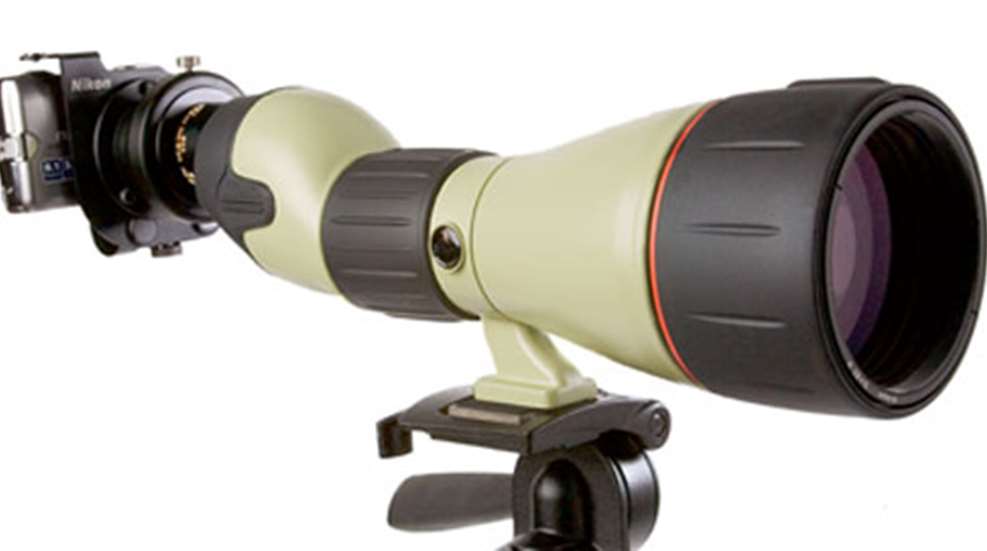
The spotting scope I used in my digiscoping trial was Nikon's 82mm ED STR Fieldscope. Optical glass is sharpest at its center, so a large objective provides a greater center surface and thus greater resolution; the 82mm Fieldscope is large, by any definition, and thus offers superior resolution. Nikon's extra-low-dispersion (ED) glass works by focusing all variations and lengths of light waves on the same optical plane. This also enhances resolution, color and contrast, all of which lead to a great image through the scope or in the form of a digital image. The STR stands for "straight eyepiece," but angled eyepieces are also available.
The Nikon Coolpix P4 digital camera is the second major component of the DigiScope system. The handy 8.1 megapixel P4 is roughly the same size as a credit card, but approximately 1 ½ inches thick. It's petite, but it's tough, with a solid metal body that can take abuse in the field. The camera has a 3.5X optical zoom, 4X digital zoom and built-in flash. Although is has a small internal memory, I suggest purchasing at least a 256 megabyte memory card to ensure you'll have plenty of image storage between downloads. You won't misjudge an exposure with 16 preset shooting modes, including landscape, snow conditions, dusk/dawn and others.
The FSB bracket is a mount that positions the camera securely to the Fieldscope, aligning the camera precisely with the scope's exit pupil so it can capture the image after it is magnified by the spotting scope. When you see the desired image in the camera's 2.5-inch LCD screen, you depress the shutter by employing a shutter-release cable that comes with the bracket. (Because the image is magnified so much the cable release is necessary to prevent camera shake imparted by your hands.) Setup was easy; it took only seconds to mate the bracket to the eyepiece and the camera. Be sure to adjust all tension screws tightly. The entire unit must be stabilized via a tripod, again, to avoid camera shake.
Since I am a professional photographer by trade, I was a little skeptical of the claims at first. Sure the extended magnification of a spotting scope would easily increase my focal length (magnification) by four times or more over my telephoto camera lens, but I theorized that the image quality would suffer. What I found surprised me. No, the quality of the images aren't quite as good as those taken with telephoto lenses on cameras (see the photo comparison), but with digiscoping equipment you save weight compared to using a telephoto lens of equal or less magnification. You also save money. A comparable telephoto camera lens, like a 600mm f/4 (that is, a lens with a 600mm focal length and maximum aperture of f/4), can run $7,000. Yet the Nikon DigiScope package above can be assembled for about $1,750 (including the spotting scope). My setup included the 82mm ED STR Fieldscope, the P1 camera (camera technology changes about every six months; now the kit includes the P4 camera), the FSB-3 bracket, 30x eyepiece and a cushioned view-through case for the scope. Unlike the telephoto equipment, with the digiscoping setup you can separate the spotting scope for hunting chores and the camera for birthdays or successful hunts.
Type: 82mm spotting scope
Magnification: 30X eyepiece
(others available)
Objective Lens Diameter: 82mm
Focusing Range: 16.4' to infinity
Eye Relief: 15.2mm
Exit Pupil: 3.3mm
Field of View @ 1,000 yards: 125'
Coatings: fully multi-coated ED glass
Dimensions: length-12.9"; width-4.25"; weight-56.4 ozs.
Construction: all-metal body
Accessories: cushioned case
MSRP: $999.99