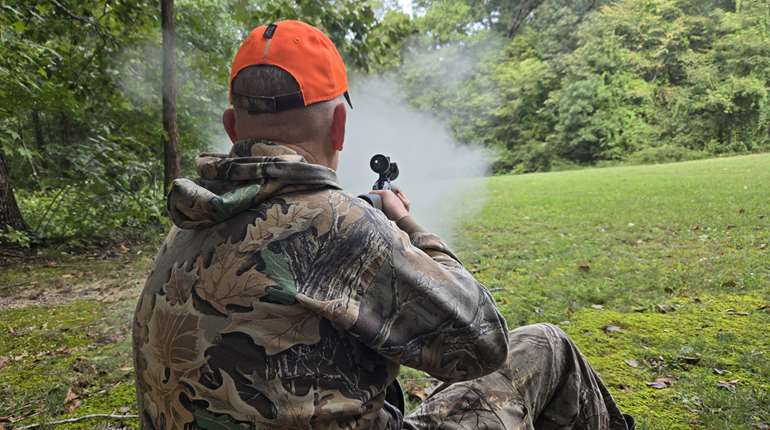
It just wasn’t our day. We had started high in the mountains hunting for snowshoe hares, but the lack of snow and the icy conditions made it hard for the dog. So we drove into the lower farm country to hunt cottontails. On the farm we tried, cottontail populations were low and hunting was slow. No doubt the increasing abundance of predators was a factor, but the biggest issue was simply that the habitat was changing and the rabbits didn’t have a lot of good places to live.
Then Steve Shaw suggested a spot he knew a few miles away, and after lunch we wound up on a big electrical power transmission line. I had my doubts, but it was full of rabbits and it was one of the most productive days of hunting we had that season.
When it comes to hunting, like most people, I rarely think about power lines. I know a few places where I sit and watch for deer crossing, mostly because I can see a long way, but that’s about the extent of my involvement. So, when I realized that the reason we had rabbits was because of the habitat created by this open corridor as it passed through a mature forest, I got interested and started asking questions.
When he is not rabbit hunting, Steve is a forester for the Vermont Electric Power Company (VELCO), the same company that owns the transmission lines where we were hunting. He was the perfect guy to explain what was happening.
“Just like a lot of other places in the country,” he said, “Vermont has changed. We are losing farm land to development, and social pressures have brought changes to forest-management practices so that there is much less clear-cutting. The result is that we now have a preponderance of mature forest, which is not particularly productive for wildlife habitat. Most forest-dwelling wildlife such as whitetail deer, cottontail rabbits, grouse, turkeys and a multitude of other species depend on edge areas and regenerating forest for good habitat. This habitat is important, not just for game species, but also for a lot of non-game species including a wide range of songbirds, both migratory and native; also, species we often don’t think much about such as mice, moles and voles. But they are all important to a healthy forest and a healthy and diverse wildlife population.”
Steve continued, “With the continuing loss of farmland and the maturing forest, these power line corridors are becoming a major factor in providing that habitat. While they are not all that wide, the power line corridors are very long, often running for hundreds of miles, so they create a lot of edge habitat. Because they cross a lot of different terrain and habitats, they can encompass a huge diversity of plant and wildlife species.”
VELCO has received an award from the National Wild Turkey Federation for its work with wildlife habitat, and it just received a Right-of-Way Stewardship Council accreditation for excellence and environmental stewardship in responsible vegetation management within high-voltage electric transmission corridors. In looking further into this, I found that VELCO is not alone. Most power companies in the country have similar land-management programs. VELCO spends millions of dollars on wildlife habitat, and has worked to identify and protect several species of endangered vegetation: species that might not have a chance without the unique habitat created by the power lines. They employ experts in the field like Steve to ensure things are done correctly where it concerns land owners and wildlife. They often partner with organizations like the Audubon Society to identify and address regional and national wildlife and habitat issues.
The key is a selective vegetation program. Clearly, VELCO cannot allow big trees to grow under the power lines as they will interfere with the lines. However, if they just cut trees the habitat ends up a monoculture, which is not good for wildlife. What happens is that stump sprouts grow very fast and very thick. They have to mow them off on a four-year cycle. This gets worse and worse every cycle. So, rather than brush hogs or chainsaws, VELCO makes use of the newest, modern, low-toxicity, fast biodegrading herbicides. They use a careful, selective, low-key application from a backpack on specific plant species. This approach is much more environmentally friendly than the old “chainsaw it all down” approach. As Steve said, “We try to be good ecologists. After all, we live here, too.”
Steve told me they encourage low-growing species of vegetation so the land ends up with a sustainable habitat compatible with the power lines. Rather than hacking and slashing, they work to develop this sustainable habitat of low-growing vegetation, which is far better for wildlife. With every vegetation-management cycle, the impact of what has to be done is reduced as the desired habitat emerges.
This also helps reduce invasive species like multiflora rose, buckthorn and other introduced species that are not only poor wildlife habitat, but are not indigenous to the area.
One benefit of this selective vegetation approach is that as much as 90 percent of the endangered species identified lie in areas employing selective vegetation management programs. If they were just cutting to clear the lines, as was the practice for years, this would not happen; everything would be mowed down, including these fragile species. Now, companies like VELCO can protect the species that need a little help to survive.
It clearly is working, as we saw with the cottontails. Also, Audubon has done studies that found endangered or threatened shrub land birds like the golden-wing warbler, the eastern towee, the field sparrow and the prairie warbler are using the habitat created with selective vegetation programs. A simple statement from Mark LaBarr, conservation program manager for Audubon Vermont, sums it up. “The partnership with VELCO has been great.”
VELCO patrols the power lines by helicopter, and I was invited for a ride-along. The vast amount of open and edge habitat was very apparent as we patrolled a small section of the many hundreds of miles of power line right of way the company controls. Of course, we were too high to see little critters like rabbits or songbirds, but we did see several deer and a moose. VELCO supervisor of right of way management Jeff Disorda, who was my host that day, pointed out two different spots where he had seen bears just a few days prior.
Electricity is critical to our lives, and it has to travel across wires to get from the generation point to our homes. Those corridors used to move that electricity must be open to protect the wires, and for wildlife it turns out that’s a good thing.
VELCO and hundreds of other power companies all over this country are good neighbors and good stewards of the land and are concerned about the ecological impact of these power line corridors. They have found a way to turn a negative into a positive, and in this ever-changing society that is America, they just may turn out to be one of wildlife’s best friends. ah