While Global Positioning System (GPS) units are now used almost daily in our lives, there was a time when maps and compasses were the only tools for finding your way, whether driving across the country or heading into the backwoods.
Like many hunters who have been hitting the woods since childhood, I didn’t feel the need for a GPS unit when they first came out. I knew how to find my way in and out of the woods without that fancy contraption that just added weight. I already carried a compass, and I knew how to improvise a sundial using a watch or even a stick and a couple of stones. I might get slightly turned around, but I would never get lost, even in places where I hadn’t been before. There were times, though, that I would miss my stand by a few yards in the dark and have to wait until it was light enough to see before climbing up to hunt. It was these experiences, along with recommendations by friends that made me change my mind and get a GPS unit. And while I still find a GPS unit to be beneficial for finding stands in the dark, it’s in mobile hunting, such as Run ‘N’ Gun turkey hunting, where these little electronic boxes really show their worth. For this reason, I carried the Magellan eXplorist 110 throughout the Virginia spring gobbler season.
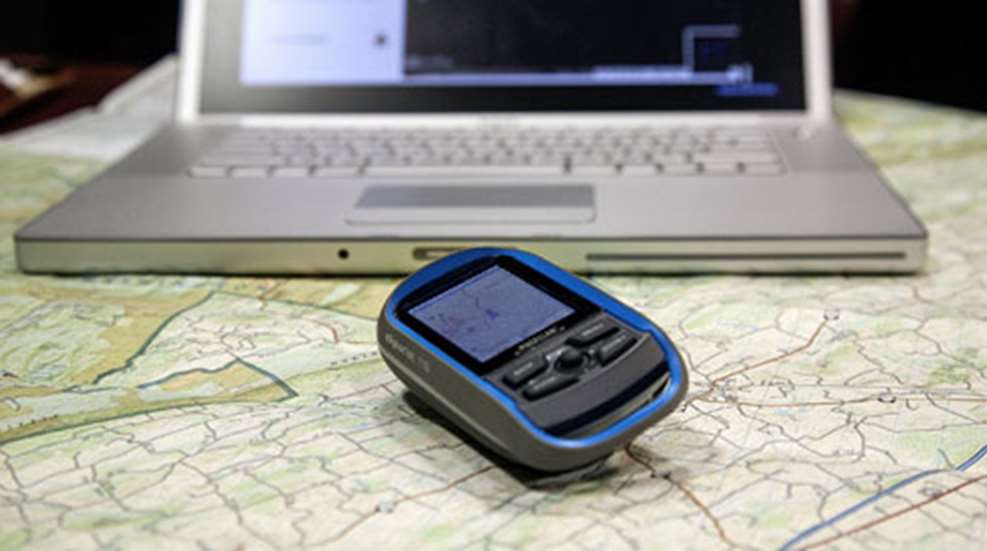
At $129, the eXplorist 110 is Magellan’s latest entry-level GPS unit. It’s a big improvement over earlier models—one of which I happen to own—with a color screen, a world map and extended battery life.
The eXplorist 110 can be used to find your location, save waypoints for later return, track your progress on an excursion and take you straight to coordinates while providing distance and direction. It runs on multiple satellite systems (WAAS/EGNOS/MSAS), which provides accuracy to 3 to 5 meters, has a digital compass, holds 500 waypoints and 25 routes, can calculate area and has 2 GB of memory for future updates. It also has a multitude of icons for quick waypoint identification, is water proof (IPX-7) and weighs less than 6 ounces. In this, the 110 is not much different than most other GPS units. However, this little entry model contains some features that weren’t available on earlier models and are usually reserved for more expensive models.
According to Sam Muscariello, director of product marketing, similarly priced units don’t usually come with a color screen, easy-to-use imagery and the ability to adjust the power function to suit the users’ needs. He also said that the eXplorist 110 is smaller, more ergonomic and easier to use than comparable units.
“We looked at the economic conditions and decided to put out a device that is affordable for everybody with the features they want,” Muscariello said.
Overall, the eXplorist 110 works like most units. When it is on you can mark locations and it leaves “bread crumbs” constantly, so you can backtrack your route if needed. However, the power settings on the 110 can be adjusted to basically turn the unit off (Active Suspend Timer), except for the tracking, to save battery life. The benefit of this is that users can power down the unit when sitting or not in use, but the unit will still leave bread crumbs. So, if you shoot a big deer and forget to turn the unit on in the excitement, you won’t become lost while tracking your trophy.
In the Woods
I took off on my first excursion into the woods with the eXplorist 110 without having spent much time learning the system, and none reading the manual. Of course, since ease of use is an important feature, this was how I planned it.
I knew where I wanted to start, so after giving it time to lock onto the satellites to mark my truck, I headed straight there and marked the location by pressing just a couple of buttons on the unit. From there, I went hunting, steadily marking trails, openings, potential roost trees and other likely locations. In between uses, the unit sat in the pocket of my bug suit under my vest. Even with the receiver covered by cloth, trees and clouds, the 110 never lost signal, constantly tracking my location and distance traveled.
During some downtime (nothing gobbling), I sat down to start learning the 110; ease of use, where everything was stored and what icons were available for waypoints. A feature I found while sitting in the woods was the hunt/fish calendar, which lists excellent and good times for hunting and fishing, and rise and set time for both the sun and moon. Having a geocentric clock for your location really helps in knowing legal shooting hours, and would have been useful as a child in order to keep my parents’ rule of being back in the house by sunset.
As far as ease of use, the 110 is a winner. I hunted with it multiple days without a problem before finally going back to the manual to learn the intricacies of this particular unit. It only has five, low-profile control buttons, which were fairly easy to use, except that the joystick required close attention when adding names to waypoints to prevent entering the wrong letter (though the unit helps the user by listing the previous entry with an additional number starting at one). Gloves made the process a bit more cumbersome, but not enough to really matter unless you’re in a hurry. Another feature I found interesting was that the unit could be set to either add a waypoint or bring up the dashboard by pressing and holding the joystick. I set my dashboard up for the compass as I like to constantly monitor my direction.
Other features I liked were the paperless geocaching with 500 cache listings, the world map and the unit’s compatibility with VantagePoint software, which is downloadable free from Magellan and allows users to view locations on a computer. I also liked the lanyard attachment and that the unit is waterproof up to 7 feet for 30 minutes, as rain is just one thing you have to deal with in the outdoors.
I did, however, find a few problems. One was with the battery indicator. While the unit had excellent battery life—I was on 20 hours plus when they finally needed replacement—the indicator showed full battery until about an hour before it died, showing half power during that last hour. This could cause some problems for people who check battery life at home, rather than carrying spares. The other issue was the appearance of a couple of waypoints that I didn’t mark, at least on purpose. It also changed one of my icons to one that I had used previous to mark a similar land feature. While there is a possibility that I made a mistake when logging the waypoint, I thought I used a different icon. I just chalked it up to a ghost in the machine, as I have experienced other abnormal behavior with electronics. My final complaint is that there are icons for almost any activity, including coffee, insects, sports and even dinosaurs, but no hunting or fishing specific icons. That is, however, only a minor issue.
Overall, the 110 is well thought out in most regards for the average user. It can be used for hunting/fishing, geocaching, hiking and, with its world map, driving to a degree. And for the price, Muscariello is correct when he stated: “The 110 is outdoor navigation for everyone.”