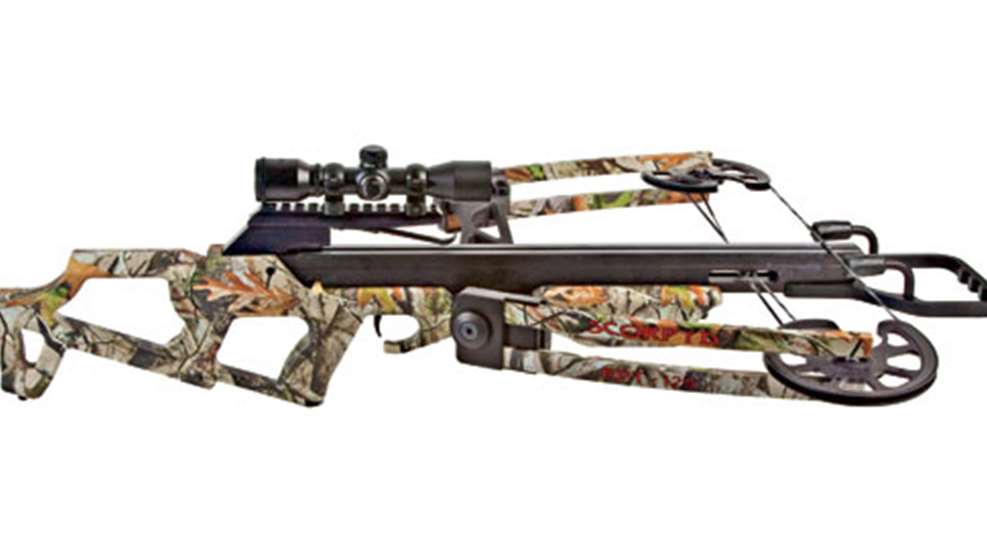
Scorpyd (pronounced score-ped) is a brand-new crossbow company that gets its name from the profile of its peculiar, cam-forward design when viewed from above. Proprietor Jim Kempf claims a patent on what he calls "Reverse Draw Technology" (RDT). Basically, RDT takes a compound bow and mounts it string-forward (instead of riser-forward) on the frame. This allows his crossbows to utilize a long powerstroke despite only measuring slightly more in total length. He says this is the key to his crossbows' speed and power. After testing, I believe him.
Even with a relatively low draw weight of 125 pounds, the RDT 125 shot a 356-grain bolt an average of 382.2 fps. I think there are two major factors that generate this speed. One is indeed the elongated powerstroke; the longer it is, the more speed the string can generate and transfer to the bolt. At 20 inches, the RTD owns the longest of those tested. Of course any company could increase the length of its crossbow's powerstroke, but in typical crossbows it would also increase its overall length and make it cumbersome to carry and shoot. By using Reverse Draw Technology, the RTD was also the shortest bow overall of the lot. Also contributing to the bow's speed are its huge, efficient dual cams that, together with the limbs, produce 110 ft.-lbs. of energy. As for accuracy, it averaged 2.8 inches at 40 yards.
Perhaps most impressively, it was the quietest crossbow we tested. Much of this can be attributed to the parallel limb design that cancels vibrations instead of sending them elsewhere to reverberate. Its rubber string catchers also muffle vibrations. For sure, the fact that the crossbow "only" has a 125-pound draw weight naturally makes the bow quieter than others, but because of its design, it doesn't sacrifice speed or power.
The Scorpyd's composite stock has a few nifty features. Its buttstock pivots down and around the pistol grip, reducing overall length by 5.5 inches for easy carrying and storage. A strong magnet at the attachment point assures a firm, quick but silent lockup of the skeletonized buttstock. A molded channel behind the receiver accepts the included rope cocker and it is highly recommended because it employs pulleys to reduce the pull weight-thereby saving your back-and it ensures a consistent, equal load-up of the limbs that our tests proved to increase accuracy. The underside of the stirrup is tapped to accommodate a quiver.
Mechanically, the RTD is safe, smooth and effective. Its cocking mechanism has a no-dryfire feature-something very important in a crossbow where energies derived can quickly cause limbs to "blow up" if they are not retarded by the weight of an arrow. The brass, ambidextrous safety is intuitive and effective. The RDT's trigger averaged just under 4 pounds. The machined receiver is topped by a Picatinney rail for mounting optics.
If you can't tell that I like this bow already, here's another fact: In addition to being the quietest, the shortest and the second fastest, it is also the second least expensive that we tested.
Draw Weight: 125 lbs.
Advertised Speed: 370+ fps (350 gr. bolt)
Tested Speed: 382.2 (356-gr. bolt)
Advertised Kinetic Energy: 110 ft.-lbs. (350 gr. bolt)
Axle-to-Axle Length (uncocked): 22"
Powerstroke: 20"
Overall Length: 37.5"
Tested Trigger Pull Weight: 3 lbs., 15 ozs.
Weight: 9 lbs.
Accessories: scope, quiver, 4 bolts, sling
MSRP: $949.99