Nearly any shooter who is familiar with high-end rifles has heard the name J.P. Sauer & Sohn. After all, they’ve been in the business longer than the U.S. has been a country. That said, the company is guilty of being limited in scope, as it essentially stays within the confines of bolt-action rifles. Branching out in recent years, it found itself bringing shotguns to market with the help of some revered European scattergun manufacturers. In time, autoloaders began to fill out the ranks, largely targeted at upland bird and turkey hunters. In short, the firearms were made for mild conditions that are relatively easy on guns. This left a natural gap for the waterfowler, which did not go unnoticed. Therefore, in late 2022, J.P. Sauer & Sohn revisited Italian manufacturer Breda, this time to craft a firearm that could endure an onslaught of saltwater and perform without fail. Aptly named the SL5 Waterfowl, I had the opportunity to take one out to put it through its paces.
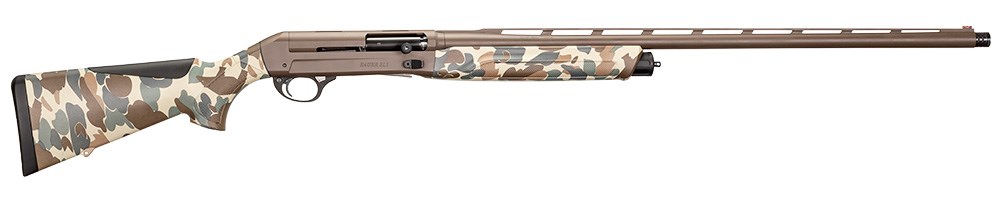
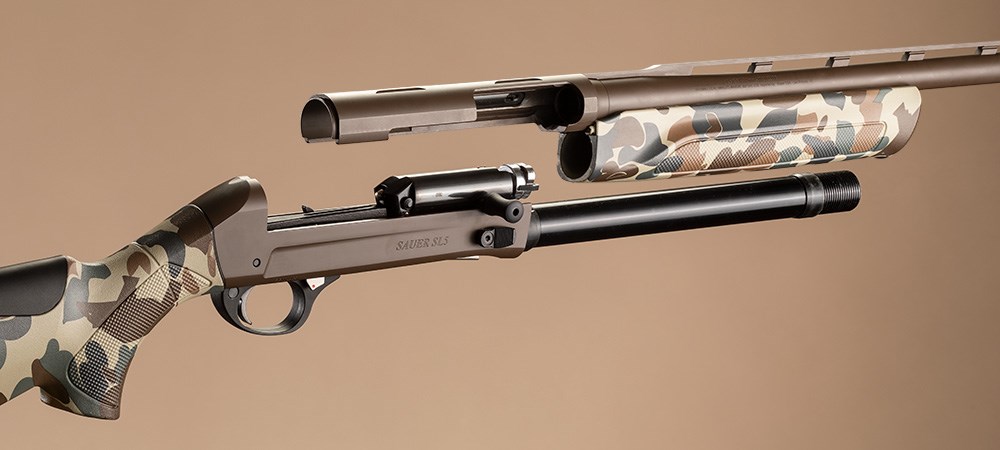
Like most shotguns, this one arrived without the barrel attached, displaying the first interesting aspect of its construction. The SL5 Waterfowl is built on a split receiver system, similar to an AR-15. The chrome-lined barrel is attached to the steel upper, which nestles into the aluminum lower receiver and is held in place by the end cap. This is a unique twist on a conventional design and one that more intimately integrates the barrel into the rest of the parts. It cuts weight via the aluminum lower, and also undoubtedly puts the red fiber-optic front sight into perfect alignment with the receiver, as the two are now permanently connected.
Seated in the lower portion, a Benelli-like, inertia-driven system cycles the action. This is the easiest way to ensure reliability in rough conditions. Instead of relying on gas pressure and often far-from-pristine internals to cycle the action, the energy of the SL5 recoiling against your shoulder is all that is needed to bounce it open and eject the fired case. A spring located in the stock rocks the bolt assembly back into battery, chambering a fresh cartridge in the process.
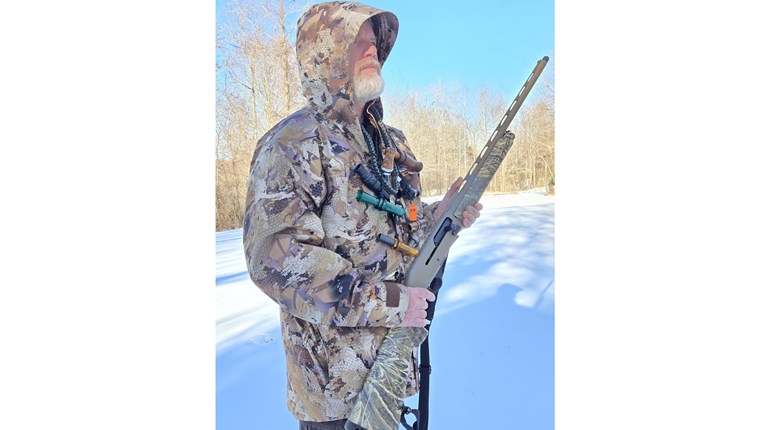
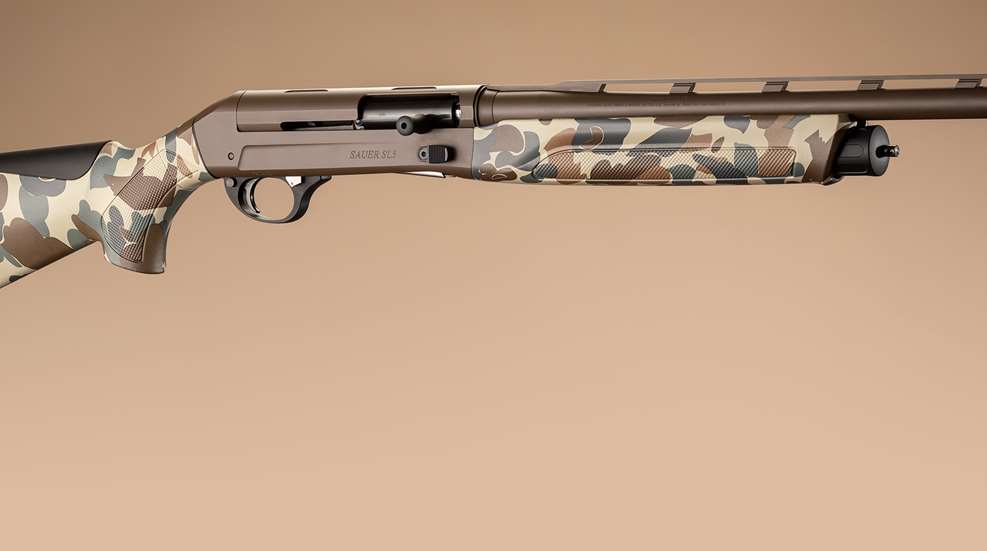
Just as the internal parts are all coated or finished to resist corrosion, so are the external components. The SL5 wears a stock set comprised of a high-density polymer that is inherently waterproof and treated with a “Fred Bear Old School” camouflage dip. Buyers have their choice of a matching camo receiver and barrel, or a shotgun with a brown Cerakote receiver and barrel. There is also a utilitarian all-black model, which cuts costs and provides a blank canvas for an aftermarket camouflage job if so desired. Each of these trims allow for your choice of a 26-, 28- or 30-inch barrel.
Intrigued by the familiar yet different design, I quickly scheduled a range day to pattern test the SL5 Waterfowl and break a bevy of clays for “science.” I wanted to conduct my testing with ammunition that would transcend various applications to avoid a long, drawn-out discussion on performance, and to find a one-and-done solution to keep on my shelf, possibly. All arrows pointed to the four boxes of Winchester Xpert High-Velocity No. 6 Steel Shot that I have been sitting on. This shell skirts the lower threshold of short-range duck hunting, while being well-suited for small game and upland birds, all the while being inexpensive enough to throw at clay targets. Arguably, I could have limited my testing to a purpose-built duck load, but I can’t see a reason not to enjoy this SL5 outside of that hunting season. Besides, inertia-driven shotguns typically need hard-thumping ammo to run well; these standard-recoil shells would provide an acid test of sorts.
I started my range session by shooting 10 patterns to see if the attached barrel system had any impact on accuracy; it did. At 40 yards, my patterns were dead center, which is great because it means more hits, but it’s bad because it takes away any excuses. During my presentation, I thoroughly enjoyed the stepped rib, as it served as a crude rear sight, allowing me to center the fiber-optic rod within its space. In total, I fired all 10 patterns with the modified choke installed, as it is the middle ground of the complete set of five included with the gun. On average, I was able to put 182 out of the 307 pellets into a 21-inch circle, without discernable gaps large enough for even a dove to fly through.
With the paperwork behind me, I readied a Champion FreedomBird electronic trap and positioned it to throw clays toward me, simulating a duck that won’t quite decoy. From a seated position, I mashed the fire button and engaged a series of targets as they flew overhead. During this portion of the testing, I gathered a better feel for how well the SL5 swung and shouldered and found the neutral cast to agree with my left-handedness. Sauer includes a set of ERGOFIT inlays to adjust this for either dexterity as well as adjust cast or drop, but I liked it just how it was. As an instructor, this characteristic bodes well with me because that means that I can likely hand this over to just about any student, and he or she will also have immediate success. This should also be appealing to hunting guides for the same reason.
After putting another 50 rounds through it, I gained an appreciation for the soft rubber recoil pad and cheekpiece, as I didn’t have any soreness to speak of. Naturally, this is also a product of the 2¾-inch shells I was using that day, but these features become doubly important when the shotgun is loaded with the 3½-inch magnum shells that the SL5 Waterfowl is capable of firing. I finished the day by running the gun in the unsupported standing position and was again successful, so long as I did my part. This also provided the gun an opportunity to malfunction, which I am happy to report it did not.
J.P Sauer & Sohn’s entry into the sport of waterfowling was a pure delight to have on the range. I found its inimitable approach to the classic inertia system provided an extra level of accuracy, while its retro camouflage pattern was both sentimental and functional. Blasting clays with it was sheer joy as it pointed and balanced as if it were custom fit to my body. Additionally, should your takeaway vary, hardware is included to adjust and match my experience. Overall, this is an excellent step outside the rifle maker’s proverbial box, and one that waterfowl hunters will surely appreciate.
Technical Specifications
• Type: semi-auto shotgun
• Gauge/Chamber: 12/3½"
• Capacity: 3+1
• Barrel: 26", 28" (tested), 30"; chrome lined; vent rib; interchangeable choke tubes
• Trigger: 6-lb., 14-oz. pull weight?
• Sights: integral scope mounts; red fiber-optic front sight
• Safety: cross-bolt
• Stock: synthetic; Fred Bear Old School camo; 14¼" LOP; 2" drop at heel; 1½" drop at comb
• Metal Finish: Brown Cerakote
• Overall Length: 50⅜”
• Weight: 7 lbs., 11 ozs.
• Accessories: Crio Plus choke tubes (C, IC, M, IM, F), choke wrench, stock spacers
• MSRP: $1,779; jpsauer-usa.com