Heat waves bounced and shimmered across the veldt, turning distant camelthorn trees into dancing apparitions. The band of gemsbok bulls we’d been following since early morning showed briefly, black and white, stiletto horns mirage-bent toward the sky. Our professional hunter (PH) Derek crouched sideways a few rapid steps, then set his shooting sticks for my son Josiah. The shot was long, and I waited with bated breath as Josiah settled onto the sticks. Through my glass I watched as his bullet took the old bull squarely through the shoulders. It was a perfectly placed shot, from a difficult position, on one of the toughest plains-game animals on earth.
Plains Game Shot Placement
Wildlife in Africa is tough, and dies reluctantly. Life in a brutal environment has endowed them with tough skin, hard bones and incredible tenacity of life. Place your bullet well and they expire rapidly, but shoot one wrong and you’re in for a tough recovery job. As hunters, we must do everything in our power to make clean, ethical kills, so when you go on safari to Africa pay close attention to your PH’s advice on shot placement. TIP: For good info and trustworthy outfitters, check out "Book Your Hunt;" an outfitter-direct booking agency. I've used and enjoyed their services.
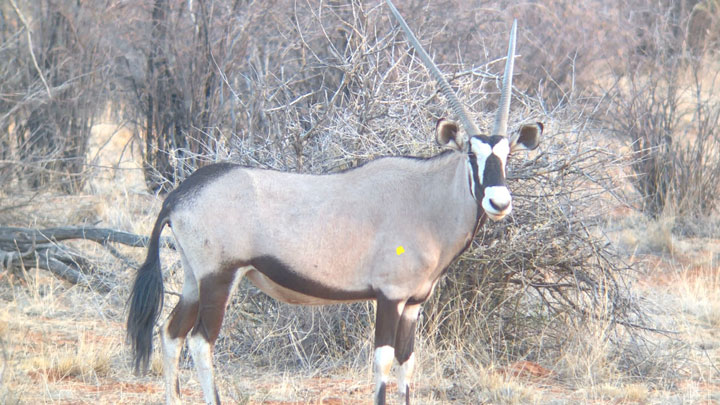
One of the biggest differences we as American hunters encounter is the fact that the vitals on African plains game sit further forward than do those on the North American wildlife we’re accustomed to hunting. (Or the shoulder sits more to rearward—either way you view it, the results are the same.) In order to hit African game through the vitals, you must shoot them through the shoulder (see photos), not behind the shoulder like you’d shoot North American game. Shoot an African animal behind the shoulder, and you’re likely to hit only paunch.
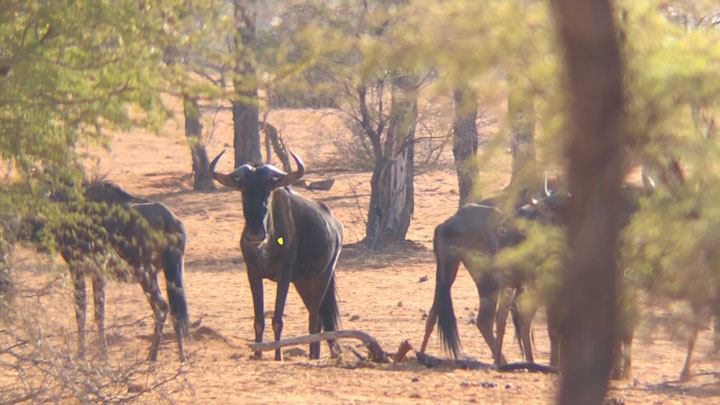
It’s also a fact that many of the African plains-game species should be shot a bit lower than we’re used to shooting our North American game. Many of them grow rather tall bones—I believe they are called spinal processes—upright from their backbone. As much as one-third of their body height can be non-vital. This varies from species to species, so again, follow the shot-placement advice of your PH. There’s a great book available, The Perfect Shot, that’s filled with fantastic illustrations. It’s an invaluable resource for studying and visualizing good bullet placement prior to your first safari. You can order a copy through Amazon.
For almost all African plains game, this simple shot-placement rule will work: on a broadside animal aim directly above the front leg, and one-third up the body. If the animal is quartering toward or away from you, adjust your aim accordingly so the bullet will center the vitals that are sandwiched between those shoulders.
Bullet Choice for Africa
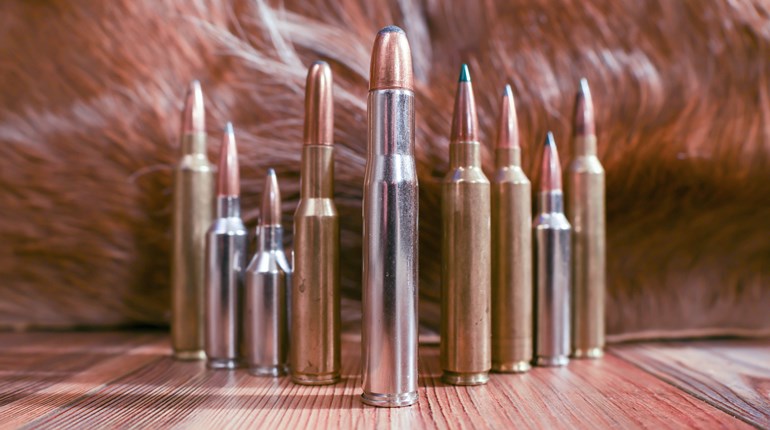
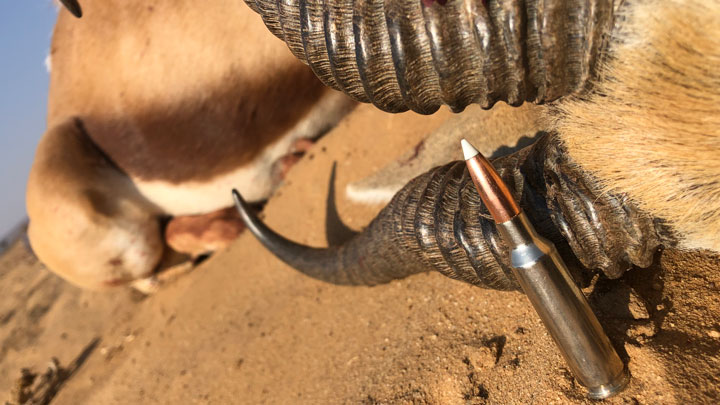
Tough hide and dense bone make shot placement important. It also dictates that you use a sturdy bullet to penetrate deeply and kill cleanly. I’ve personally used Nosler AccuBond and Federal Terminal Ascent projectiles with great success.
Accuracy in Africa
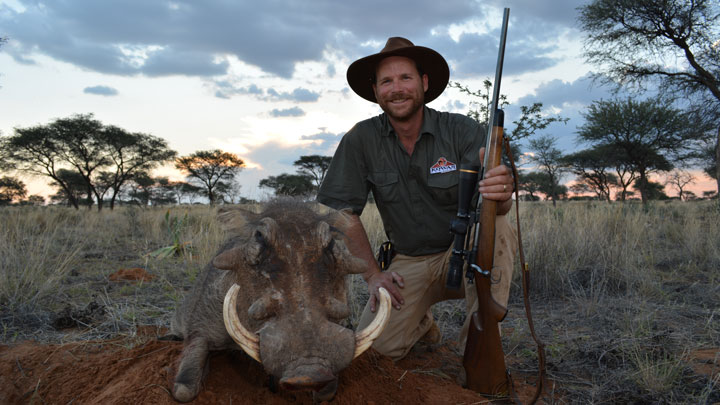
Tall yellow grass waved thigh-high across the Thornveld, a golden sea in the evening light. A huge warthog rooted his dinner from the red Kalahari soil, occasionally popping his head up to see-level to check his surroundings for danger. A warthog was high on my bucket list of African animals to hunt, and this one’s gleaming ivory tusks had my full attention. Closing to within 70 yards, Jacques, my PH, set the shooting sticks and plugged his ears. I leveled my old Springfield across the sticks, spread my feet, steadied the crosshairs and pressed the trigger.
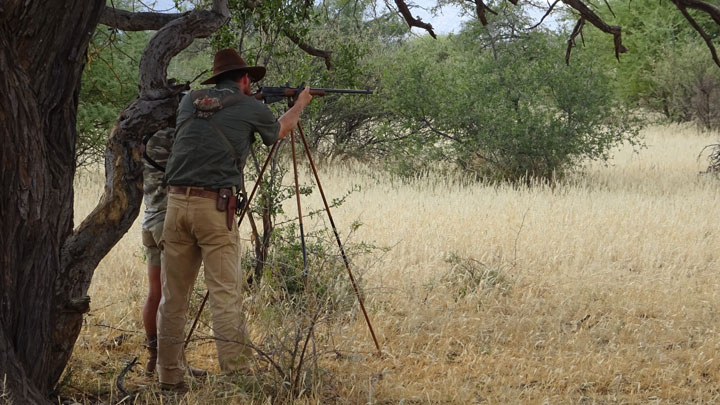
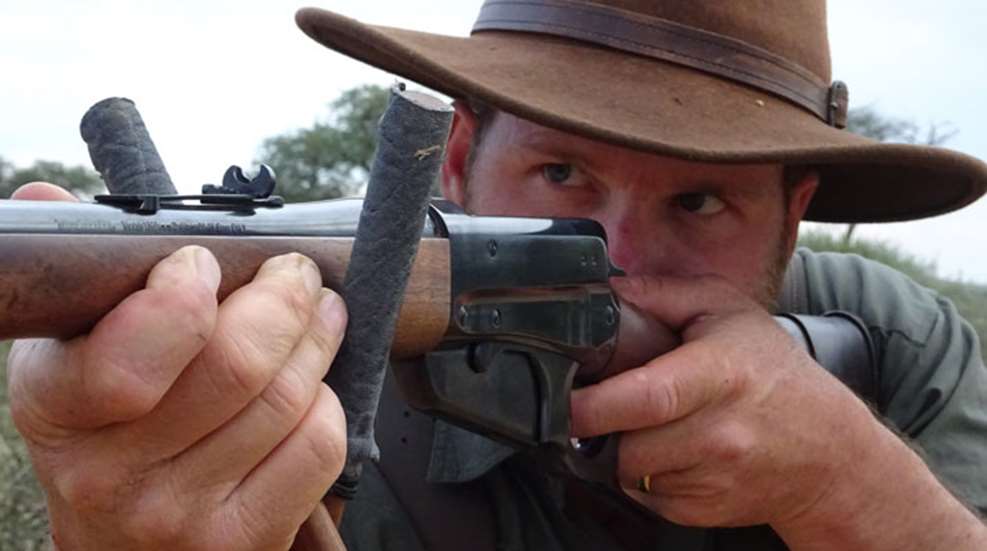
The most common field shooting position across Africa is standing, with shooting sticks for support. The motivation for this is tall grass that submerges you when you try to go prone, or even sit or kneel. The only way to clear the grass for a shot is to stand and shoot off sticks. Shooting from tall sticks can feel incredibly unstable when you first attempt it, but with practice and correct technique, the position becomes very steady, fast and effective. It is not, however, steady in the same sense as shooting from the prone position, and as a result, stalking within 200 yards or less before taking the shot is common across most of Africa.
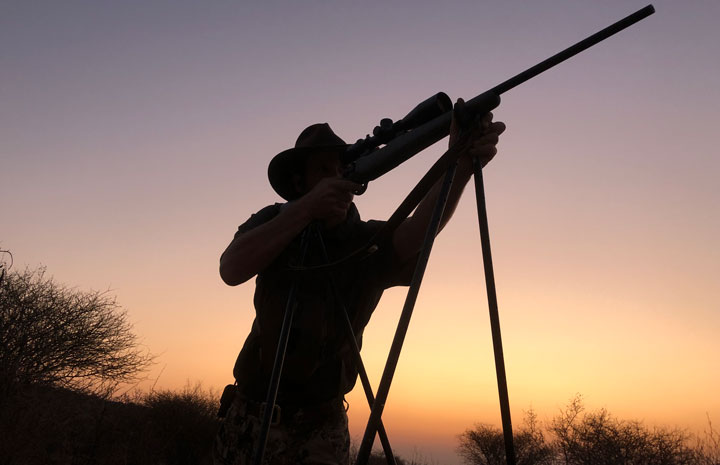
Before going on safari for the first time (or any time) it’s a good idea to practice shooting from tall sticks. Here are a few tips that’ll help you perfect your technique.
Right Height: Learn what height feels best and practice adjusting the sticks to suit. Your PH will recognize what works for you and will set the sticks about right, but you should be ready to fine-tune them. Chest-high is best for most shooters—it’ll feel too low at first, but you’ll rapidly get used to bending forward at the waist and settling your rifle into the sticks. This—bending forward—will help steady your position.
Square Up: Most shooters naturally turn their feet perpendicular to the target when shooting from an offhand, or standing, position. When using tall sticks as support, it’s better to square your feet and body up so they are parallel or square to the target. It’ll take some getting used to, but squaring up will eliminate most of the side-to-side barrel movement that is so common when resting your rifle over sticks.
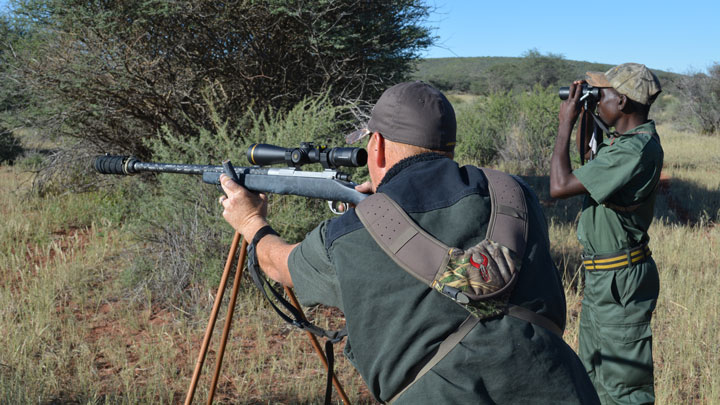
Hold the Sticks: Grip the sticks in a choke-hold right where they cross, and place your forefinger or thumb atop the barrel to hold it down snug. Alternately, you can wrap your wrist around the sticks and hold your rifle by the forearm, locking it firmly down into the fork of the sticks. This’ll help stabilize the rifle so it doesn’t jump around during recoil, and will enable you to make a fast follow-up shot if necessary. With your hand around the sticks you can instantaneously adjust them for height and angle, or even pick them up and move a few feet to one side for a better shot angle if necessary.
Squeeze the Trigger: Just like every other type of precision shooting, you must press the trigger smoothly if you wish to hit your target. Practice getting on the sticks, on target and steady. Then dry fire your rifle, carefully watching your crosshairs through the click. Once you can keep the crosshairs on target through and after the click, you’ve mastered the from-sticks position. Now take your sticks to the range and to the field, and shoot from a variety of distances at a medley of targets. When you’re finally stalking the African thornveld and that big kudu bull steps out of the brush, you’ll settle onto the sticks and take the shot like you were born to it. Who knows? Maybe you were.