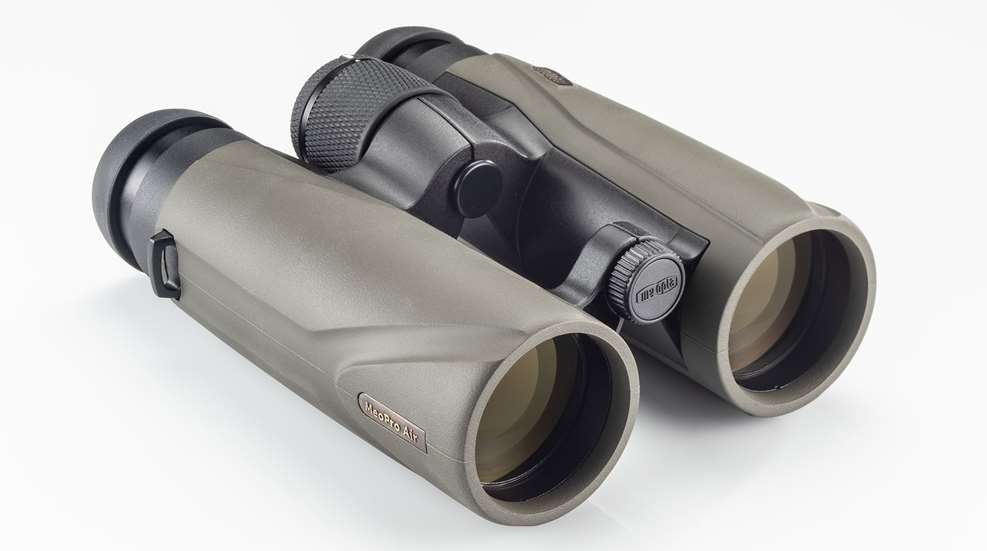
Binocular manufacturers, bless ’em, try so hard to improve their products or at least tweak them to give us something different, something new, some feature that will set them apart and inspire us to buy. Hey, I’ve no quarrel with that! Different and better just makes it easier for each of us to find our perfect match. And Meopta’s MeoPro Air 10x42 might be the perfect binocular for you.
This binocular’s very name illustrates this marketing concept. Air. MeoPro Air suggests an instrument lighter than standard, does it not? And this model at 29.2 ounces naked (no strap, lens covers) does weigh about 2 ounces less than the 10x42 EL binocular from Swarovski. It also weighs about 3 ounces less than Meopta’s own MeoStar B1 Plus 10x42 HD, but it’s 9 ounces heavier than their MeoPro HD 10x42. Meopta explained that the new Air fills the middle ground between the less expensive MeoPro HD line and the top-tier MeoStar line.
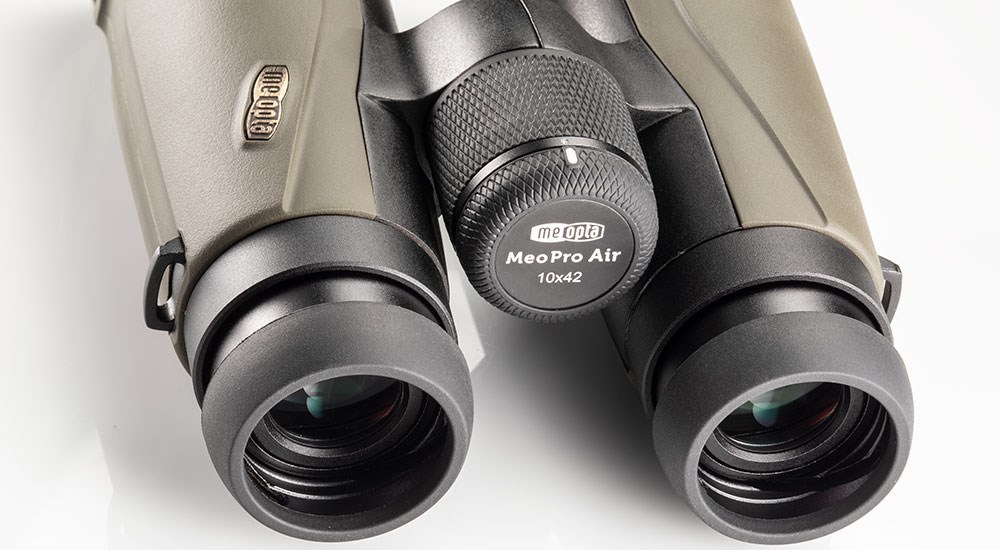
So maybe Air in this title references, what? Clarity? Like looking through air? We may never know. Nor do we need to. Regardless the marketing slant, it’s best to judge binoculars on two things: their raw performance (light transmission, contrast, resolution, field-of-view, eye relief and focus control) plus their “compatibility.” By that I mean how well they fit and function for you. It’s somewhat vague, but you know it when you see it. Or feel it. For some often inexplicable reasons certain binoculars just feel and work better for us. This might be one of them.
These subtle “feel” differences were brought to my attention as I compared my sample Air against the aforementioned Swarovski plus a similar Tract binocular. All performed well and handled nicely, but there was something indefinably different in the way I felt about each. Might have been balance, the way they “fit” my face and hands … . It’s hard to explain, but something you might notice as you sample this and other binoculars. Since we can’t judge “feel” for you, we’ll concentrate on optical and mechanical performance in this review.
In pure optical performance the Air claims 83 percent light transmission. That’s a product of the number of lenses in the instrument combined with their anti-reflection coatings and the type of glass used in the prisms, phase-coated BaK-4 glass in this instance. Phase-coating doesn’t alter light transmission, but sharpens resolution by minimizing light ray scatter or roiling that results from its passage through two chunks of stacked prism glass in each barrel. What does influence transmission are the prism mirrors. Meopta doesn’t report this in its literature or advertising, but I’m guessing these are silvered mirrors as opposed to the higher performing dielectric. The proof is in apparent image brightness. Compared against the Swarovski EL, I could detect a hint of light loss through the Air, perhaps a third of an f-stop.

Meopta claims all lenses in the Air are fully multi-coated with its proprietary MeoBright coatings. These utilize wave cancellation technology to nearly eliminate light loss during its transition into and out of each lens. Anti-reflection coatings also increase contrast by controlling flare and glare. While glassing into shadows with the morning sun hitting the objective lenses, I saw a significant curve of bright, rather sharply defined flare on the visual fringe 180 degrees from the sun position. This would enlarge and shrink if I shifted my eyes off axis to the barrels. The Swarovski didn’t exhibit this. Somewhat oddly, the MeoPro Air retained high contrast and a glare-free field of view across the remainder of the image field. In fact, while glassing a robin atop a tree some 100 yards away and a dark bush and two fence posts 2.5 miles away, I found the Air image impressively sharp with good contrast, only slightly less than that through the more expensive Swarovski.
The more expensive EL gets the win for resolution (sharpness) as well, but only by a hair. And that may have been perception reflected by the slightly brighter image.
Overall what I noticed about the Air was its balance, easy handling and impressively saturated, high-contrast images. The usual armor-coated body, three-position locking eyecups and perfectly tensioned focus wheel contributed significantly to “field usability.” The click diopter adjustment wheel atop the focus wheel makes it quick and easy to tweak eye-to-eye focus while keeping the instrument to your eyes. Generous eye relief of 22mm worked beautifully with and without eyeglasses. A standard ¼x20 tripod mount hole in the front hinge makes it easy to mount the Air to an aftermarket tripod adapter for steady viewing.
Less useful were the magnetically attached objective covers. While a clever idea, I discovered that in practice these easily stripped off if the binocular rubbed across my coat or shirt. A mechanical link seems the better option. Or no covers at all.
Meopta has been working overtime to fine-tune and expand its excellent binocular lines. Their efforts increase the chances each of us might find the perfect match. The only way to find out is to test drive units like the 10x42 Air. Compare the view, price, balance and handling, that mysterious “feel,” and determine if this might be the optimal optical tool for your style of hunting.
Technical Specifications
• Type: roof prism binocular
• Magnification: 10X
• Objective Lens Diameter: 42mm
• Focusing Range: 7.75'-infinity
• Eye Relief: 22mm
• Exit Pupil: 4.2mm
• Field of View @ 1,000 Yards: 360'
• Coatings: fully multi-coated; MeoBright, MeoShield, MeoDrop; phase-coated prisms
• Construction: magnesium-alloy body w/rubber armor; HD glass; BaK-4 prisms; tripod adapter mount; nitrogen purged; waterproof, fogproof, shockproof
• Dimensions: height 5.9"; width 5"; weight 29.2 ozs.
• Accessories: lens covers, neck strap, lens cloth, carry case
• MSRP: $999.99; meoptasportsoptics.com