For me, upland hunting is characterized best by hardworking gundogs and cool cocktails shared after a day of beating brush. I love watching those dogs point, flush and retrieve, and I always enjoy reminiscing with compatriots about the epic misses we will never live down and, of course, the long shots we will never forget. Those great pokes at departing gamebirds that drop them stone dead at 50 yards or beyond are the kinds of shots that require equal parts skill and luck. They nearly defy the ballistic capabilities of 12- and 20-gauge shotguns, and they’re unheard of with svelte 28s no matter how plucky the load—unless you’re swinging a Benelli Ethos, one of the few 28-gauge semi-automatic scatterguns to feature a 3-inch chamber.
Late in 2016, I was one of a half-dozen hunters who field-tested the sub-gauge—along with a 3-inch high-velocity load from Fiocchi—at Pheasant Bonanza Hunt Club in Tekamah, Neb. During the three-day unlimited hunt, our party bagged hundreds of birds—mostly a mix of wild and released ringnecks—and gained a real appreciation for the easy handling and surprising power of the little 28-gauge Ethos. The biggest surprise was how well the combination performed on pheasants as the shot distance increased; we all made some long shots worth remembering.
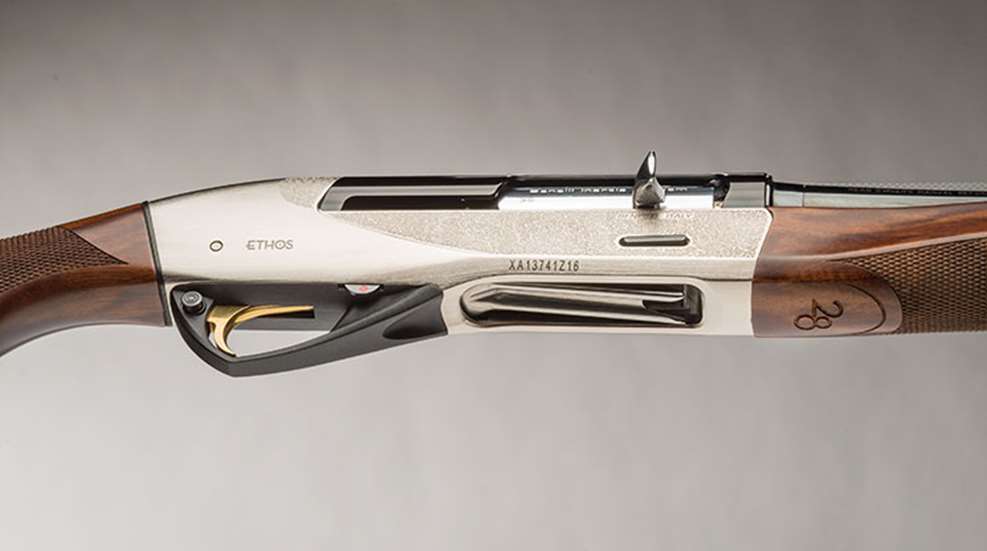
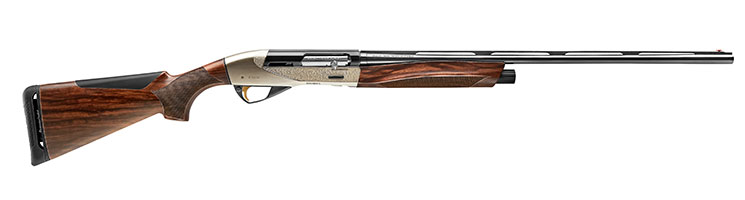
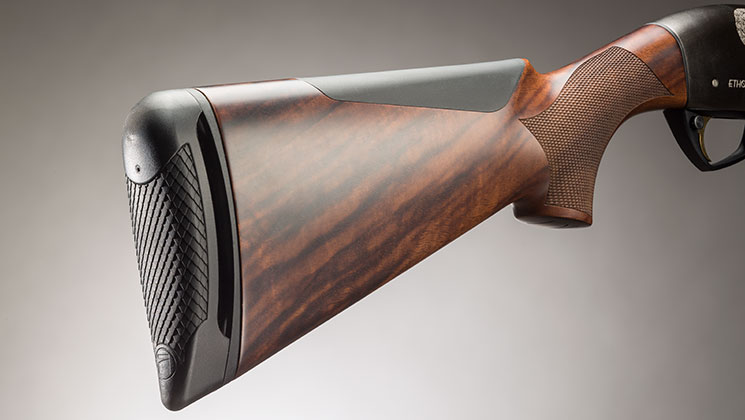
Introduced in 2014, the Ethos is an inertia-driven semi-automatic shotgun that benefits not only from Benelli’s decades of experience with the operating system it pioneered, but also from the then-new Progressive Comfort recoil mitigation technology—essentially an interlocking assembly of flexible buffers within the buttstock, offering increased recoil absorption depending on the strength of the load fired. Despite the high degree of mechanical innovation within, the Ethos still features traditional styling, albeit in a modern form. Gracefully sweeping lines tastefully blend the AA-grade walnut stock and fore-end with the cryogenically treated, blued-steel barrel and nickel-plated receiver bearing fine, feather-like engraving. The aesthetically pleasing Ethos proves that despite a focus on the American consumer market, Benelli has not forgotten its Italian roots.
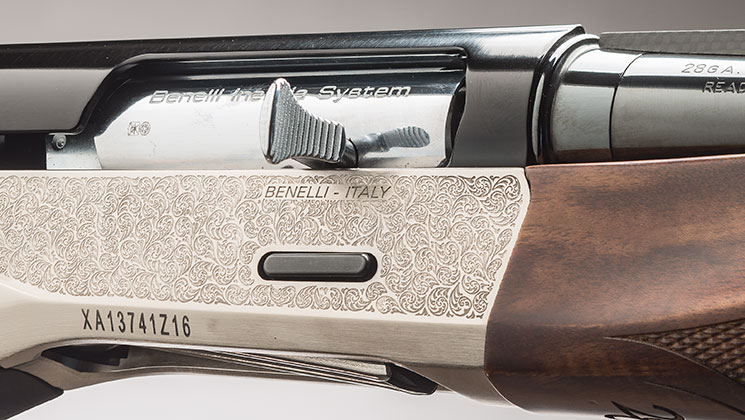
The 28-gauge rendition of the Ethos incorporates all the signature features of the line, just in a proportionally smaller format. The gun features a 26-inch barrel threaded for Benelli Crio flush choke tubes, five of which are included with the gun. As with the larger versions, the 28-gauge utilizes a removable carbon-fiber ventilated rib above the barrel—interchangeable with aftermarket options—which has a metal mid-bead and a fiber-optic front sight. Benelli includes three fiber-optic pipes—yellow, orange and red—to suit the user’s preference.
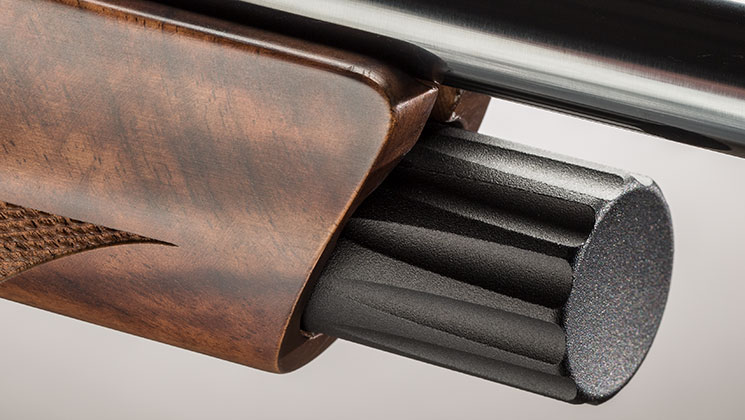
Those familiar with the Ethos, and its forebears, will appreciate the “quality of life” upgrades made for the platform are retained in the 28-gauge model. Topping the two-shell magazine is an ample magazine cap with large grooves to increase purchase and a polymer anti-seize bushing that prevents the cap from binding. The enlarged bolt release is easily accessible, even for gloved hands, and while it does not have the proportions exhibited by similar components on competition guns, it does not detract from the gun’s appearance, either. Likewise, the reshaped cartridge-drop lever, located at the front of the trigger guard on the right side, angles slightly outward from the receiver to make it easier to activate. Finally, a polymer cheekpiece incorporated into the stock protects the shooter’s face during recoil and, in combination with the Progressive Comfort system, makes the Ethos a really enjoyable shotgun to shoot all day—all the more in the 28-gauge configuration.
The Ethos family is also credited with fixing the infamous Benelli “click”—the unmistakable sound of your shotgun failing to fire because the bolt is not fully in battery. This condition especially afflicts hunters who quietly and gently check their chambers to ensure the presence of a shell. Quietly, gently closing the bolt on many legacy Benelli inertia-driven designs doesn’t get the job done—those guns need the action to close with authority in order to guarantee lockup. In the Ethos, Benelli added a new detent mechanism to the bolt assembly, which ensures the two-lug, rotating bolt head with right-side extractor claw will return fully to battery, every time.
One of the benefits of inertia-driven operation is that such guns are very capable of cycling even light-for-chambering loads. But the 28-gauge Ethos, in my opinion, comes into its own at the other end of the spectrum, firing the larger, though less common, 3-inch shells. As far as I can tell, Fiocchi Ammunition is the only company loading 3-inch 28-gauge shells, and only in a handful of options. For comparison, the company offers a 2¾-inch high-velocity hunting load that throws ¾ ounce of No. 6 shot at around 1300 fps—not too shabby. But the company’s 3-inch high-velocity load significantly ups the ante by propelling a full ounce of No. 5 shot to the same velocity. Speaking from firsthand experience, it’s strong medicine for even the larger upland birds. Best of all, despite its light weight—only 5 pounds, 5 ounces—the Ethos managed the increased recoil well, and after three days of shooting the larger, heavier shells, my shoulder was none the worse for wear.
Like the rest of the Benelli upland family, the 28-gauge Ethos is a quality sporting shotgun from a trusted maker. It looks great, handles and swings beautifully, and runs without a hitch. While a 28-gauge isn’t for everyone, the lighter Ethos is a pleasure to carry afield, and the 3-inch shells go a long way toward closing the power gap between this increasingly popular sub-gauge and its larger kin. For those who think the most memorable shots still require equal parts skill and luck, I suggest you keep your luck and try this Ethos.
Technical Specifications
• Type: inertia-operated semi-automatic shotgun
• Gauge/Chamber: 28/3″
• Barrel: 26″; cryogenically treated; removable carbon-fiber vent rib; threaded for Benelli Crio choke tubes
• Sights: metal mid-bead, fiber-optic front
• Magazine Capacity: 2 rnds.
• Trigger: 5.9-lb. pull weight
• Safety: cross-bolt
• Stock: AA-grade European walnut, satin finish; polymer cheekpiece; Progressive Comfort recoil-reduction system; LOP 143/8″; drop at comb 11/2″; drop at heel 21/4″
• Metal Finish: nickel-plated receiver, blued barrel
• Overall Length: 47″
• Weight: 5 lbs., 5 ozs.
• Accessories: hard case; 5 Benelli Crio flush choke tubes (C, IC, M, IM, F) and wrench; 3 fiber-optic front-sight inserts
• MSRP: $2,199; benelliusa.com