A century ago, Charles Newton introduced Americans to the 6.5mm cartridge in the form of his .256 Newton. Firing a 129-grain bullet at 2760 fps and chambered in the Newton bolt-action rifle, it might have become a standard had the Great War not intervened and sunk Newton’s business.
No other American company tackled a 6.5mm cartridge until the .264 Winchester Magnum was unveiled in 1958. This was one of the first short, belted magnums and fired a 140-grain bullet that attained a muzzle velocity Winchester initially billed at 3200 fps. Its life was brief but controversial, as the cartridge was loved by some but condemned by many for its short barrel life, excessive muzzle blast and erratic performance on game. To be honest, the .264 Win. Mag.’s failure as a cartridge resulted not from a lack of ballistic virtue so much as a combination of unsuitable bullets, inadequate powders, and the shooting public’s failure to understand the relationship between velocity and barrel length.
In light of this, Nosler’s decision to design an all-new .264-caliber cartridge—the .26 Nosler—intended to be the ultimate small-bore, long-range hunting cartridge took considerable nerve. To say Nosler is challenging history with its first commercial cartridge is putting it mildly, but with the variety of ultra-slow-burning powders now available and premium bullet technology at a level only dreamed of in 1958, the 26 Nosler could well be the 6.5mm that finally makes the caliber widely popular in the United States.
What sets most .264 cartridges apart from the .257s below and the .270s above is their long, heavy bullets—typically, 140 to 160 grains—which penetrate on game, buck the wind and hold their velocity at long ranges. The first 6.5mm military rounds, introduced in the 1890s, used even heavier bullets—usually 155 to 160 grains—with very high sectional densities. During the years between the .256 Newton and the .264 Win. Mag., wildcatters worked on various 6.5mm cartridges, and this interest continued even after the latter’s demise. Today, .264s are more usually loaded with bullets around 140 grains.
The new 26 Nosler is a modern, high-capacity rimless cartridge with a sharp shoulder and minimal body taper. Its base dimensions are almost identical to the .404 Jeffery. With a maximum cartridge overall length of 3.340 inches, it fits in a standard-length action. Nosler states the rimless design (as opposed to belted) promotes optimum accuracy. This is debatable; without question, other factors make a much greater contribution to accuracy in a rifle.
Filled to the mouth, the 26 Nosler case holds 108.5 grains of US 869 powder, exactly the same amount as the .300 Weatherby Magnum, which means it should duplicate the performance of the 6.5-300 Weatherby wildcat. Presumably, its rimless design is supposed to give it an accuracy edge over that popular target cartridge. We’ll leave that to the long-range benchresters to sort out.
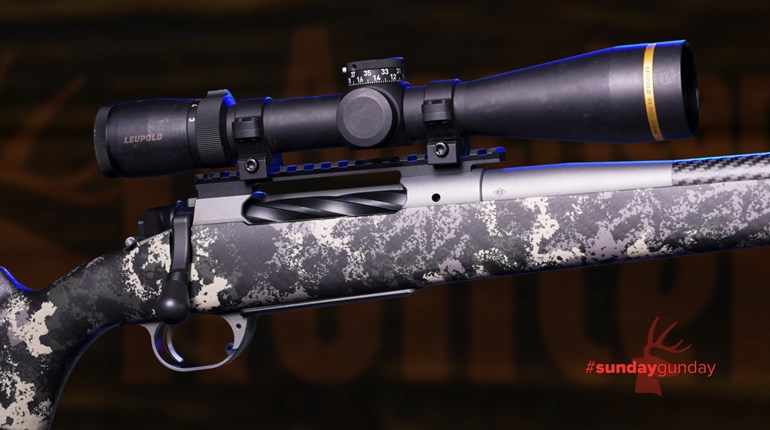
This is neither a review of the rifle, nor the factory ammunition, but of the cartridge itself. It is impossible to divorce the latter from the other two, however, especially since the Nosler M48 rifle and Nosler brass and loaded ammunition are all that is yet available.
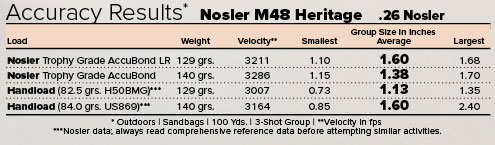
Not content with the cartridge itself, Nosler fashioned a new bullet, the 129-grain AccuBond Long Range, specifically for it. The new bullet is available both as a component and in loaded ammunition. The company’s other factory load uses a 140-grain AccuBond.Nosler guarantees minute-of-angle accuracy with the M48 Heritage rifle I was sent for testing. Such guarantees naturally carry a ton of caveats, but we can assume they are talking averages, not every single group. Accuracy results were mixed during my testing. Some groups were larger than an inch at 100 yards, some smaller. Recommended handloads delivered better accuracy than the comparable factory ammunition in this particular rifle.
Like its high-volume kin, the 26 Nosler is a handloader’s cartridge. By that I mean you are unlikely to get either maximum velocity or optimum accuracy with anything but loads tailored to your individual rifle. While my tests with the M48 Heritage rifle and the 129-grain AccuBond Long Range factory load did not achieve the 3400 fps muzzle velocity Nosler claims, one of my handloads exceeded it by almost 40 fps. To get this performance, you need ultra-slow powders like Hodgdon US869, H50BMG and Retumbo, or Alliant Reloder 33 and Reloder 50. On the other hand, the 140-grain AccuBond factory load certainly delivered the ballistic goods as promised.
The 6.5mm is increasingly regarded as an aficionado’s caliber, and the 26 Nosler is billed as the ultimate possible in that diameter with today’s powders. If it doesn’t succeed, probably nothing will.
Technical Specifications:
Caliber: .264 (6.5mm)
Action Length: standard
Factory Loads: Nosler Trophy Grade 129-grain AccuBond Long Range; Nosler Trophy Grade 140-grain AccuBond
Ballistic Coefficient: .561, 129-grain AccuBond Long Range; .509, 140-grain AccuBond
Muzzle Velocity: 3400 fps (claimed), 129-grain AccuBond Long Range; 3300 fps (claimed), 140-grain AccuBond
Muzzle Energy: 3,310 ft.-lbs., 129-grain AccuBond Long Range; 3,119 ft.-lbs., 140-grain AccuBond
Uses: deer, antelope, similar-size game
MSRP: $60 (per 20-round box)