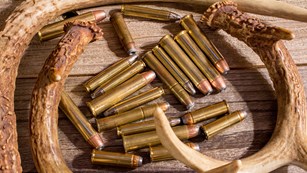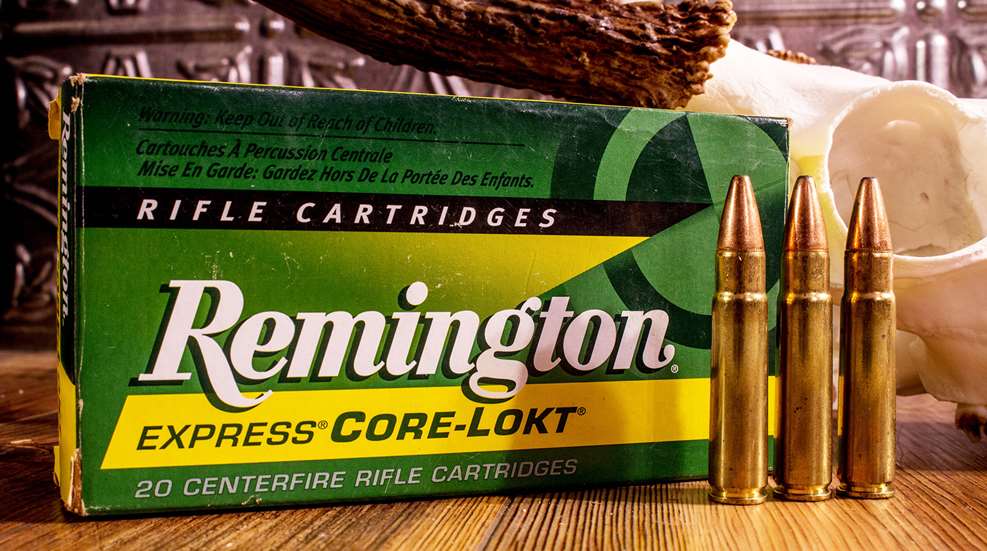
When I picture a lever gun cartridge—especially one designed for use in a tubular magazine—there are certain features that stand out as common. A round- or flat-nose bullet and a nice wide rim come quickly to mind. The .45-70 Government, .30-30 Winchester, .32 Winchester Special and .444 Marlin: all share these attributes. So how in the world did a cartridge developed for an autoloading rifle come to be one of our most revered lever-action cartridges? Let’s take a closer a look at the .35 Remington.
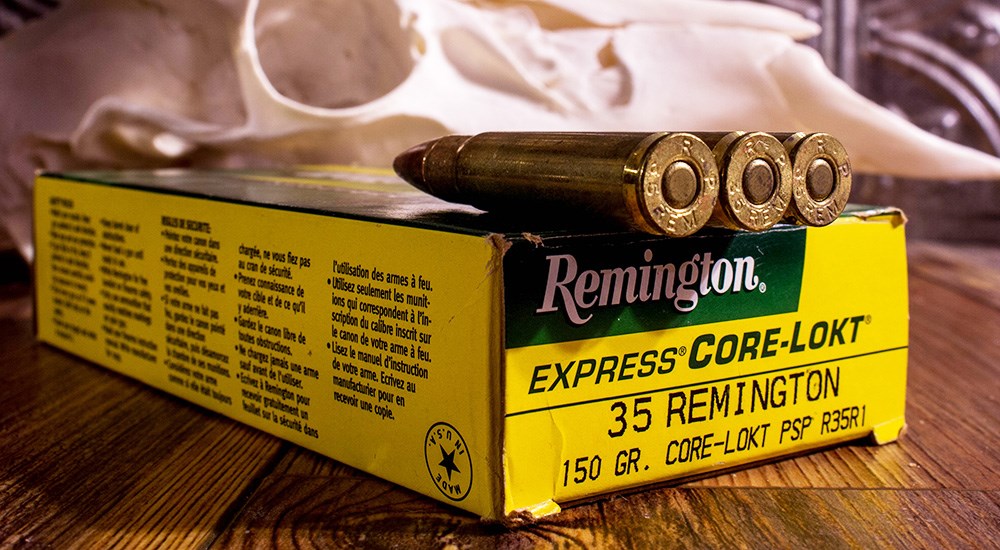
How many Marlin 336s in .35 Remington have graced deer cabin walls? It is, next to the .30-30 Winchester, at the top of the heap among the iconic deer-hunting cartridges, and in the classic Northeastern woods context, remains a perfectly viable choice. It was released in 1906, as one of a quartet of rimless cartridges from Remington—including the .25 Remington, .30 Remington and .32 Remington—designed for use in the Model 8 autoloading rifle. Where the first three were all popular bore diameters at the turn of the 20th century, .35-caliber wasn't exactly tearing up the scene. As far as I know, only the .35 Winchester—a now-obscure bottlenecked, rimmed cartridge—predates the .35 Remington, and only by three years.
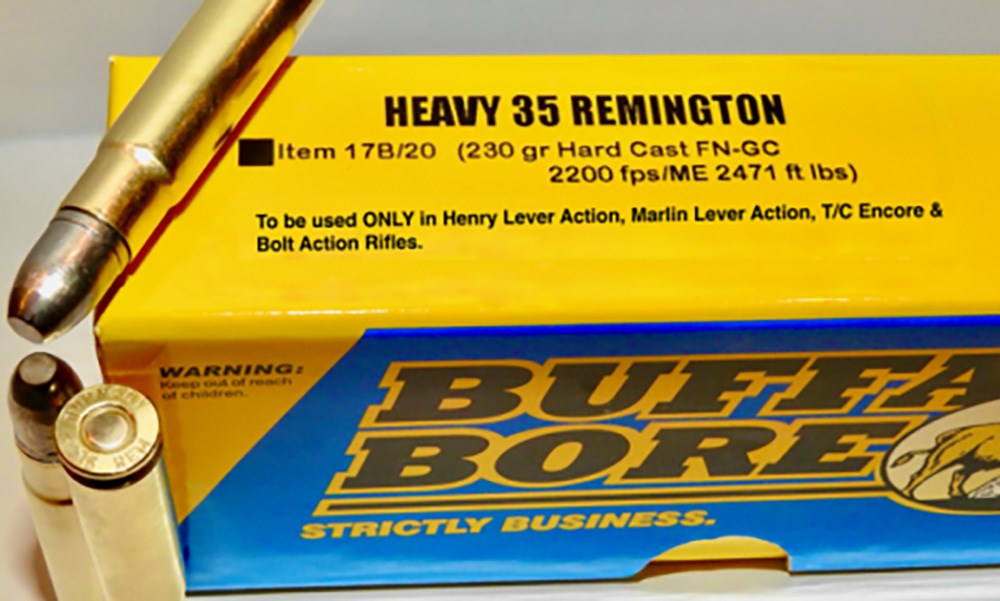
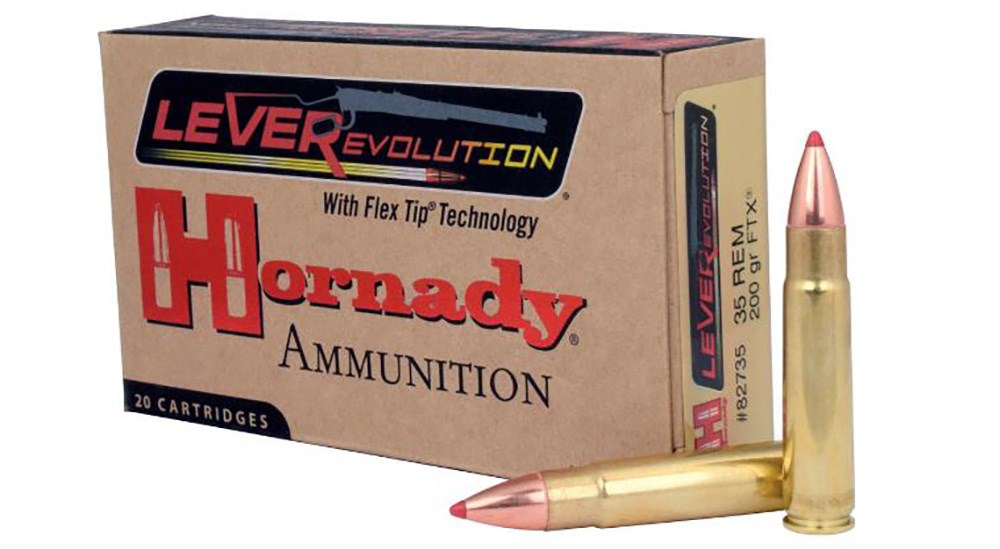
The smaller trio of Remington cartridges is all but gone—I've shot a couple .30 Remingtons, but have yet to even lay eyes upon the .25 Remington or .32 Remington—but the .35 Remington continues to shine to this day. It is a simple design, being a rimless bottleneck case, using light-for-caliber bullets at moderate velocities. With a case head diameter of 0.463-inch, slightly smaller than the 7x57mm Mauser or .30-06 Springfield, the .35 Remington’s case measures 1.920 inches, with a cartridge overall length of 2.525 inches. The 35 Remington uses a 23-degree 25-minute shoulder for headspacing, with a neck measuring 0.337 inches. The bullet diameter is .358-inch—common to the .35 Whelen, .358 Winchester, and .358 Norma Magnum—though the .35 Remington does not use the 225- and 250-grain spitzer bullets which perform so well in the larger cases. Instead, the 35 Remington employs round nosed bullets on the lighter side, with the most common loads sporting 150- and 200-grain bullets, with some modern loads going as heavy as 220 grains. Velocities are mild, with the 150-grain load clocking in at 2300 fps, the 200-grain loads leaving the muzzle at 2080 fps, and the 220-grain load (Federal’s new HammerDown) cruising at the same speed. There are a couple of speedier offerings, namely the Hornady LeveRevolution 200-grain FTX tipped spitzer (the pliable polymer tip is soft enough to be safe for use in the tubular magazine rifles) at 2225 fps, and Buffalo Bore’s 220-grain load at 2200 fps.
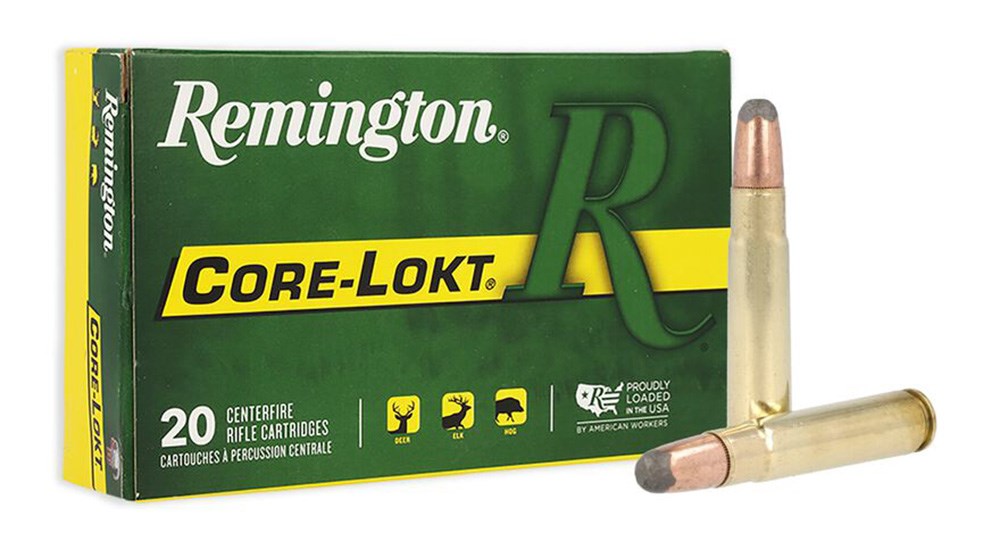
Though the .35 Remington is certainly not looked at as a flat shooting cartridge, Hornady’s LeveRevolution load surely makes it a 200-yard cartridge, as that load can be zeroed at 200 yards, with a 100-yard rise of just 3 inches, retaining over 1,300 ft.-lbs. of energy at 200 yards. the 150-grain load can be zeroed at 200 yards, though the 100-yard rise climbs to 4.3 inches (more than I personally care for) and at 200 yards that bullet will only have 755 ft.-lbs. of energy. In my opinion, that load—as well as the common 200-grain loads—is best relegated to inside of 100 yards, and on deer and similar-sized game. The .35 Remington has taken a good number of black bears, and even elk and moose, though I firmly believe there are better tools for the latter two species. But in a handy rifle, at “woods ranges,” the .35 Remington offers plenty of horsepower without turning the shooter’s shoulder to mush. In the many lever-action carbines, like the highly popular Marlin 336 and the more modern Henry models, the .35 Remington represents a wonderfully portable stalking rifle, delivering a bullet of larger frontal diameter than does the classic .30-30 Winchester, with the option of more bullet weight. While the lever guns might be the most popular, they aren’t the only option.
Remington offered the aforementioned Model 8 autoloader, and its successor the Model 81, as well as the 760 and 7600 pump guns, and a few bolt actions such as the Model 600 and Model 7. Savage offered a pump rifle—the Model 170—and, if you are lucky enough to ever find one, Winchester chambered the esteemed Model 70 for the cartridge for a few years in the ‘40s.
The biggest threat to the .35 Remington is, ironically, Remington’s new 360 Buckhammer. Running at a higher pressure level—33,500 psi for the 35 Remington and 50,000 psi for the Buckhammer—the Buckhammer is a faster cartridge, despite it being straight-walled, and has a velocity advantage over the older .35 Remington. Ammunition remains available, with factory loads offered by Remington, Federal, Hornady, and others, and it surely isn’t difficult to handload the 35 Remington, if factory ammo becomes difficult to find.
In the age of high ballistic coefficient projectiles and fast twist rate barrels, cartridges like the .30-30 Winchester and .35 Remington seem to almost go against the grain of popular thinking. But as hunters have proved for the last century and more, these cartridges remain fully capable of filling the freezer with venison each season.
Looking for previous installments of our "Behind the Bullet" series? We've got you covered.
• .405 Winchester
• .350 Remington Magnum
• 400 Legend
• .17 Winchester Super Magnum
• 350 Legend
• .303 British
• 26 Nosler
• 6mm Remington
• .270 Winchester Short Magnum
• 360 Buckhammer
• 30 Nosler
• 7-30 Waters
• .370 Sako Magnum
• .17 HMR
• 6.5 Weatherby RPM
• .327 Federal Magnum
• .450 Bushmaster
• 7mm PRC
• .275 Rigby
• .340 Weatherby Magnum
• .416 Ruger
• 27 Nosler
• .257 Roberts
• 7mm Weatherby Magnum
• .300 PRC
• .350 Rigby Magnum
• .450 Nitro Express
• .17 Hornet
• 7mm STW
• 6.8 Western
• .375 Ruger
• .223 Remington
• 6.5x55 Swedish
• .416 Remington Magnum
• .300 Winchester Short Magnum
• 28 Nosler
• 6.5 PRC
• .22 WMR
• .458 Winchester Magnum
• .22 Hornet
• .280 Ackley Improved
• .240 Weatherby Magnum
• .458 Lott
• .264 Winchester Magnum
• .348 Winchester
• 33 Nosler
• .260 Remington
• .30-30 Winchester
• .416 Rigby
• .358 Norma Magnum
• .22 LR
• 7mm-08 Remington
• 8mm Remington Magnum
• .338 Federal
• .224 Valkyrie
• .338-06 A-Square
• 9.3x62mm Mauser
• .257 Weatherby Magnum
• .45-70 Government
• .300 H&H Magnum
• .25-06 Remington
• .30-06 Springfield
• 6.5 Creedmoor
• .300 Remington Ultra Magnum
• 7mm Remington Magnum
• .470 Nitro Express
• .280 Remington
• .300 Winchester Magnum
• .270 Winchester
• .222 Remington
• .45 ACP
• .404 Jeffery
• .44 Remington Magnum
• .41 Remington Magnum
• .243 Winchester
• .338 Winchester Magnum
• .357 S&W Magnum
• 6.5-284 Norma
• 8x57 Mauser
• .38 Smith & Wesson Special
• 7x57mm Mauser
• 9mm Luger
• .35 Whelen
• .454 Casull
• .375 H&H Magnum
• .45 Colt
• .22-250 Remington
• 10mm Auto
• .308 Winchester