I grew up around many hunters who shot autoloading rifles; in my youth it seemed more guys carried a Remington ‘automatic’ than anything else. They were accurate enough for our shots here in the Northeast, and they offered what many hunters were after: firepower. I grew up hunting on fruit farms, where the deer weren’t just a source of protein—to many of those hard-working farmers, they were the enemy. The destruction caused by marauding whitetails, who would destroy the fruit trees these fellows had worked so hard to nurture, was unacceptable. The nuisance permits doled out by the state made it open season.
Mind you, nothing went to waste, but the need to dispatch two or three deer in a single sitting made the autoloading rifles that much more attractive. A cousin to one of the farmers came hunting with us one day, and he too carried an auto, but this one was different; this one looked special. Not wanting to sound foolish, I quietly asked my dad what exactly he had—after all, I felt undergunned with my Model 94 in .30-30 (and I was wrong)—and he replied with one word: Browning.
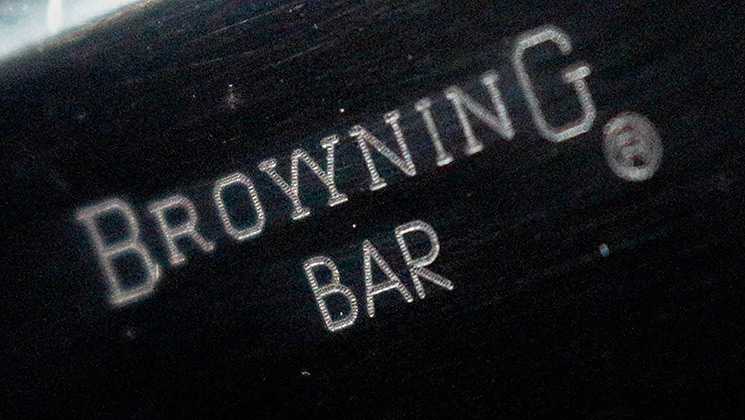
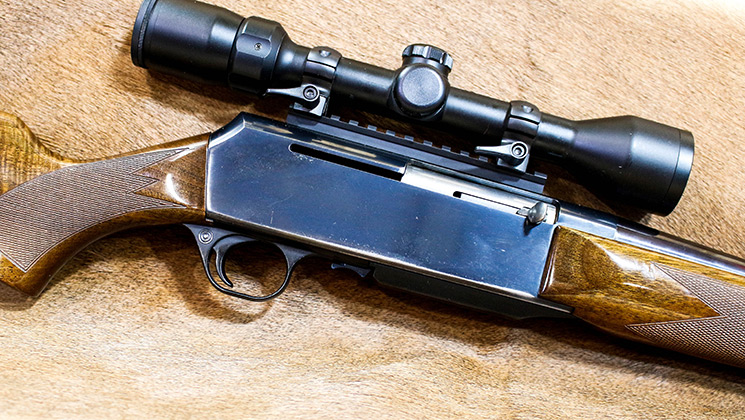
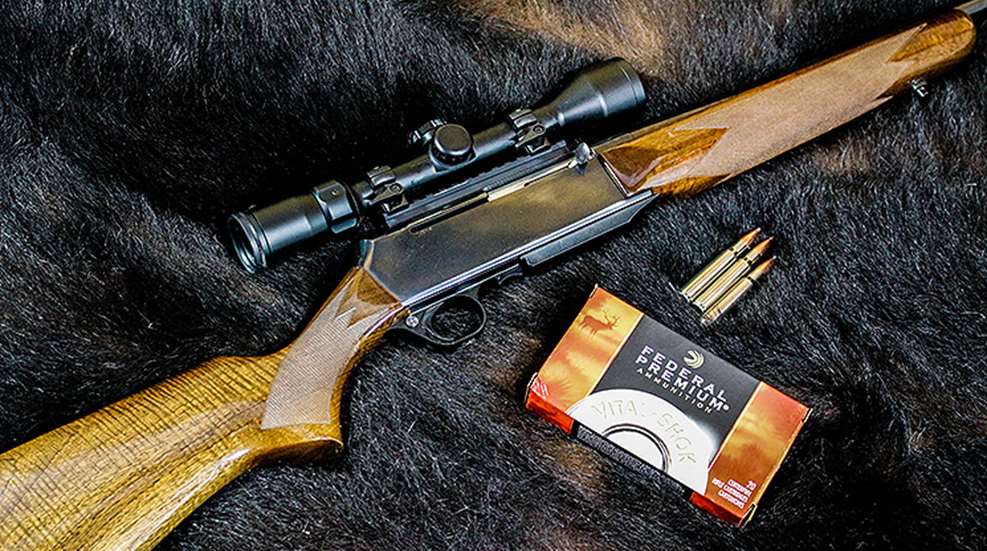
I furtively admired the gentleman’s rifle—if I recall correctly it was a .30-’06—and its trim lines and gloss finish, wondering if some day I could afford one. Well, the older me has been bitten by the bolt-action bug, but there’s no denying that the Browning BAR is one cool rig. That pronounced angle at the rear of the receiver, the clean lines, the pretty furniture; they all add up to a classy package, one that still catches my eye. And, they came chambered for magnum cartridges, including the .338 Winchester! How can one deny the cool-factor of this rifle?
While there was a “BAR” used in the First and Second World Wars—designed by one John Moses Browning—this sporting rifle is a different animal, yet there are ties to the designer. John’s grandson, Bruce Browning, had a hand in the design of the sporting rifle, in the late 1960’s. Using a very strong rotary-locking bolt head with seven lugs, and a gas system to cycle the action, the BAR was lighter on the shoulder than some of the steel butt plate rifles that were popular in that era. Browning played on the success of the Auto-5 and Sweet Sixteen shotguns to promote the new semi-automatic sporter, with its over-designed steel receiver that could handle all sorts of pressure, safely.
The original 1960’s chamberings were 30-’06 Sprg., .270 Win., .308 Win. and .243 Win., with the long-action models weighing in at 7 lbs, 6 oz., featuring iron sights as well as drilled and tapped for scope mounts. The rifle uses a cross-bolt safety, on the rear of the trigger guard, and just ahead of the trigger guard lies the magazine release, which drops the hinged floorplate magazine.
The BAR has been produced in Belgium since its inception, though the assembly work was transferred to the Viana, Portugal factory on the early 1970’s. The initial offerings were the Grade I, which offered subdued appointments, and Grade II, which had fancier wood, and engraving on the receiver; it was this model that caught my eye as a youngster.
The BAR remained virtually unchanged until the 1990’s when the Mark II was introduced. Changes were minimal, and the outward appearance remained rather faithful to the original, but there were some new options available, such as the B.O.S.S. (Ballistically Optimized Shooting System), which acts as both a muzzle brake and vibration damper, to allow the shooter to “find the sweet spot” of his or her barrel. I will go on record saying that I’ve never liked the looks of the rifles equipped with this system, and their success rate is a debatable topic, but I do know some folks who swear by them, as well as those that swear at them.
The Browning BAR MK 3 got a bit of a facelift, if you will, and the easily identifiable lines of the original have been rounded a bit, giving it a more futuristic look, and if that suits your fancy, so be it. I prefer the classic, original look, but considering the MK 3 is available with polymer stocks, and in Mossy Oak Break Up Country camo pattern, I can see why this continues to sell. It’s available in many short-action calibers like .243 Win., .308 Win. and even the .270 and .300 WSMs, as well as .270 Win. and .30-’06 Sprg. If you prefer the original style, the Mark II Safari is very close to the Grade II variant, and is available in a number of long-action cartridges, such as .25-’06 Rem., .30-’06, 7mm Rem. Mag., .300 Win. Mag. and .338 Win. Mag.. Browning clearly recognizes the changing environment in the hunting rifle world, as I appreciate the fact that though they embrace the modern advancements in alloys and polymers, they still pay homage to their roots by maintaining the lines of the original BARs in the Mark II line.
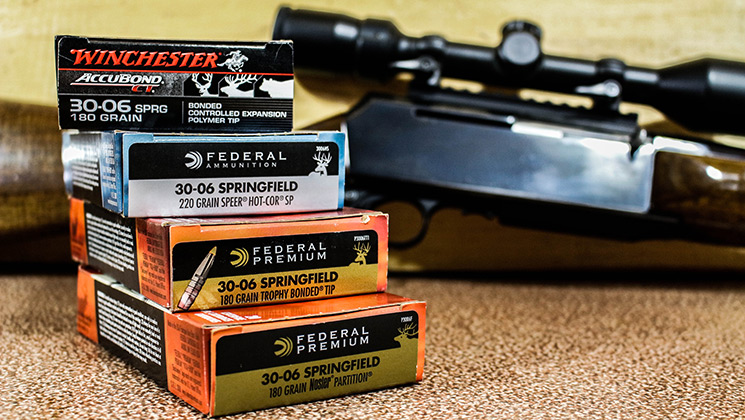
But wait, how do they shoot? Well, I’ll confess the fact that I haven’t spent a tremendous amount of time behind the trigger of a BAR, but what time I have spent has been satisfying. For years, my buddy Dave deMoulpied has used an early 80’s BAR, in .30-’06 Sprg. that would rival the accuracy of most bolt guns. This rifle, pictured above, will digest just about anything we’ve fed it, from premium ammo to the cheapest ammo we could find. Until recently, this rifle was Dave’s main-squeeze in the New York deer woods, whether in the oak woods of the Hudson Valley, or the beech and hemlock forests of the Adirondacks, and it has accounted for dozens of bucks, in all sorts of inclement weather. Where other brands of autoloaders have exhibited some problems functioning in truly cold temperatures, Dave’s BAR has always been rock steady. I’ve shot other BARs, and while they were reliable, none have come close to the performance of this rifle.
There is a definite following for the Browning Automatic Rifle, and for a good reason: in the world of autoloading rifles, it stands a head above the rest.