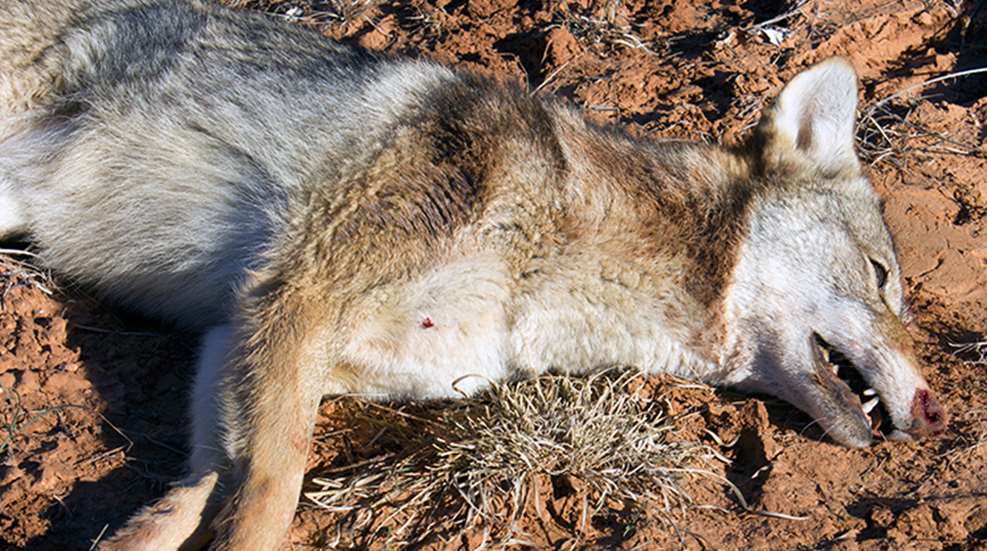
Depending on when and where you’re reading this, the hunting seasons for most game animals have come to an end. For most of us, the long weeks between the end of deer season and the beginning of turkey season can be pretty torturous. The good news is that this is an ideal time to get out and hunt predators. Coyotes are legal to hunt year-round in every state that I’m aware of—let’s take a look at some tactics and strategies that you can employ to be more effective at killing coyotes. We enlisted the help of legendary coyote killer Fred Eichler, the host of Predator Nation to help us with our list.
The Setup
This is the absolute key to the kingdom if you’re going to kill coyotes—you could have everything else going for you but, if the setup is wrong, you’re not going to have success. “The setup is the biggest thing that messes guys up. A lot of people just think they can plop down anywhere and call in a coyote. I spend as much time looking at where I’m going to setup as I do setting up.” Fred told us.
First and foremost, you need to be where they coyotes are—look for sign such as tracks, scat or hair caught in fences to establish the areas where coyotes frequent. If you can locate a dirt road or trail that they use for travel, use that as your primary spot to setup. “Coyotes can haul butt down a dirt road a lot quicker than they can going through the woods—they use them just like us.” Fred added.
Be absolutely sure that you have the wind in your favor—if a coyote smells you, it’s over. The best-case scenario is using a remote controlled call so that if a coyote circles the call to check the wind, you can still shoot him. Camo is key and you must be able to remain still. Call for 15-30 minutes maximum before moving to another location. Keep in mind that your hunting area may only have enough real estate for one really good setup—if that’s the case, don’t hunt that spot until the conditions are perfect.
Use Domestic Animal Sounds
This was one of the great tips that we got from Fred: “One of the calls that I have the best luck with, especially in areas where coyotes have been pressured, is the calf bleat. A lot of people have little farms or run a few cattle—almost every coyote that lives in even a semi-rural area where there’s a few cows around, they all know that calf bleat sound. I’ve had coyotes just charge in, caution to the wind, with a calf bleat in areas where I couldn’t call them in with a rabbit in distress, ‘cause they were familiar with that.” Using sounds that coyotes associate with local food sources rather than with hunters, is a surefire way to get more dogs coming your way.
Use a Semi-Auto
A semi-auto such as an AR-15 won’t make coyotes come into your setup and it won’t necessarily make you a better shooter, but it will be a serious advantage if multiple animals come to the call. I’m not talking about blazing away at the countryside, I’m talking about the ability to make precise shots without taking your eyes off the animals. I personally use a sound suppressor on my hunting AR when hunting predators: it protects my hearing, it helps mask the location where the shot came from (even with supersonic ammo), and virtually eliminates muzzle rise. The coyotes will still hear the shot, but the split second of confusion caused by the suppressed report may buy me enough time to take out a second animal.
Use a Decoy
Depending on the terrain that you’re hunting, and the type of call that you’re using, employing some kind of visual aid for coyotes to key-in on can be very helpful. A coyote decoy is great if you’re using territorial calls, and a turkey decoy can be great since they are a serious food source for predators. My favorite are the motorized decoys such as the Foxjack that add motion to the mix. The decoy will attract the coyote to the specific area where you are set up to shoot, and may keep their eyesight focus while you get yourself ready. Be sure that the use of a decoy is legal in your area.
Go Electronic
Mouth calls are inexpensive and effective, but they have their limitations. If you’re going to do some serious predator hunting, an electronic call is a great investment. Prices have come down to the point where a hunter can pick up a basic E-call for under $100 and more advanced units such as the Primos Alpha Dogg hunter for under $400; the excellent FOXPRO Shockwave is just under $600 but is a fantastic hunting aid. That may seem like a lot of money until you consider the value of the domestic and game animals those coyotes will kill in a year. I know that, at our farm, we could buy a couple of Foxpros for the price of one domestic calf being killed by a predator. Electronic calls can be used remotely to disguise your location, won’t cause you fatigue during 20 minute calling sessions, and allow you to keep your hands free for glassing and shooting. Quality electronic calls offer a wide variety of animal sounds that go far beyond the traditional distress calls that most coyotes are wise to.