Misses happen—I’ve had some heartbreaking misses on game before and have no doubts that it'll happen again. There are so many variables at play when we’re taking shots at game and sometimes too many of those variables stack against us and we don’t connect or, worse, we connect poorly. While we cannot eliminate bad shots, we can do our best to minimize them—especially the ones that are easy preventable. There’s a difference between “stupid misses,” those that we could avoided with proper preparation or technique, and “hard misses,” where we take a tough shot, do our best and still don’t make the hit we want. We can minimize, but not prevent, the hard misses. But the stupid misses are almost always preventable. Let’s examine a few common causes of the dreaded miss, so that we can do our best to prevent stupid mistakes.
Point-of-Impact Shift
We zero our gun from one surface—let’s say a bench rest or sandbags—and we expect that the bullet will strike the same place when we fire over a pack, off a bipod or from any number of field positions. Well, sometimes it does, and sometimes it doesn’t. Lots of movement takes place during the milliseconds that pass from the moment the firing pin ignites the primer until the bullet clears the crown of the muzzle. The way the gun is held, what the gun is rested on, how tightly the shooter grips the forend and what the rifle impacts during recoil can all alter the bullet’s point of impact. Just last week I was preparing a new rifle for a hunt this fall. I fired a three-shot group at 100 yards from a traditional bench rest with a rabbit ear rear bag and let the rifle cool down. I then traded the rest for a couple of sandbags and rested the forend of the rifle in my palm, with the back of my hand supported by the bags—the rear bag remained in place. Not only was the second group nearly half the size of the first, it was two inches lower and an inch to the left of the first group—enough to cause a miss or a very bad hit at 300 yards or more. Not every rifle is this susceptible to POI shift based on the firing position, but you never know until you test it. Shoot your rifle on paper from a variety of positions so you’ll know for sure how it will react.
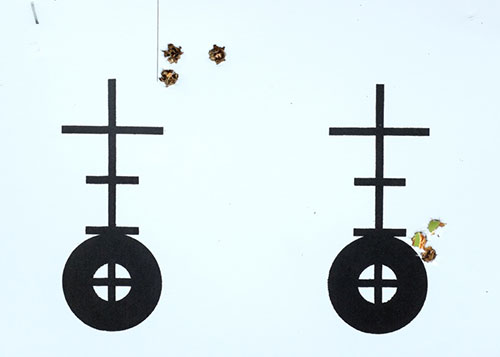 The group on the left was fired from a traditional bench rest, while the group on the right was fired with the author gripping the rifle’s forend over sandbag. Same gun, same load, same wind—different point of impact.
Incorrect Zero/Dope
Caught up in the craze of “long range” shooting, some hunters are taking shots at greater distances than ever before. The problem is that many of those hunters don’t have access to a range that allows them to confirm their points of impact at extended ranges, much less practice hitting something that far away. Just because your rifle looks like it’s zeroed at 100 yards and the box says the cartridge produces “X” muzzle velocity doesn’t make it so. Modern ballistic programs are fantastic, but if you enter the wrong data, it’s "garbage in and garbage out.” To use dope effectively, you must know your actual muzzle velocity (which means using a chronograph), elevation and atmospheric conditions, the correct height of your scope above the bore, and the true ballistic coefficient of your bullet. Even then, what looks like a good zero at 100 yards may end up being pretty far off at 300, 400 or 500 yards. You simply must shoot your rifle, with the load you intend to hunt with, at the distances that you plan to shoot and confirm that your data is correct. Anything less is unethical guesswork.
Bad Scope
Scopes break. They actually break more often than most hunters realize and they can break a fair bit more commonly than the optics manufacturers would like you to think. Some optic brands fail less often than others, but they all fail.
Sometimes scope failures can be obvious, like a visibly broken reticle or a scope that doesn’t adjust when you turn the dials (I’ve had both in the past couple of years), but failures are often more subtle. A gunsmith friend of mine recently built a rifle for a client and mounted a customer-supplied high-dollar scope for testing. The rifle shot cloverleaves at 200 yards but, when he dialed-up the elevation in the scope to simulate a 500-yard shot on the 200-yard paper target, the groups became minute-of-basketball. After much testing and head scratching, it was determined that the scope would not hold the reticle steady at the extreme ends of the adjustment range. Had this occurred in the field, the client would have likely never known that the scope was to blame.
Wrong Magnification
This is a relatively new phenomenon that coincides with the advent of “come up” reticles that provide aiming points for various ranges. If that reticle is on the second focal plane, as the majority of scopes are in this country, the calibrations are only correct at one power setting. The reticles on most of these scopes are designed to be accurate at the highest power setting on the scope, but that’s not always the case. Zeiss’ well-regarded Rapid-Z reticle uses an online software program to tell you what power setting to use based on the ballistics of your rifle/load. Make the mistake of using any of these reticles on the wrong power setting, and you will likely find yourself missing or wounding game.
You
Let’s face it: Most of us are the real weak link in the chain of hitting our targets. We wiggle, we squirm, we breathe, our hearts beat, our palms sweat, we get excited and make mistakes, and we shoot better some days than others. Very few of us practice enough to have absolute confidence in all of the shots that we take, and many of us don’t practice at all. Ask any guide what their biggest challenge is and they’ll tell you two things: their clients are out of shape and their clients don’t shoot as well as they should. None of us like to think that description applies to us but, it probably does. Take advantage of some of the excellent training schools available and practice, practice, practice. It’s easy to blame the scope, the rifle, your zero or the bullet, but the most likely cause of a miss is the hunter or huntress staring at you in the mirror.