Over the last 50 years, we’ve seen tremendous development with big-game hunting bullets. Early on, new bullet innovation was centered on bullets capable of handling high velocity impact. Bonding, partitioned cores and mono-material bullets were the answers to high velocity.
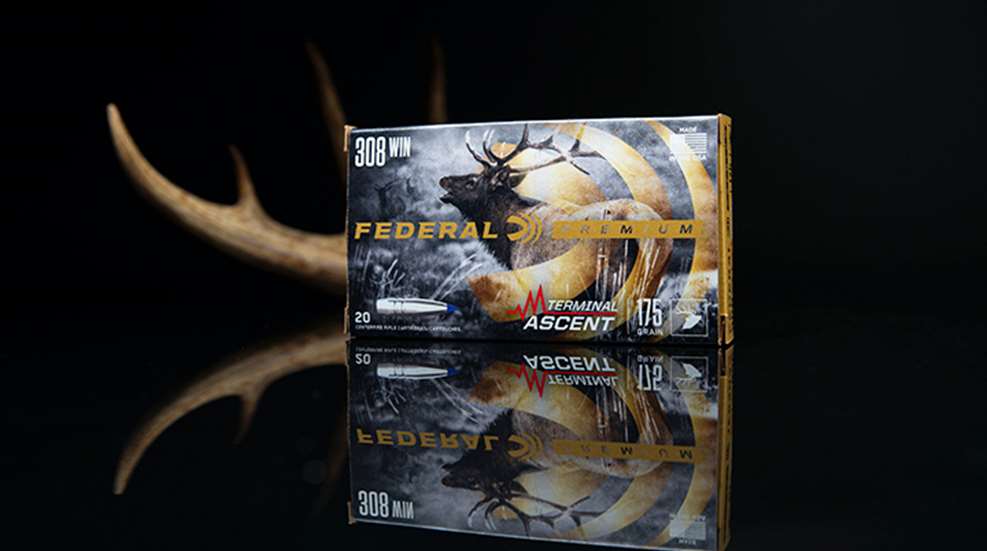
However, many of today’s hunters not only need bullets that will handle high velocity impacts, they need bullets that will also deform and damage lots of tissue when impacting at low velocity. This is because hunters are now shooting at distances previously considered, out of range. Federal’s new Terminal Ascent ammunition was purpose-built to solve that very conundrum.
Building bullets that expand and drive deep is not difficult. John Nosler did this 70 years ago with the Partition, and there have been lots of bullets built to do that very same thing since then. What is difficult is building a bullet that will expand and drive deep when it strikes an animal at 50 yards, 500 yards and even further. Of course, if you’re planning on shooting at a critter anywhere beyond 300 yards, the bullet must also be capable of delivering extreme precision.
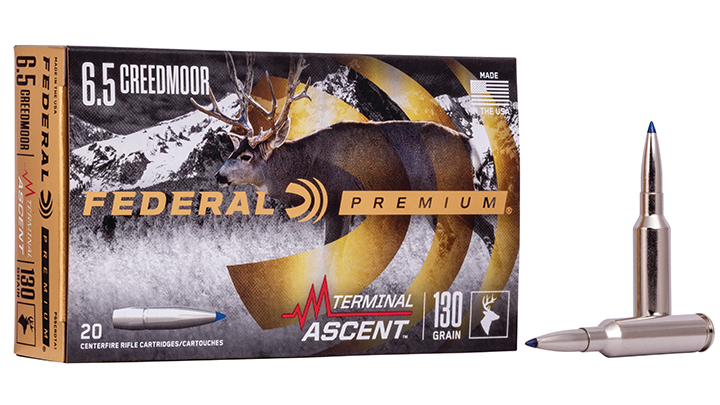
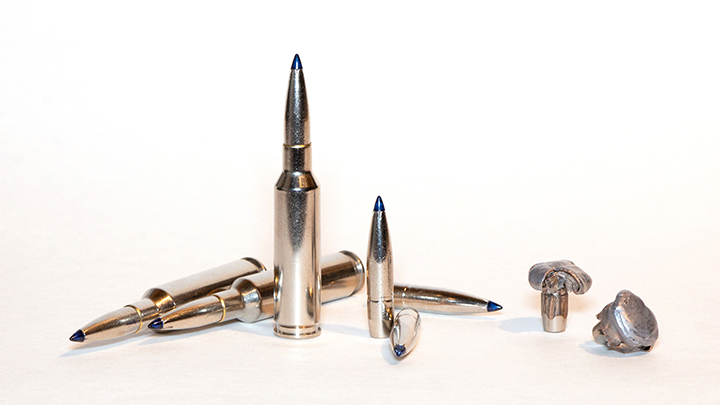
That was the goal with the new Federal Terminal Ascent; to create ammunition that worked as well at distance as it did up close. To do this, Federal incorporated a variety of features. They started with a heat-resistant polymer tip to prevent degradation in ballistic coefficient (BC) during flight. But this is not your average plastic tip; it has a hollow core that initiates expansion at slow velocities.
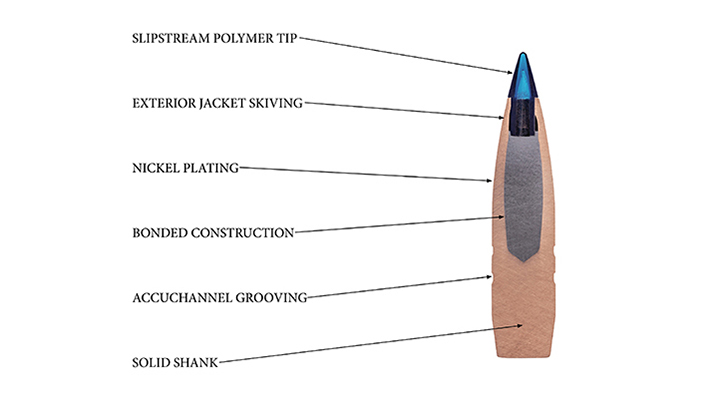
Terminal Ascent bullets have a copper jacket and a lead core. Like the Nosler AccuBond bullet, that core and jacket are bonded together. In addition, they also have a skived jacket and a large hollow point nose cavity which helps to better initiate expansion over a wide velocity range. Another unique feature is what Federal calls AccuChannels. These are grooves in the jacket that are similar to what is found on Barnes Triple Shock bullets, but AccuChannels are different. Most bullet grooves are a straight cut; Terminal Ascent bullets have grooves with sloped edges. This helps the bullet be more aerodynamic, boosts BC and helps deliver consistent flight.
Finally, Terminal Ascent bullets have a solid copper shank. This helps with weight retention, which in turn aids with penetration. Because of the Slipstream Tip, skived jacket and bonding, Terminal Ascent bullets also damage a lot of tissue because they deform/expand over a broad band of impact velocities. Essentially what you get is a balanced delivery of penetration and expansion, which optimizes tissue destruction at close range and at distance.
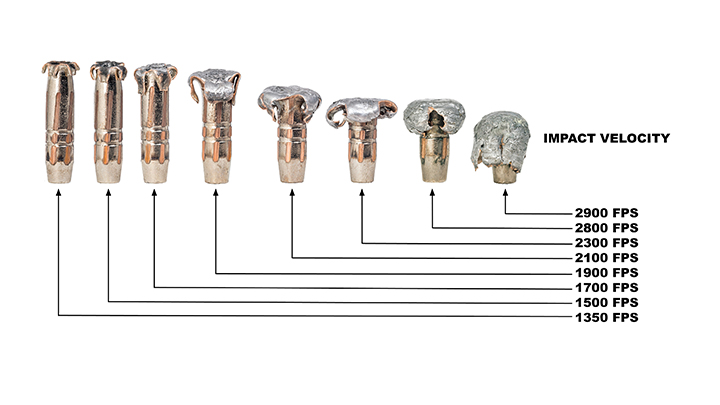
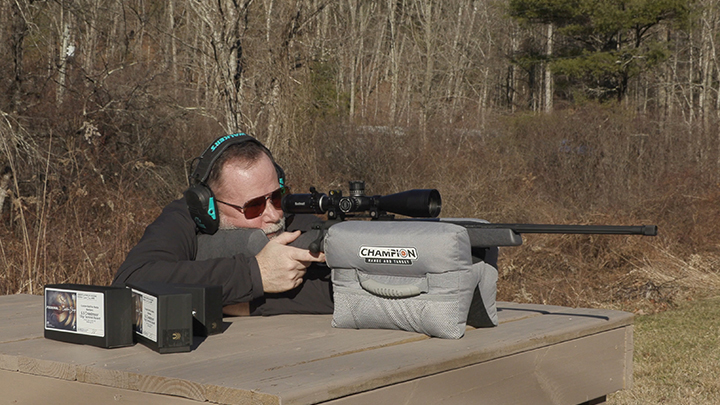
I recently tested the 130-grain 6.5 Creedmoor Terminal Ascent load from Federal, which has a G7 BC of 0.263 and a G1 BC of 0.532. I shot it to test precision from a bench at 100 yards out of Ruger’s new Hawkeye Hunter and a Mossberg Patriot rifle. I then tested it in blocks of clear ballistics at 100 yards. I also handloaded the same bullet so it would strike at 100 yards with the impact velocity you would expect to see at 300 yards. (NOTE: Downloading does not give a precise picture of performance at distance. The reduced muzzle velocity also reduces rotational velocity, and a slower rotational velocity degrades deformation. The terminal performance of downloaded bullets is close but not exact.)
The results were promising if not impressive. Five-shot groups at 100 yards averaged just slightly over an inch. And, with a 100-yard impact velocity of 2653 fps, the bullet deformed with a frontal diameter of .635-inch, which is 2.4 times its unfired diameter. It also penetrated to a depth of 24 inches. At the 300-yard impact velocity (2328 fps) the frontal diameter of the recovered bullet was .591-inch (2.23 times the unfired diameter) and it penetrated 28 inches.
Precision and terminal performance like this, delivered in factory ammunition that’s loaded in corrosion resistant, easy feeding, nickel plated cases, seems to be exactly what the modern hunter needs. Federal believes you can expect near double diameter expansion, even with impact velocities as slow as 1900 fps, and measurable expansion even when bullets impact as slow as 1400 fps. If that proves to be true, Federal will have trouble making this stuff fast enough, and it’s sure to put a lot of meat in the freezer and horns on the wall.
Terminal Ascent ammo is currently available in the following loads:
Load | Muzzle Velocity | G1 BC | MSRP
130-grain 6.5 Creedmoor | 2825 fps | .532 | $58.99
130-grain 6.5 PRC | 3000 fps | .532 | $59.99
136-grain .270 Winchester | 3000 fps | .493 | $50.99
136-grain .270 Winchester Short Magnum | 3240 fps | .493 | $51.99
155-grain .280 Ackley Improved | 2930 fps | .586 | $58.99
155-grain 28 Nosler | 3200 fps | .586 | $65.99
155-grain 7mm Remington Magnum | 3000 fps | .586 | $56.99
175-grain .308 Winchester | 2600 fps | .520 | $47.99
175-grain .30-06 Springfield | 2730 fps | .520 | $47.99
200-grain .300 Winchester Magnum | 2810 fps | .608 | $59.99
200-grain .300 Winchester Short Magnum | 2810 fps | .608 | $59.99
For more information, visit federalpremium.com.