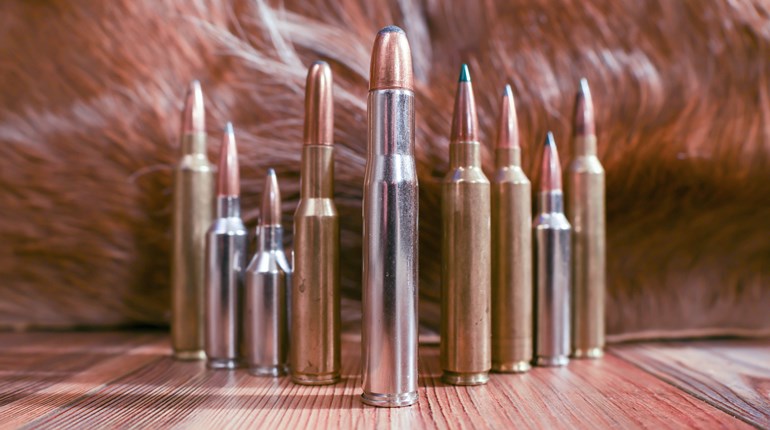
If you think the .30-30 Winchester and .30-06 Springfield have taken a good amount of game in the U.S., the .303 British and 8x57 Mauser will most definitely rival, if not beat, those numbers.
As the United States saw the wisdom of using their military cartridges as hunting rounds—think .45-70 Government, .30-40 Krag and .30-06 Springfield—so did the United Kingdom and Germany, and the .303 British and 8x57 Mauser saw extensive duty in the colonies of both countries. Both cartridges—in one guise or another—were adopted by their respective countries in 1888, and both remain popular to this day. Both offer similar performance levels, but which is the smarter choice for the modern hunter?
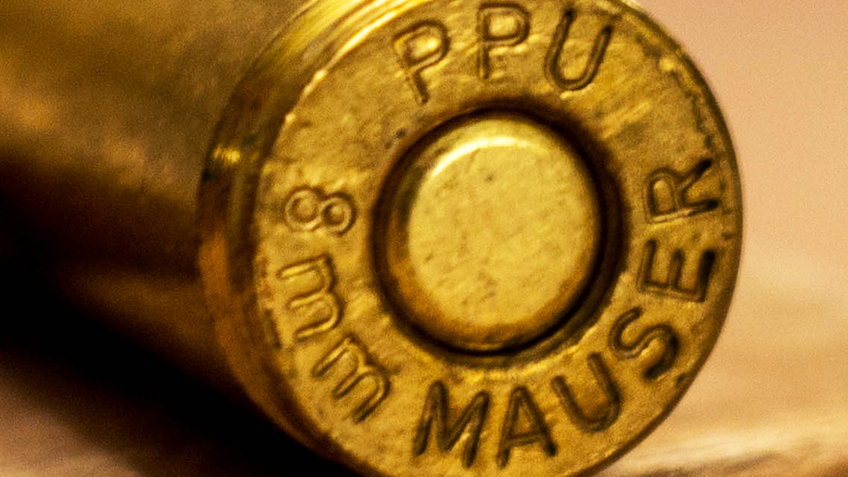
The 8x57 Mauser, or the 7.92x57 Mauser, 7.92x57mm J, 7.92x57mm JS or one of several names bestowed upon the cartridge, went through a series of revisions over the years. It was the first cartridge to use the soon-to-be-incredibly-popular 0.473-inch-diameter case head that remains in use in so many cartridges to this day, and its rimless design showed exactly how smooth a repeating rifle could feed from a box magazine. With a 57mm case, and an initial bullet diameter of .318-inch, the 8x57 would use a 227-grain round nose bullet, and designation of “I”—for Infanterie—which the U.S. Army mistook for an ornate “J.” Once the bore was revised in the early 20th century to 0.323-inch—the diameter which is still in use today—the designation was changed to “IS,” or “JS,” as it’s known here. That JS revision used a lighter, spitzer bullet weighing 153 grains.
Prior to Germany’s loss in World War I in which she lost her colonies in Africa including German East Africa (now Tanzania) and German South West Africa (now Namibia), many colonists and settlers relied on the 8x57 as their hunting rifle. It was used against all species—with varying levels of success—including elephant, and the rifles were handed down from father to son. My good pal, Namibian PH Jamy Traut, pulled out an iron-sighted 8x57 Mauser on the first day of our hunt together this year, if that’s any indication as to how well the 8x57 has hung on in a country which hasn’t been German in a century.
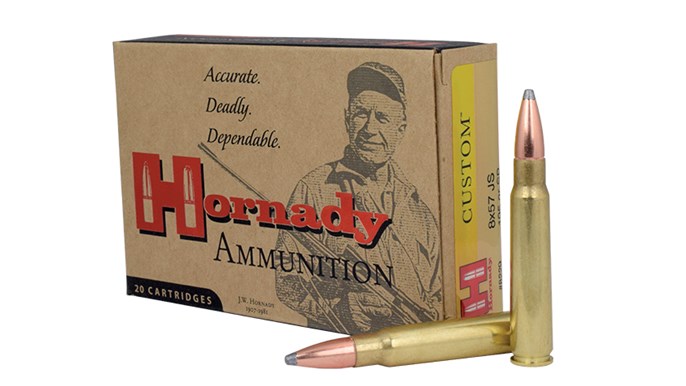
Bullet weights for modern 8x57 hunting ammunition run between 170 and 200 grains, though the handloader has bullets weighing between 125 and 220 grains at his or her disposal. Velocities for the 8x57 Mauser—in European loads—tend to run about the same as the .308 Winchester, or just slightly behind the .30-06 Springfield, making the 8x57 a solid choice for an all-around hunting rifle. Many American factory loads are loaded “light” in deference to the early rifles, of suspect metallurgy.
Her Majesty’s .303 British is a shining example of Victorian-era engineering. The tapered, rimmed cartridge uses a bullet of .312-inch, named for the land diameter as the British do about half the time. It began life using a compressed black powder charge under a 215-grain round nosed bullet at 1850 fps. In the hands of soldiers and hunters, that load made an impression around the globe, from India to China to Australia to Africa. It was this load which Lt. Col. John H. Patterson killed the Maneaters of Tsavo in 1899. In different renditions, the .303 British would remain the chosen military cartridge until the 1950s, when it was replaced by the 7.62x51mm NATO. It had a large following among sportsmen in the British colonies, and remains a popular choice in Canada and South Africa. The cartridge was popular enough to be chambered in the Winchester Model 1895 lever-action rifle, and there were many surplus Lee-Enfield rifles after World War II, which hunters on a budget took advantage of.
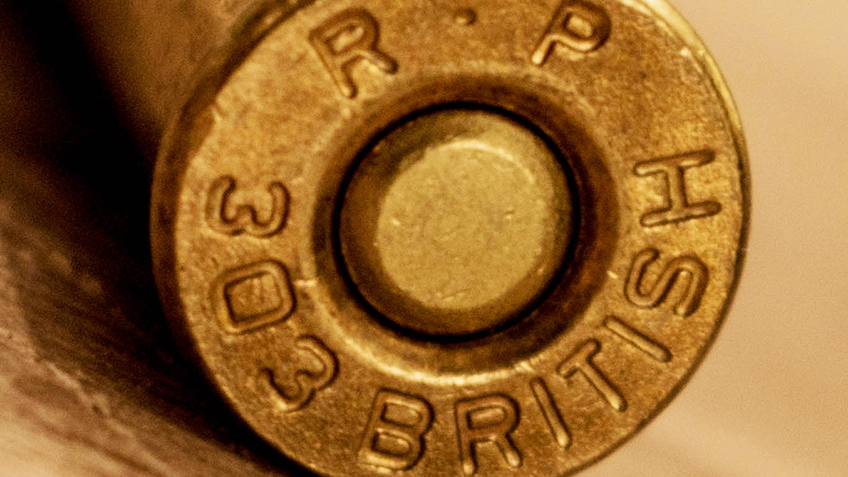
The .303 British makes a good choice as an all-around cartridge, with enough rifles still in commission and enough good ammunition to feed them. Modern ammunition is centered around the 150- and 180-grain bullets, and the velocities tend to run just a bit slower than the .308 Winchester, with the 150-grain load moving along at an average of 2675 fps, and the 180-grain at just under 2500 fps.
Which serves the hunter better? If you were to scour the gun shops for a cool vintage rifle, which would be the smarter choice? In this instance, I have to give the advantage to the 8x57 Mauser, for a few reasons. First, it feeds much, much better in a traditional bolt-action rifle. The rimless design doesn’t hang up in a box magazine, and the 19-degree shoulder gives excellent headspacing. The Gewehr 98 and K98 rifle are easily sporterized, and I’ve found them much more accurate than any .303 I've spent time with.

While I’ve seen some cool double rifles in .303 British—and equally cool double rifles in 8x57 JRS, a rimmed version of the 8x57 Mauser—the practical hunter armed with a Mauser 98 in 8x57 is, in my opinion, better armed for the hunting fields. There are far more .323-inch component bullets to choose from for the handloader, and as a bore diameter, the 8mm or .323-inch has a definite advantage over the .311″-.312″ of the .303 British. For those who possess an accurate 8x57 Mauser rifle, and are familiar with its trajectory, there are few worries afield.
Looking for previous installments of our "Head to Head" series? We've got you covered.
• .30-06 Springfield vs. All Other .30s
• .17 HMR vs. .17 WSM
• .450 Nitro Express vs. .470 Nitro Express
• 350 Legend vs. .35 Remington
• .280 Ackley Improved vs. 7mm Rem. Mag.
• .404 Jeffery vs. .416 Rigby
• .243 Winchester vs. 6mm Creedmoor
• .300 PRC vs. .300 Win. Mag.
• .30-06 Springfield vs. .270 Winchester
• 6.5 Creedmoor vs. 7mm-08 Remington
• 8x57 Mauser vs. .318 Westley Richards
• .358 Winchester vs. .350 Remington Magnum
• .22-250 Remington vs. .220 Swift
• .270 Winchester vs. .270 WSM
• .26 Nosler vs. 6.5-300 Weatherby Magnum
• .458 Win. Mag. vs. .458 Lott
• 7mm Rem. Mag. vs. .300 Win. Mag.
• .243 Winchester vs. 6mm Remington
• 7x57mm Mauser vs. 7mm-08 Remington
• .25-06 Remington vs. .257 Weatherby Magnum
• .338 Winchester vs. .375 H&H Magnum
• .30-30 Winchester vs. .35 Remington
• .257 Roberts vs. .250-3000 Savage
• .270 Winchester vs. .280 Remington
• .35 Whelen vs. 9.3x62mm Mauser
• .416 Rigby vs. .416 Remington Magnum
• .308 Winchester vs. .30-06 Springfield
• .22 Nosler vs. .224 Valkyrie
• .300 Win. Mag. vs. .300 WSM
• .223 Remington vs. .22-250 Remington