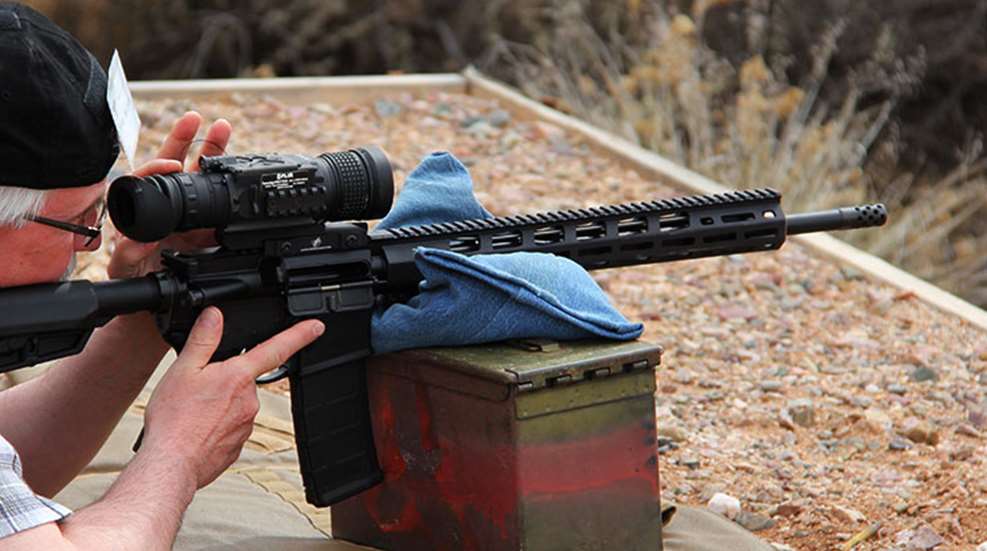
FLIR is a leading manufacturer in thermal technology, and I’ve used FLIR thermal monoculars and riflescopes for the last six years for hunting and scouting. They all work—and they work very well—but size had been problem, for FLIR as well as other thermal manufacturers. I used FLIR’s RS64 thermal scope several years ago on a Florida hog hunt, for example, and while it put me on hogs very effectively in the black of the night, the unit itself was large and bulky.
Therefore, I was interested to find out just how well FLIR’s two newest—and much smaller—thermal scopes would perform, the ThermoSight Pro Series PTS536 and PTS736. This past April, I had the chance to find out during a two day media event FLIR hosted at Gunsite in Paulden, Ariz., one of the country’s premier firearms training facilities.
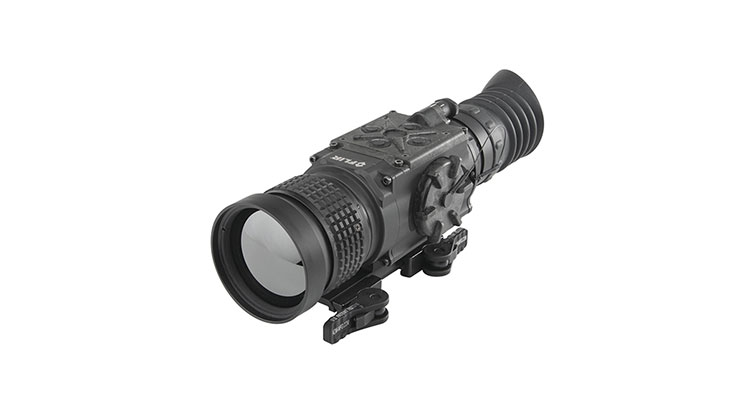
Short answer? Both the PTS536 and PTS736 are first-rate thermal scopes and will effectively allow the night hunter to take hogs, coyotes and other animals (as legally permitted) well out to 300 yards, and likely further. And these two new thermal scopes cost several thousand dollars less than many thermals on the market today.
Last year, FLIR introduced the entry-level PTS233 thermal scope. I’ve used it and it’s a nifty little unit. But with its 1.5X magnification and smallish 19mm forward lens, I rate it as a 100- to 150-yard scope. Enter 2018’s “Big Brother” duo, the PTS536 and PTS736 scopes, boasting 4X and 6X magnification, respectively, as well as digital zoom. They also feature a large forward lens—50mm on the PTS536, a 75mm lens on the PTS736. More lens surface helps create superior resolution, especially at distance.
At Gunsite, I tried them out mounted on Ruger AR-556 rifles firing Hornady Varmint Express loaded with 55-grain V-MAX bullets. First, I shot a Ruger AR-556 equipped with a PTS536 at steel silhouettes at 200 yards. The silhouettes were 12-inches wide at the chest and I aimed for center mass. The PTS536 required some adjustment. I changed out the reticle to what was a better color—red, in this case, from what had been a black setting—and adjusted the focus ring at the back of the unit.
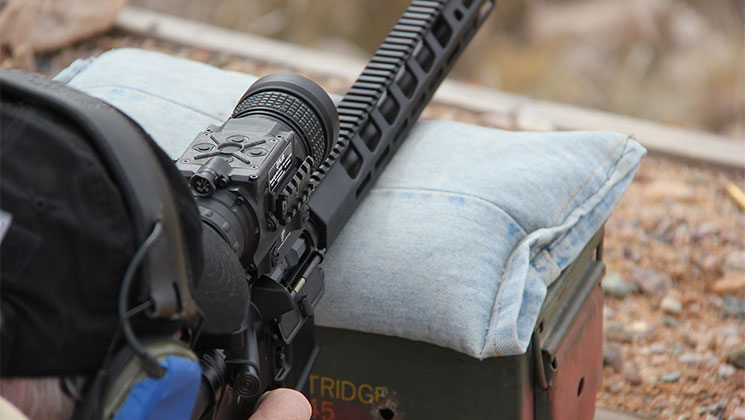
I slammed steel easily, nearly 30 times in all, firing from a prone position. The resolution and detail on the PTS536 was so good, in fact, I could see the bullets impacting on the center of the chest-area. At the 300-yard range, I took on the same size steel silhouettes, this time with a PTS736 mounted on the Ruger AR-556. Here, the best reticle color was turquoise, a change made quickly and easily by simply pushing the reticle control button several times.
With the unit’s 6X magnification, the 300-yard steel was extremely easy to hit, center shot after center shot, firing from the prone position. In fact, it got too easy, almost boring, really—and that’s not a criticism! Had the steel at 300 yards been a 200-pound hog, I could’ve easily decided to take a head shot versus a body shot and have a freezer full of free-range pork.
In both cases, the shooting was done during daylight hours, which isn’t a problem for the technology, as thermal detects heat. At night, the units should preform even better for a hunter, given the cooler air and warm bodies of hogs and coyotes.
According to FLIR, these scopes are so accurate at longer distances because they are built around a new, high-performance 12-micron Boson thermal camera core. Previous thermals were built with 17-micron cores. They worked well, but the new 12-micron versions allow more pixels, which translates to increased optical magnification, cleaner images and a better field-of-view.
Both units will look out into complete darkness and discern even the smallest variations in heat signatures. You can clearly see an animal at 200 yards at night and distinguish it from that still-warm rock—with practice, of course. Like most high-tech, thermal detection has its own learning curve.
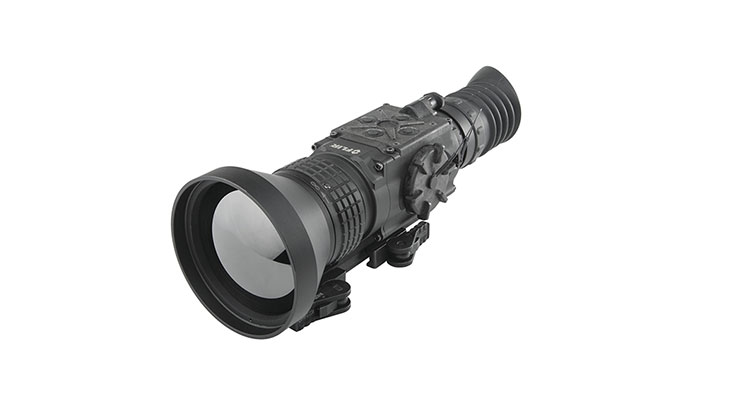
According to FLIR, “both new ThermoSight Pro models offer 60Hz video refresh rates, 320x256 thermal resolution, USB-C connectivity, user-controlled imaging palettes, image enhancement filters, and built-in digital compass and inclinometer. Shot-activated onboard recording allows for the internal storage of up to two-and-a-half hours of video or 1,000 JPEG images. ThermoSight Pro models also feature multiple reticle and thermal palette options and crisp iconology and graphic overlays over virtually all backgrounds.”
Both units are also easily adjustable. The controls at the top of the units feature four small buttons positioned around a central “On-Off” button. Press the outside buttons to adjust the thermal color palette, reticle shapes and colors, and image enhancements.
The units also feature built-in quick-detach mounts that easily mount onto Picatinny and Weaver-style rails.
This is thermal, so even though prices keep decreasing, the technology is not inexpensive. The PTS536 has an MSRP of $3,795 and the PTS736 has an MSRP of $4,795. Prices on the internet aren’t any less, either. But for a scope that will let you decide on a head-versus-body shot on a hog, at 2:00 a.m. in pitch black? That kind of technology is going to put a dent in most anyone’s bank account.
Technical Specifications: FLIR ThermoSight Pro Series PTS536
• Detector Type: 320 x 256 VOx Microbolometer
• Digital Zoom: 2X, 4X
• Eye Relief: 45mm
• Field of View: 4.5° x 3.5°
• Focus Range: 10m to infinity
• Image Processing: FLIR Proprietary Digital Detail Enhancement
• Internal Memory: up to 2.5 hours of recorded video or up to 1,000 pictures
• Operating Temperature: -4°F to +122°F
• Size (L x W x H): 10.2″ × 2.7″ × 3.3″
• Weight: 1.78 lbs.
• Lens System: 50mm; F/1.0
• Optical Magnification: 4X
• Reticle Types: dot 4 MOA; line dot; cross center dot; cross; crosshair; "no reticle"
• Mount Types: Picatinny; MIL-STD 1913; Weaver rails
• Includes: CR123A battery (2), battery cassette, spare battery cassette, USB to USB type C cable (3'), lens cloth, quick start guide, hard carrying case
• MSRP: $3,795; flir.com
Technical Specifications: ThermoSight Pro Series PTS736
• Detector Type: 320 x 256 VOx Microbolometer
• Digital Zoom: 2X, 4X
• Eye Relief: 45mm
• Field of View: 3° x 2.5°
• Focus Range: 10m to infinity
• Image Processing: FLIR Proprietary Digital Detail Enhancement
• Internal Memory: Up to 2.5 hours of recorded video or up to 1,000 pictures
• Operating Temperature: -4°F to +122°F
• Size (L x W x H): 11.1″ × 3.5″ × 3.7″
• Weight: 2.14 lbs.
• Lens System: 75mm; F/1.0
• Optical Magnification: 6X
• Reticle Types: dot 4 MOA; line dot; cross center dot; cross; crosshair; "no reticle"
• Mount Types: Picatinny; MIL-STD 1913; Weaver rails
• Includes: CR123A battery (2), battery cassette, spare battery cassette, USB to USB type C cable (3'), lens cloth, quick start guide, hard carrying case
• MSRP: $4,795; flir.com