Elmer Keith. The mere mention of the man’s name evokes a slew of historical references. He was born in Missouri in 1899, lived in Idaho and was, simultaneously, equal parts sixgunner and big bore rifle enthusiast. While he holds a place of honor among many different factions of the firearms industry, among his greatest accomplishments was the development of several handgun cartridges, including the .357 S&W Magnum.
 Keith had done rather extensive research with the .38 Special cartridge, pushing the pressure limits in the .38-44 Smith and Wesson target pistols. Experimenting in the 1930’s—with the help of D.B. Wesson and Phillip B. Sharpe—Keith saw room for improvement in the .38 Spl. case, and in response to the Colt .38 Super, began to use ever-heavier bullets and greater powder charges. Extending the .38 Spl. case by 1/8th-inch, to a length of 1.290”—so that the cartridge wouldn’t fit in a .38 Special chamber—the new .357 Mag. offered a considerable increase in velocity over its parent. This new handgun cartridge used the same .357” bullets, but took better advantage of the range of bullet weights—from 110 to 180 grains.
Where the .38 Spl., even in its +P guise, will drive a 158-grain bullet to 890 fps, the .357 Mag. will push the same bullet at 1250 fps; you can easily see why shooters and hunters rapidly embraced the new cartridge. Combine the velocity increase with the ability to drive the heavier 180-grain slugs to 1100 or 1200 fps—depending on brand and barrel length—and you’ve got the makings of a good hunting round, whether as a primary firearm or as a backup gun.
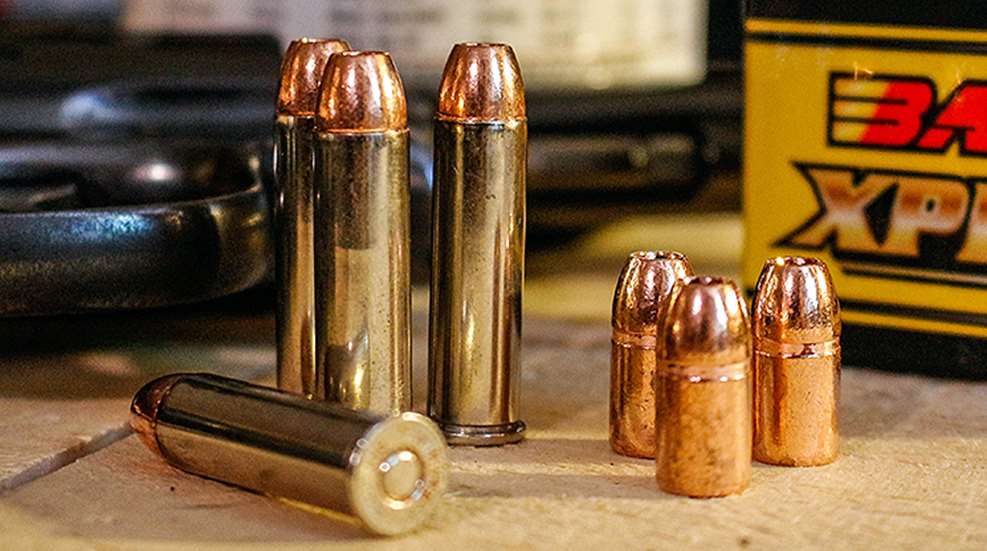
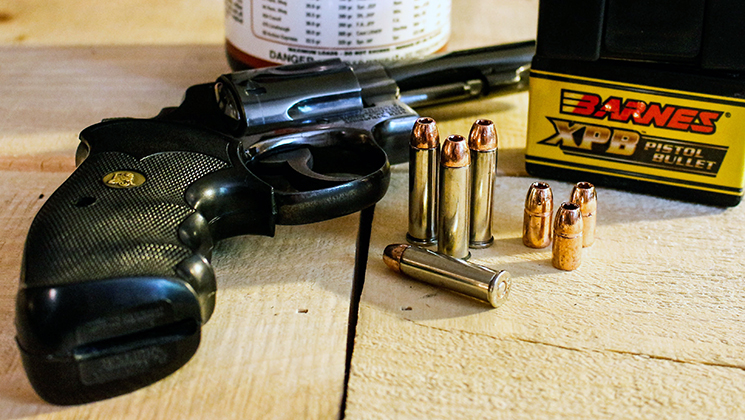
The .357 Mag. makes a perfectly viable cartridge for hunting deer and black bear, in either rifle or pistol form. In a rifle, it’s a solid 75-100 yard gun, and in a pistol, I've seen some guys print groups at 50 yards so small it’d raise your eyebrows. I can only imagine the delight of those westward pioneers, if they could’ve gotten hold of a pistol/rifle combination in this caliber; circling the wagons might have had a different outcome. Premium bullets will make the .357 Mag. even better; mate the cartridge with a Swift A-Frame or Barnes XPB and you’ve got some serious bear medicine.
The .357 Mag. shares the same rim and body diameter as the .38 Spl. cartridge, and like Keith’s plan for the .44 Mag., the hotter cartridge can and will safely fire the shorter, less powerful parent cartridge. Using the lighter loads for the .38 Spl., the shooter can become very familiar with his or her .357, developing good muscle memory and shooting techniques without the heavier recoil of the full-house .357 loads. The standard .38 Spl. loads run at a pressure of 17,000 psi, and the .38 Spl. +P loads have a maximum pressure of around 20,000 psi; the .357 Mag. can be pushed to 35,000 psi, so you can imagine that pressure differential equates to a healthy increase in recoil. The .357’s kick doesn’t quite equal that of the .44 Mag. or .454 Casull, but it does have a unique, sharp recoil that can be intimidating to some. That said, I personally find the .357 Mag. to be very shooter-friendly, especially of the handgun fits the shooter well. It is a very useful cartridge—though with a larger powder charge, it definitely performs better in a 4” barrel than any of the snubnose configurations—having the flexibility of three different levels of power.
Factory loads for the .357 Mag. are available from nearly every manufacturer of pistol ammunition. There are light, 125-grain hollowpoints, like Federal Premium’s Personal Defense line; there are heavy, flat point premium bullets like the Swift High Grade Heavy Revolver, built around the 180-grain A-Frame bullet. Federal Premium also produces a Reduced Recoil load, using their 130-grain Hydra-Shok, for those looking for a bit less pounding, and there are full-house loads, like Hornady’s Custom line, pushing the 158-grain XTP bullet at 1250 fps.
Want your .357 in a proper rifle? There are great developments in that department as well. Hornady’s LeveRevolution—with the 140-grain FlexTip spitzer—will improve the trajectory in comparison to the flat and round nosed bullets. The rubbery tip is completely safe to use in a tubular magazine, and helps initiate expansion.
There have been many visionaries in the firearms industry—the John Brownings and the Peter Paul Mausers—but I firmly believe that if for nothing other than the .357 Mag. and .44 Mag., Elmer Keith deserves inclusion into that group. The .357 Mag. is a sound and useful design, one that will continue to be enjoyed by shooters and hunters alike for decades to come.
Looking for previous installments of Behind the Bullet? We've got you covered.
• 6.5-284 Norma
• 8x57 Mauser
• .38 Smith & Wesson Special
• 7x57mm Mauser
• 9 mm Luger
• .35 Whelen
• .454 Casull
• .375 H&H Magnum
• .45 Colt
• .22-250 Remington
• 10mm Auto
• .308 Winchester