Ammunition companies have been trying for decades to build a better bullet, especially the tipped variety. There are plenty of options on shelves, and for most hunters there’s no reason to upgrade. But wait. What about those seeking perfection and wanting to push the envelope to 600 yards or beyond? That’s the trend today.
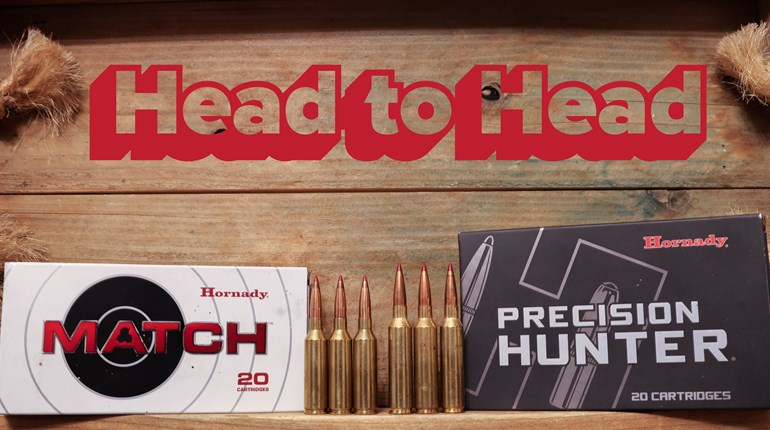
Hornady addressed this category with its introduction of two new tipped bullets that excel at extended ranges for hunting and match applications. The company’s ELD-X (Extremely Low Drag-eXpanding) bullet for long-range hunting and ELD Match bullet both have what Hornady calls the Heat Shield Tip and are available to reloading enthusiasts as well as in new lines of Precision Hunter and Match factory ammunition.
The development of both bullets included an aura of rocket science. Before Hornady created the new ELD series, company ballisticians noticed current tipped bullets were inconsistent in flight, especially at high velocities and extended ranges. Standard measurement of velocity and ballistic coefficient (BC) is tracked through the use of chronographs. Determining BC incorporates two, maybe three, points of data collection, which are generally separated by 100 yards. Chronograph tests do not account for what’s happening with a bullet before, between and after it passes through the data capture zone. Partial assumptions are included when calculating BC via this method.
 In 2011 Hornady adopted Doppler radar technology that the military has been using for weaponry tracking since the 1960s. Doppler revealed what chronographs could not by measuring the shift or frequency changes reflected from a moving object every 1-2 feet. Doppler divulged there was a shift in tipped-bullet flight that chronographs weren’t capable of detecting. And by using the bullet’s drag coefficient, which is the calculation of an object’s total resistance in air (or water) related to the object’s shape, Hornady was able to get an exact breakdown of the projectile’s performance with no assumptions necessary. With the new information, engineers pointed a finger at heat as the culprit of inconsistent flight.
A high-velocity bullet encounters extreme heat during flight, albeit for a brief period of time. One traveling at 3000 fps can experience temperatures above 800 degrees Fahrenheit. Standard polymer, the material used for most current tips, can be in a rubber-like state at room temperature and has a melting temperature of 320-345 degrees. Doppler showed that at .1-.15 second of bullet travel, or 100-150 yards downrange, flight degradation was already underway, and Hornady engineers believed the intense heat was changing the shape of the polymer tips.
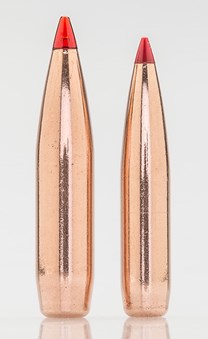
Hornady’s answer was the Heat Shield Tip, made with a patent-pending material that does not reach a rubber-like state until 475 degrees and has a melting temperature above 700. The new composite material does not degrade at normal bullet velocities and retains its shape even if velocities are nudged beyond normal. To take advantage of the technology Hornady increased the size of the tip and optimized the meplat diameter for more heat capacity. Immediately Doppler readouts showed a huge jump in the BC of the ELD bullets and uniform drag from shot to shot, which translated to improved accuracy at long range.
It’s impossible to recreate a duplicate test environment at my home range, but Hornady invited me to visit the company’s Doppler-equipped test site and compare competitors’ bullets side-by-side with the new ELD-X bullet at long range. Testing over a distance of 1,620 yards, Doppler data showed the ELD-X 212-grain bullet shot from a .300 Win. Mag. yielded an average BC of .336, based on the G7 standard. Both competitor bullets we tested had higher advertised BCs, but when we analyzed Doppler data from comparable weight bullets fired in the same rifle, over the same distance and under the same atmospheric conditions, the two competitors yielded a G7 BC high of .317 and .319.
Through Doppler evaluation, Hornady determined that many current BCs listed for bullets were off—and some by quite a degree. Hornady also tested its A-Max bullet against the Heat Shield Tip design and in all calibers of 6.5mm and larger, BCs were dramatically higher with the latter. (Hornady admits that for calibers smaller than 6.5mm, testing showed no real advantages to the Heat Shield Tip.)
Besides boosting BC, the Heat Shield Tip aids expansion at extended ranges and at velocities as low as 1600 fps. Plus, since Hornady wanted the ELD-X to work for all hunting situations including shots at short ranges, designers gave the bullet a thick shank and an InterLock ring to control expansion and to keep the jacket and core together at high impact velocities.
Extensive gelatin testing at short and long ranges confirmed the ELD-X offered devastating, penetrating wound channels. My real-world test on a 51/2-year-old mule deer buck at 300 yards was eye-opening. The 200-grain ELD-X bullet from my .300 Win. Mag. entered, expanded and plowed a massive wound channel through the buck’s huge body. He tipped on the spot.
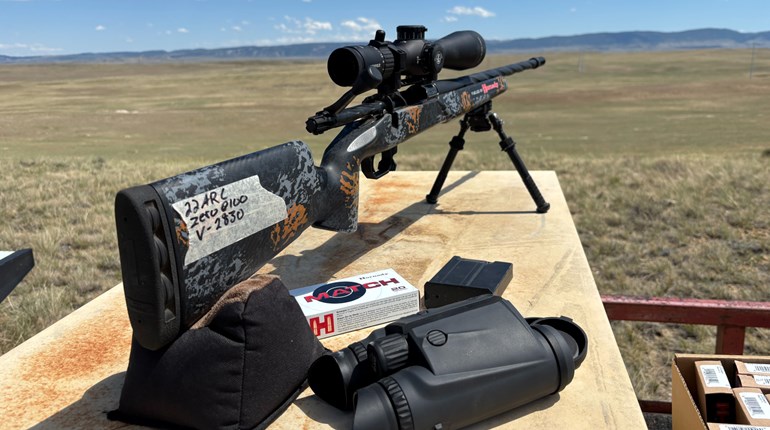
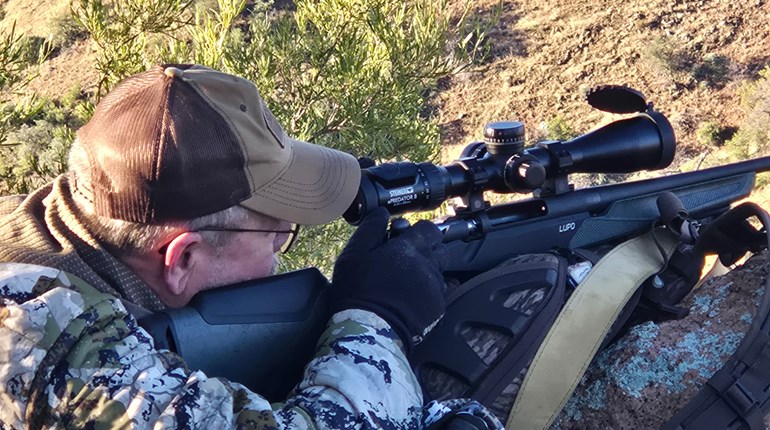
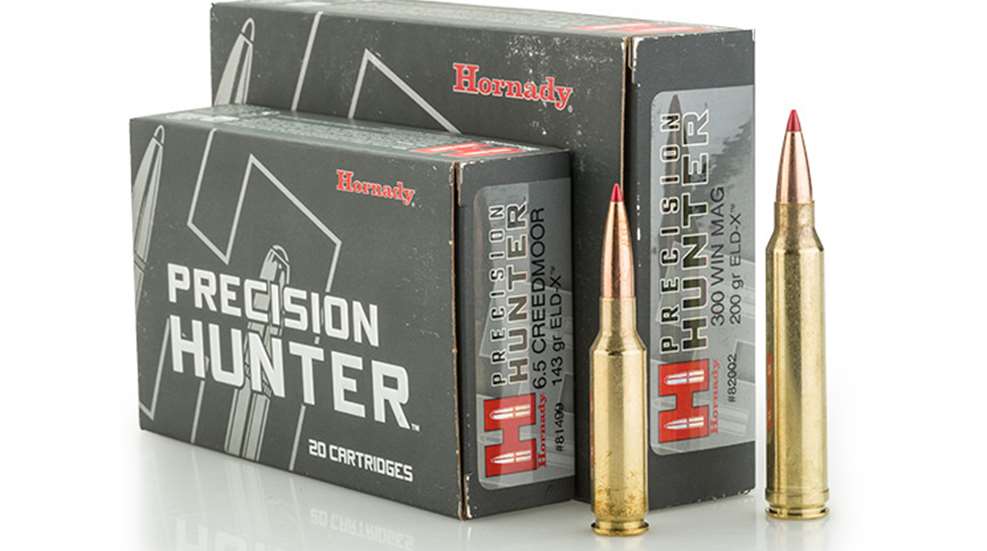
I tested Hornady Precision Hunter ammunition loaded with ELD-X bullets in 6.5 Creedmoor and .300 Win. Mag. At 100 yards I obtained consistent sub-MOA groups with each load in factory rifles, and I was able to tap metal silhouettes the size of big-game vitals on every shot at 600 yards when the Wyoming winds weren’t screaming across my pasture.
At the Hornady range, under the direction of a wind spotter, I was able to hit metal targets consistently from 600-1,200 yards shooting a custom rifle in .300 Win. Mag. During this test I used 212-grain ELD-X handloads, and the bullets were buffeted by a 15 mph crosswind. Hornady test shooters recorded 4-inch groups with the 200-grain ELD-X shot from a .300 Win. Mag. at 930 yards. Of course your rifle results will vary, but if you have a rig that shoots well now, I have reason to believe it will shoot even better at long range if you feed it ELD-X bullets.
Hunters who have the shooting skills to take big game at extended distances and those who want a bullet that will perform consistently both in flight and on impact at all practical ranges are the real winners in this advancement. With prices comparable to other premium-grade ammunition there’s really no reason to not consider Hornady Precision Hunter or reloading with the ELD-X bullet. You never know when the trophy of a lifetime will step out 714 yards away.
Technical Specifications:
• Caliber: 6.5 Creedmoor (tested), .300 Win. Mag. (tested); other 7mm and .30-caliber loads available
• Bullet Weight (grs.): 143 (6.5 Creedmoor), 200 (.300 Win. Mag.)
• Bullet Material: lead core, gilding-metal AMP jacket w/InterLock ring, Heat Shield Tip
• Ballistic Coefficient (G7): .315 (6.5mm), .315 (.30 caliber)
• Muzzle Velocity (advertised fps): 2700 (6.5 Creedmoor), 2850 (.300 Win. Mag.)
• Muzzle Energy (advertised ft.-lbs.): 2,315 (6.5 Creedmoor), 3,607 (.300 Win. Mag.)
• MSRP: $42.88 (6.5 Creedmoor), $54.77 (.300 Win. Mag.) per 20-rnd. box