On a few occasions I’ve been stunned by the ploys savvy callers made right in front of me. Yeah, no matter how good you think you are at calling turkeys there is always someone out there who can surprise you. When they do something you never considered to bring in a call-shy tom those last few yards or even to get a gobbler to leave his hens, well, then you just have to take off your hat and bow to a master—and then unabashedly incorporate the tactic into your bag of tricks. Here are five ruses I witnessed, was astounded by and have since successfully used.
Go Big
“He’s an old bastard. We’ve been trying to shoot him for years,” Mark Drury, of Drury Outdoors, whispered as a tom gobbled 100 yards away from a tree on a ridge above us. We were just inside the edge of a woodlot looking down into a small cow pasture that circled to our left and went up and over a hill behind us. At the bottom in front of us was a small stream. Beyond the stream was the wooded ridge and the roosted gobbler.
We had to get in there an hour before light to get this show ready. I soon found out why.
“That old boy has a lot of hens,” said Drury. “He pitches down here with them, but always out of range. Not this morning.”
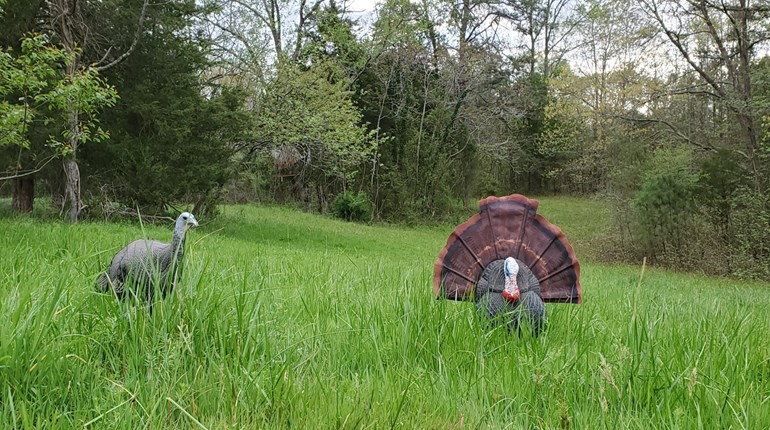
Mark had placed two hen decoys and a gobbler decoy in the pasture in front of us. In the early light he took out a turkey wing and mimicked three fly-downs. He then started softly yelping and gobbling. After a while his turkey calling grew to a chorus of cutting and yelping. His charade was so big hens started pitching to us from the ridge and Mark got quiet. The gobbler didn’t fly down until we were covered with hens. Some of them were calling. The gobbler eyed our setup from the air and landed out of sight over a rise in the pasture on our left. Mark started cutting with a mouth call and the hens started looking and then coming into the woods. This got the gobbler’s curiosity working. He craned his neck just over the rise for a peek. When I shot he disappeared. But he was there, down for good just over the rise.
Gobble Like a Jake
Midmorning we heard a soft gobble followed by a few half-gobbles. This told us some subdominant birds were 200 yards away and across a green field. It was the third week of the season and it was hot. I set up and tried soft yelps and purrs. Nothing. I tried scratching in the leaves on the quiet morning and used a wingbone turkey call—a call few hunters in my area use. I heard another soft gobble, but they still didn’t come. After an hour I was ready to give up and back out in search of a more receptive tom. These birds had obviously been bumped a few times and had likely been thumped into passivity by dominant gobblers.
This is when a hunter with me—a retired cop—whispered that he’d give it a try. He started working a gobble shaker so aggressively I thought he’d chase them away. But he wasn’t making full-throated gobbles. He was gobbling timidly—like a teenager trying to sound tough as his voice cracks. After a few minutes of this the subdominant gobblers got so fired up they ran across the field and then, cautiously, with their necks craning, came into range.
I tend to get patient with hung-up toms, but sometimes aggression is more convincing.
Bring a Whole Flock
What’s a turkey vest but a bag of tricks? Too many hunters rely on just one call—and one type of call—at a time. This can work, but when gobblers have learned that a yelping hen can really be a guy with a 12-gauge shotgun it can help to sound too real not to be.
Ray Eye, the turkey-hunting guru who runs Eye on the Outdoors, made this point to me years ago. A group of gobblers and hens was in a field. They were 200 yards away and had all the company they wanted. Sure they’d gobble to us, but they saw no reason to move our way.
After a few minutes of this Ray started to sound like a one-man band. He had a mouth call in, friction calls spread in his lap and a push-button call in one hand, and was making them all play in harmony. The whole orchestra of calls was so overwhelming the hens got quiet and started to watch and listen. Then they all started over to the party. I had my pick of gobblers.
Walk Away Calling
I learned this one from Gene Nunnery’s classic book, The Old Pro Turkey Hunter, and it has worked on several cantankerous gobblers that didn’t have hens and loved to gobble but would never come. They seemed impossible to kill, until I just walked away while calling.
You call. He gobbles. You move away and call. He gobbles. You keep this up for, say, 200 yards. Finally, you use some terrain feature to hide your movement as you slip back 100 yards without making a sound. There is a good chance he’ll follow—if the tom doesn’t have hens. If you have a hunting partner, this trick is even easier. You stay put as your buddy moves away calling.
Bring a Fan
On a hunt in South Dakota I kept wondering what a turkey fan—a real gobbler’s tail feathers—was doing jutting from the back of Ken Byers’ turkey vest. The feathers, which were bouncing as he walked across open prairie in front of me, made me think of a cock pheasant’s tail a proud hunter purposely dangles from the back of his upland vest.
Ken stopped on a bluff and I asked, “Those feathers your good-luck charm?”
“Sort of,” he said. “Out here we fan in gobblers. You’ll see.”
Ken grew up hunting the Eastern subspecies, but he had to change tactics when he started hunting Merriam’s in South Dakota. He said, “Once a Merriam’s gobbler flies down from the roost he isn’t likely to gobble much. Out here they learn to rely on their vision, not their ears.”
The tactic is to sneak as close as topography will allow before one guy raises a real turkey tail fan. Turkeys have pecking orders. This makes them very likely to respond to a new tom.
We later found a group of hens and gobblers in a green bottom between steep grassy bluffs. The wind had become fierce and the turkeys had found a place out of it. There was no chance of calling them closer. It was time to try the fan. We figured they were on the other side of a 12-foot embankment. Normally, crawling toward a tom from atop an open embankment would be futile, but not with the fan.
Ken and I crawled together behind the open fan. There was a group of hens and four strutting toms. They could see us right above them, but they didn’t notice the shotgun barrel sticking out from behind the fan. I’ve since used this tactic in the Eastern hardwoods and in open fields. It is yet another thing worth having in your bag of tricks. As with any decoy, just take every safety precaution to make certain other hunters aren’t fooled as well.