Photo Courtesy USFWS
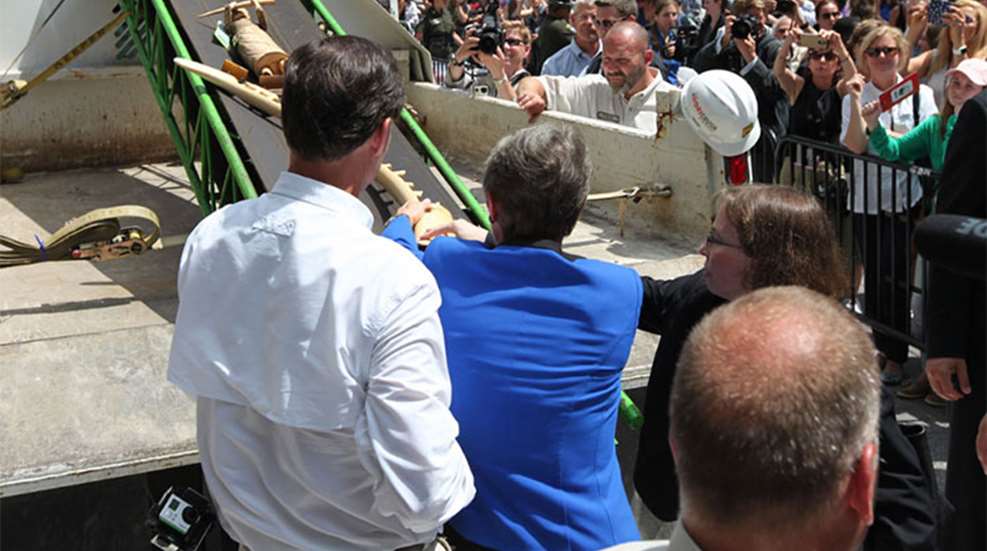
The U.S. Department of the Interior on June 19 convened in New York City’s Times Square to destroy ivory confiscated in the “war on poaching,” according to a press release from Interior. At the event, Secretary of the Interior Sally Jewell was joined by U.S. Fish and Wildlife Director Dan Ashe, officials from the state of New York and the Wildlife Conservation Society, and by officials from three virulently anti-hunting organizations: the Humane Society of the United States, the International Fund for Animal Welfare and the Natural Resources Defense Council. The action, said Interior officials, was meant to send “a clear message that the United States will not tolerate wildlife crimes that threaten to wipe out the African elephant and a host of other species around the globe.”
The ivory, more than a ton of raw and carved tusks and statues, was turned to dust in an industrial rock crusher.
The event is the latest in a series of actions by the Obama administration designed to crack down on demand for ivory that fuels international poaching rings. In July 2013, President Barack Obama signed an executive order establishing an interagency task force charged with developing a National Strategy for Combatting Wildlife Trafficking. The task force’s approach focuses on three objectives: strengthening enforcement, reducing demand for illegally traded wildlife and expanding international cooperation. Subsequently, in November 2013, the USFWS destroyed 6 tons of contraband ivory. Since then, nine governments have followed suit and destroyed ivory, and campaigns to reduce demand for ivory and strengthen laws against poaching and illegal wildlife trafficking worldwide have gained steam.
Any ivory that has been illegally traded can never be sold in the United States. Much of the ivory crushed June 19 was confiscated from the store of Victor Gordon, a Philadelphia art and antique dealer who pleaded guilty in federal court in 2012 to smuggling African elephant ivory into the country. The seizure was one of the largest nationwide of elephant ivory. Other ivory crushed in Times Square was seized in operations conducted by the USFWS, the New York State Department of Environmental Conservation and the Los Angeles Police Department.
On June 19, Jewell, chair of the White House Advisory Council on Wildlife Trafficking, said, “Today’s ivory crush serves as a stark reminder to the rest of the world that the United States will not tolerate wildlife crimes, especially against iconic and endangered animals.”
USFWS Director Dan Ashe said, “Regardless of their country of origin, we all lose if elephants, rhinos, tigers and other iconic animals disappear. The only way we will save them is together through a concerted global effort to end the scourge of wildlife trafficking and the devastation it brings to these animals. Today, the United States underscored its commitment to winning this fight, and we call on all nations to join us by destroying their confiscated ivory stockpiles, enacting and enforcing strong regulations protecting wildlife from illegal trade, and reducing demand.”
Such statements from Jewell and Ashe, however, are troubling. It’s misleading, for instance, to lump African elephants alongside animals like rhinos and tigers, which actually are endangered. Doing so confuses anti-hunters, non-hunters and hunters alike. While everyone agrees ending poaching and the wildlife trafficking it supplies should be foremost among worldwide conservation efforts, it remains to be seen how destroying ivory actually quells demand for it.
The actions in Times Square on June 19 lead Ben Carter, executive director of Dallas Safari Club, to question the rationale of the Department of the Interior. Rather than destroy the ivory in a publicity stunt, says Carter, the ivory confiscated under due process of law could be sold on the open market, and profits realized from its sale could be poured into actual conservation. The same can be said for the stockpiles of confiscated ivory held in countries across Africa: rather than destroy it, as urged by Jewell and Ashe, nations could sell it under controlled circumstances and use money earned to fund anti-poaching efforts. The sale of lawfully confiscated ivory also could reduce the price of ill-gotten ivory on the black market, say hunter-conservationists.
In fact, African elephants are listed as threatened—not endangered—under the Endangered Species Act. Trade of threatened and endangered species, and parts of them, is regulated under the Convention on International Trade in Endangered Species of Wild Fauna and Flora (CITES), a global agreement among 181 nations. As a threatened species, African elephants are indeed legally hunted in many countries (notwithstanding the USFWS’ recent decision to ban the import of legally hunted elephant tusks from a handful of countries’ populations). Many conservationists steadfastly note the only thing “endangered” about African elephants is their habitat, which is continually gobbled up by human encroachment.
African elephant ivory—including legally hunted trophies and certain noncommercial items that meet specific requirements—can be imported to the United States. The U.S. government does, however, prohibit commercial importation, and it regulates domestic trade of raw ivory and ivory products.