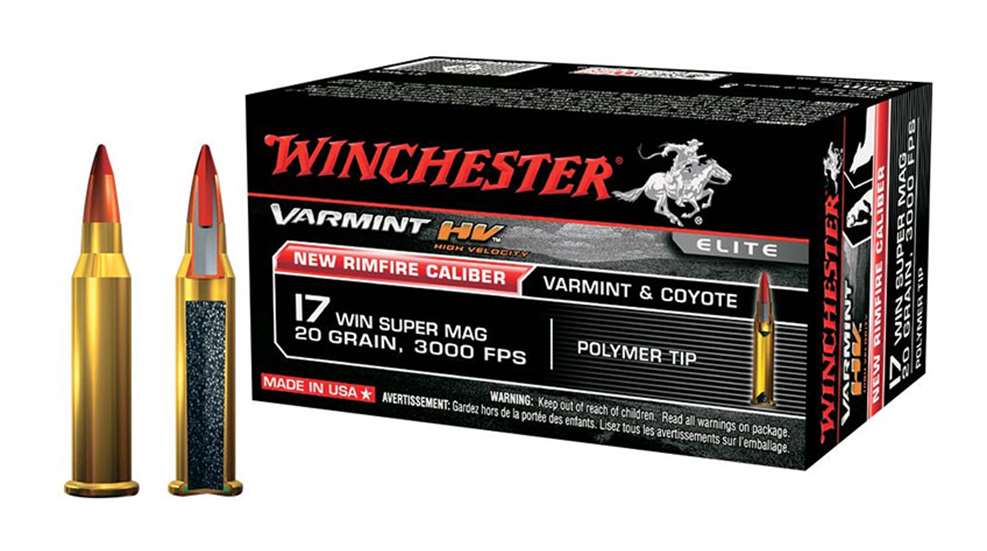
As near as I can tell, the .17-caliber bullet traces back to late 19th century France and Flobert’s experiments with rimfires using the priming compound as a propellant. The bullet diameter is noted in the United States in the 1920s by Charlie O’Neil. The first cartridge was probably the .17 Pee-Wee, based on a necked down .30 Carbine. Sometime in the late 1940s P.O. Ackley started fooling with .17s, and a bunch of wildcat cartridges followed.
The .17-caliber rifle cartridge remained the domain of the wildcat experimenter for more than two decades until Remington legitimized the diminutive-bullet concept with the introduction of the .17 Remington in 1971. That created a bit of a stir with its 4000 fps muzzle velocity and inspired some outrageous claims, including at least one idiot who said he used it to hunt brown bear.
To put it in perspective, this is a bullet that’s the same diameter as the steel BBs that kids use in Daisy air rifles. On the scale of rifle bullets, the .17 caliber is the tiny tip of the spear that represents the small end.
Once the novelty wore off and reports of barrel fouling filtered in, interest in the .17 Rem. waned. It never left us completely, but the .17 caliber never did much more on a commercial basis until Hornady had the bright idea to put the little bullets in a rimfire cartridge.
I’ve got to admit, when they necked down the .22 Magnum in 2002 and called it the .17 HMR (Hornady Magnum Rimfire) I thought it was a fad. But I was wrong, and the cartridge is extremely popular. The .17 Mach 2, based on the .22 LR case, followed two years later, but has not gained as much popularity.
The success of the .17 HMR inspired a couple of new centerfire runs at the title by making an honest cartridge out of two popular wildcats. Remington introduced the .17 Fireball in 2007 based on a .221 Fireball case. In 2012 Hornady brought out the .17 Hornet, based on, you guessed it, the .22 Hornet. But until this year, the rimfire market has been stagnant. I suppose Winchester was feeling left out. It's new cartridge is the .17 Winchester Super Magnum or WSM. Of course that’s a clever play on their centerfire WSM or Winchester Short Magnum trademark.
The .17 WSM was born from industry. Powder-actuated tools use a type of blank rimfire cartridge to drive nails. Mine uses a .22 cartridge that is available in several power levels and will drive a spike into concrete. There are various levels of power, and Winchester was making a large case, rimfire, .27-caliber cartridge to power these tools. They decided that rimfire case might make a pretty interesting .17-caliber cartridge.
The SAAMI maximum average pressure for this cartridge is 33,000 p.s.i., which is hefty for a rimfire. In fact, it’s higher than some centerfire cartridges. Brad Criner is the engineer in charge of the project and he told me that they reinforced the case to handle higher pressures. The trouble with a rimfire is that the priming compound is in the space created in the folded rim. The brass must be thin enough so that the firing pin can dent it to cause the priming compound to fire. But it can’t be too thin or the pressure will split the case. Somehow Brad and his team found the balance that allows this high pressure and still provides reliable ignition.
Winchester lists a 20-grain bullet at 3000 fps muzzle velocity and a 25-grain at 2600 fps. They offer both in a polymer-tipped bullet. Criner told me Winchester Ammo also is introducing a hollow-point 20-grain load in the future with a lower price.
When comparing 20-grain bullets with a 100-yard zero at 150 yards, the .17 HMR drops 3.14 inches below the line of sight. The .17 WSM is 1.56 inches low and the .17 Hornet is .77 inch low.
At the muzzle, the .17 HMR has 251 ft.-lbs. of energy. The .17 WSM has 400, while the .17 Hornet has 592 ft.-lbs. At 150 yards, the .17 HMR is down to 98.9 ft.-lbs., the .17 WSM is at 172 while the .17 Hornet has 271.
The .17 WSM cartridge case is 1.2 inches long vs. the .17 HMR at 1.058 inches. The body diameter is .269 while the .17 HMR is .238 inch. This is a substantially larger case. The rim diameter for the .17 WSM is .333 inch while the .17 HMR is .286. This rim dimension may be a problem for the cartridge. When the .17 HMR was launched, any company making .22 Magnum firearms had only to put a different barrel on the gun and it was good to go. (To be honest, semi-autos proved a bit more problematic.) But no gun company has a rifle designed for the case size of the .17 WSM. The other issue is that this is a very high-pressure rimfire cartridge and most existing rimfire firearm designs may not be strong enough to handle the added pressure. My guess is that most gun companies are probably going to take a “wait and see” approach before committing the R&D money to develop a new gun for an unproven cartridge.
The exceptions so far are Winchester and Savage. Winchester will chamber the cartridge in a High Wall single-shot. Savage created a new rifle called the B-Mag just for this cartridge, pictured here.
Winchester B-Mag Rifle
This blued-metal, polymer-stock bolt-action is a small and lightweight rifle, as a rimfire should be. It has two opposing locking lugs on the rear of the bolt that lock into the receiver, which is much stronger than a traditional rimfire rifle action. The Accutrigger breaks at a clean, crisp, 2 pounds, 5 ounces. The barrel is 22-inches long and the gun has an eight-shot rotary magazine that fits flush with the stock. It’s a slick little rifle and a good match for the new .17 WSM.
The .17 WSM should make a good cartridge for prairie dogs and ground squirrels out to 200 yards. With careful shot placement it will handle ground hogs, raccoons and similar pests. It will also handle foxes and bobcats when shots are relatively short. I'm sure it will see use for coyotes, but in my opinion it’s a bit light for them.
There is no question the .17 WSM elevates rimfire ballistics to a new level. But when staring into my crystal ball, the future is a bit murky. The Savage is an excellent rifle, but many American gun owners are loyal to specific brands. If enough rifle companies decide to offer guns it may well be the next success story in the long-running .17-caliber cartridge saga.