Every year I age, I increase the danger of becoming the annoying uncle at family gatherings—the one who always goes on and on about the good old days and how much better everything was back then. I tell folks I started waterfowl hunting long before lead shot was banned. I understand there is now a generation of hunters who have never experienced shooting waterfowl with anything except non-tox shot, so they probably don’t understand. But the truth is, lead is superior. Trust me, it’s better for killing ducks and geese.
But, like disco and leisure suits, lead shot for waterfowl is gone, and we need to deal with what remains.
While there are some very effective waterfowl loads using tungsten alloys, high cost prevents them from becoming the top-selling choice. Other elements would work very well but have unique problems. Gold would make an excellent choice for shotgun pellets, but a 11/2-ounce load would cost about $2,540 per shot. So steel shot still holds the No. 1 spot. And as a CEO of a major ammo maker once told me, “Until they discover a new element, that’s not going to change.”
However, today’s steel shot is a vast improvement over the early stuff. Wads, buffering and other advances have made sure that more pellets hit the birds. But the problem with steel shot has always been one of retained energy at impact.
That’s because steel is much lighter than lead. The specific gravity (SG) of a pellet’s material determines the weight of a given pellet size. Lead has an SG of 11.35 while steel is 7.8. What that means is a No. 4 pellet made from lead weighs 3.24 grains, while a No. 4 steel pellet weighs only 2.28 grains. When the identically shaped pellets are launched at the same muzzle velocity the lead pellet has more energy. For example, at 1200 fps a No. 4 lead pellet has 10.2 ft.-lbs. of energy while a No. 4 steel pellet has only 7.4. This discrepancy is compounded as the distance increases because the lighter steel pellet loses velocity faster over a given distance than the heavier lead pellet. Think of a Wiffle Ball and a baseball of equal diameter thrown at the same speed. The baseball will go farther and hit harder. The heavier projectile fights wind resistance better.
At 40 yards, the difference in energy levels is even more substantial. The lead pellet has 3.7 ft.-lbs. while the steel retains 2 ft.-lbs., just 54 percent of the energy of the lead pellet.
To overcome this problem, ballisticians tried to boost the energy by increasing velocity. Energy is tied exponentially to velocity, so even a modest boost in muzzle velocity can increase energy by a large margin. The trouble is that with the limits of technology, something had to give. To increase velocity, engineers had to reduce the shot charge weight. That meant fewer pellets in the shell and fewer strikes on the bird. Sure, one pellet might hit the brain, but the concept of a shotshell is to use multiple hits. So reduced pellet counts introduce problems that are just as troublesome as low pellet energy. Obviously, the way to fix this is to keep pellet counts high, but increase the velocity. Big Green managed to do exactly that.
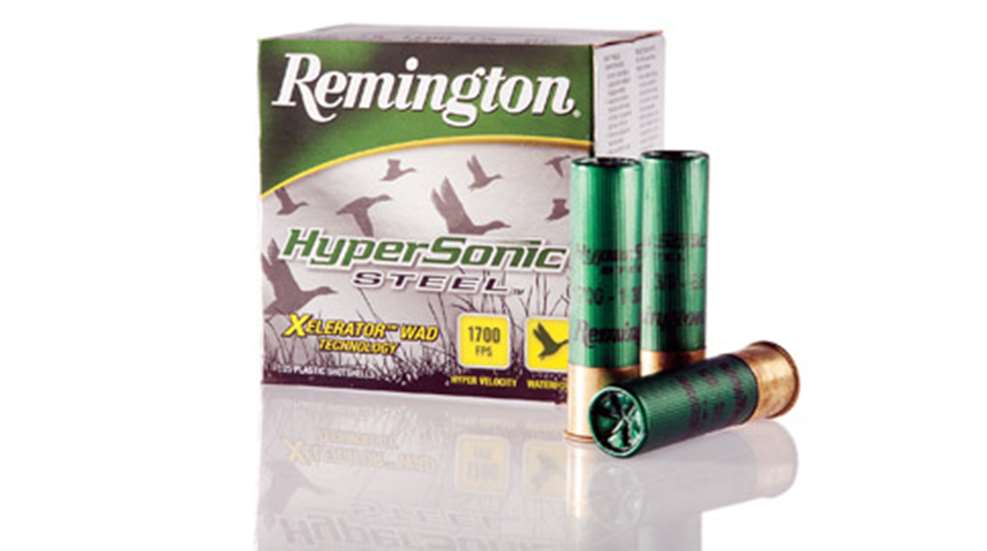
Remington’s new Hypersonic Steel shotshell loads claim a muzzle velocity (MV) of 1700 fps (12-gauge) while still retaining the traditional shot charge weights. That means a No. 4 steel pellet now exits the muzzle with 14.8 ft.-lbs. of energy. At 40 yards it retains 2.5 ft. lbs.
In comparison, Remington’s Nitro Steel High Velocity shot load has an advertised MV of 1450 fps. That means a No. 4 pellet has 10.7 ft.-lbs. of energy at the muzzle and 2.3 at 40 yards. So the Hypersonic Steel ammo has an increase of 38 percent in muzzle energy and a 9 percent advantage at 40 yards.
Remington says the way it achieves this higher velocity is by using a new wad system called the Xelerator. The wad has a cup on the end that fits over the primer area and blocks it from the main part of the propellant charge. The primer ignites a small portion of the powder charge captured in the “ignition chamber” at the rear of the wad. This small charge burns and moves the wad and payload forward. Once the wad moves forward the remainder of the powder charge is exposed and ignited. The idea is that by moving the wad column and shot forward there is an increase in available volume for the powder charge to burn and expand—sort of like the difference between a .308 cartridge case and a .30-06 case. This allows a larger amount of propellant to be used, resulting in a higher muzzle velocity without exceeding established safe pressure standards.
One other advantage of higher velocities, Remington claims, is shorter leads. It says this will result in more pellets in the head of the waterfowl for more efficient kills. They could have a point; I rarely miss in front of a duck. But it might be a little bit of a stretch. I always try to shoot for the head anyway, so will I now miss in front? I doubt it.
What I don’t doubt is that the increased velocity will provide more energy to the target. It’s still not up to lead standards, but it never will be. The increased velocity is a very good thing with waterfowl loads, as with steel shot every little bit helps.
Does it live up to claims? Well, it depends on the gun. In my Remington 11-87 shotgun the average velocity of the Hypersonic Steel actually exceeded claims slightly. In my Browning Gold the same box of ammo produced velocity that was a bit lower than advertised. That is due to the variations in the individual guns as the Browning is back-bored. It’s also due to the variations in ambient conditions as I tested the guns on two different days. This is why ballisticians have gray hair. The bottom line is Hypersonic Steel is faster than any other steel shot ammo Remington makes and as a result puts more energy into every pellet. Until the world comes to its senses and brings back lead shot for waterfowling (and while they are at it, the 1970 Dodge Challenger), this is a very good advancement for hunters.
Technical Specifications:
Type: non-toxic (steel) shotshell
Gauge: 10, 12, 20
Length: 31/2" (10, 12); 3" (12, 20)
Shot Sizes: No. 2 to BBB
Payloads (ozs.): 1, 11/4, 11/8, 13/8, 11/2
Advertised MV (fps): 1700 (12-ga.); 1600 (20-ga.); 1500 (10-ga.)
Uses: ducks, geese
MSRP: $22-$32 per box of 25