What is a Chronograph?
You want a chronograph. The device I’m talking about isn’t a watch, but it does measure time—distance divided by time to be exact. In other words, the chronographs we’re talking about measure a projectile’s velocity.
Why Do You Care About Knowing Your Velocity?
Velocity is one of the critical variables in your ballistic equation. If you guess the velocity of your bullet, then your point of impact beyond your established zero is also a guess. If you anticipate only shooting at shorter ranges, less than 200 yards, then it’s not that important. Go zero your rifle a couple inches high at 100 yards, then go forth and conquer. But if you think you might want or need to shoot out past 300 yards, then you need to know your bullet’s true velocity, and you need to care—especially as an ethical hunter. Regardless whether you’re dialing for distance or using a reticle to hold over, it’s not the time to use The Force and ditch the targeting computer.
“But wait, the ammo maker gives us velocity, so do reloading manuals,” you might say. True, but it’s the velocity as measured out of their barrels, not yours. Often their barrels are longer than standard hunting rifle barrels. Hornady’s test barrel for their .308 Win. data is 24 inches. Is your .308 Win. barrel 24 inches? Likely not. That length affects velocity. The same applies to published reloading data. Even if your barrel was the same length as the manufacturer’s, you will still likely end up with different velocity results.
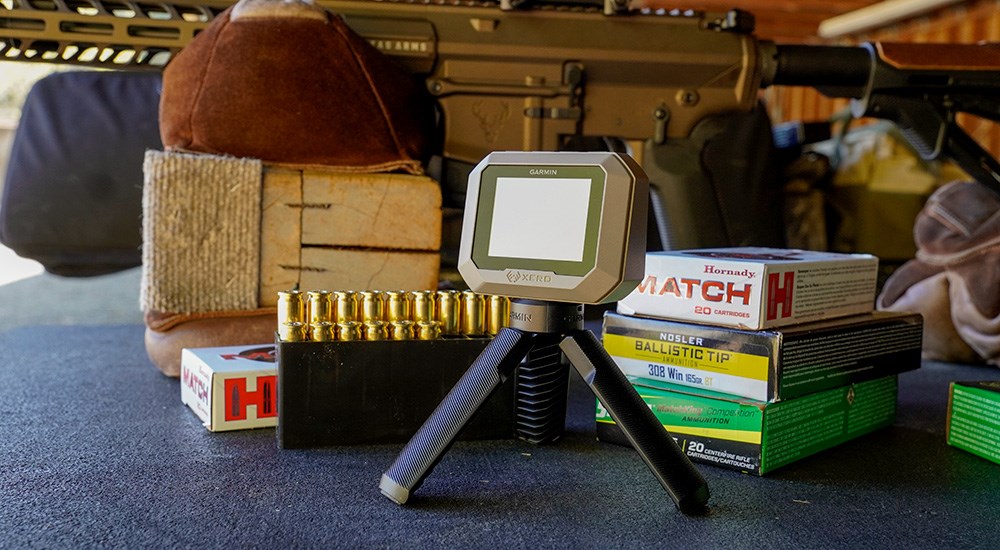
Here is a real-life example. I used a Garmin Xero C1 chronograph to measure the velocity of .308 Win. ammunition from Hornady, Nosler and Sierra from a Stag Arms Pursuit rifle with a 16.25-inch barrel, and a Savage 10 with a 20-inch Proof Research carbon-fiber barrel. Both rifles showed a loss in velocity from the factory published data with all three loads. For example, the Nosler 168-grain Ballistic Tip load has a published velocity of 2800 fps, but it clocked an average of 2568 fps out of the Stag Arms Pursuit and 2659 out of the Savage. Out of the Stag Arms rifle, that velocity difference results in 3 inches of additional drop at 300 yards and nearly 7 inches of additional drop at 400 yards when compared to the published velocity. This in no way reflects anything wrong with the guns or ammo. It just shows why it’s a good idea to accurately measure your ammo’s velocity out of your firearm.
This article won’t get into the various ballistic calculators, how to set up your gun and ammo for shooting long distance, etc. For now, let’s just agree that if you’re shooting out past a couple football fields and are interested in accuracy greater than minute of deer, you’ll appreciate having a chronograph.
Types of Chronographs
Fortunately, it’s a buyer’s market when it comes to these nifty devices. There are three types of chronographs to choose from; those that use light sensors; the MagnetoSpeed that measures the time your bullet travels the length of an electromagnetic sensor; and the newer doppler radar units that use, you guessed it, Doppler radar to track the bullet for a distance to measure the velocity. Like anything, each of these units has pros and cons.
Let There Be Light, Please: The most affordable chronographs on the market are those using light sensors. These measure the time it takes for the projectile to travel the distance between two of these sensors. The processor in the unit then calculates your bullet’s velocity. These types of chronographs, like the Caldwell Ballistic Precision 2.0 Chronograph or the Competition Electronics ProChrono DLX Bluetooth Chronograph, consist of a long body that houses the sensors and electronics, and a sunshade over each sensor. These are inexpensive and a great option for the casual shooter or those on a tight budget. Models are also available with Bluetooth compatibility and a corresponding app.
PRO: These are inexpensive, with full-featured models available for less than $200.
CONS: They must be set up in front of the firearm on a separate tripod or stand and are somewhat bulky. Overcast or low light conditions can affect the performance.
BEST APPLICATION: The shooter who only occasionally needs velocity data or for those on a tight budget.
MagnetoSpeed: The MagnetoSpeed is unique in that it attaches to the barrel of your firearm with a bayonet looking portion that resides just under the line of the bore. It uses sensors and the voltage associated with a magnetic field to measure the bullet’s velocity. The MagnetoSpeed chronographs are quite accurate and have been used by precision long-range shooting competitors extensively. The part that attaches to the barrel connects to a small base unit that houses the electronics and does all the math. These units are compact because they attach directly to the firearm. One significant drawback though is the MagnetoSpeed will almost always change your point of impact while it’s attached. So, you will have to burn 10 rounds of ammunition to get your data without those shots being useful for sighting in, practice, etc. I have used the MagnetoSpeed for a few years now and it works quite well.

PROS: Set up is simple, and the firing line does not have to go cold. These work in all lighting conditions.
CONS: The point of impact usually shifts when used. You may not be able to use it with some suppressors.
BEST APPLICATION: The shooter wants accurate data without worrying about lighting or weather or going forward of the firing line.
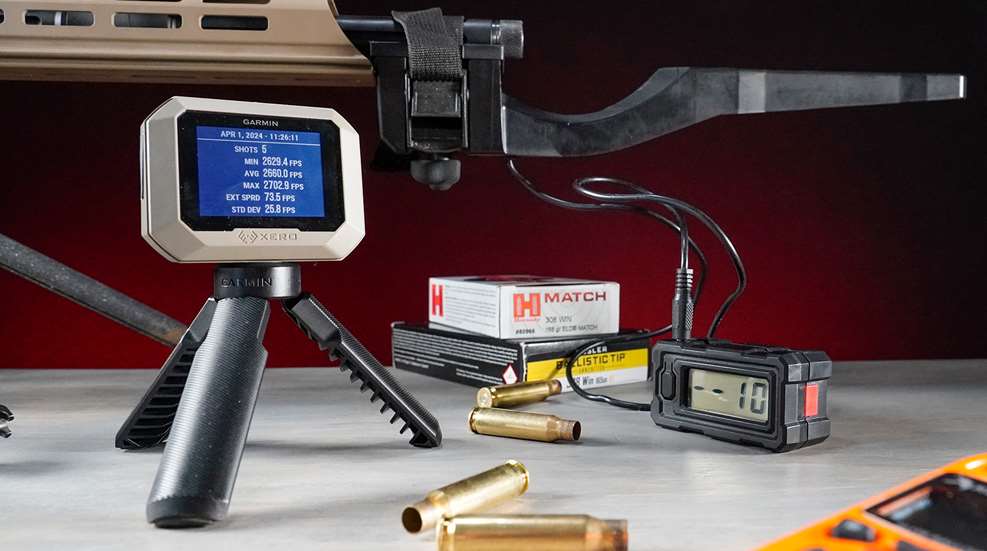
Radar Love: The newest generation of chronographs use Doppler radar to measure the projectile velocity. The Labradar was the original radar chronograph, and it was a game changer. While it was amazing at the time, it wasn’t perfect. The user interface was awkward, it went through batteries like the Galactic Empire ground through stormtroopers, and it was difficult to get lined up just right for accurate readings. Fortunately, the newest genre of radar chronographs solves all these issues as it’s smaller, lighter, easier to position, more durable and it uses less power. The most notable entry in this category is the Garmin Xero C1 Pro. Similar units are available from Caldwell and Labradar.

I’m just going to come out and say it: The Garmin Xero C1 Pro is great. When it showed up for review, the first thing I noticed was how small it was. This thing is tiny, but in a good way. It’s smaller than a typical box of centerfire rifle ammo and a lot lighter. The user interface is so simple, I have yet to even glance at the instructions. Its Bluetooth compatibility and associated app work well. It is also very forgiving regarding where you position it in relation to the muzzle to record an accurate reading. There’s no excuse to not take this along on any trip to the range.
PROS: There is no need to go forward of the firing line to set up; they are accurate, small, light and easy to use.
CONS: These are the most expensive of the chronographs available.
BEST APPLICATION: This is the best chronograph for the serious hunter or shooter who is collecting velocity data on most trips to the range on multiple rifles and loads.
Regardless whether you only shoot one cartridge or if you use multiple rifles and cartridges for hunting, having accurate velocity data will help you get the most out of your ammunition’s ballistics. This in turn will make you a better, more responsible hunter.