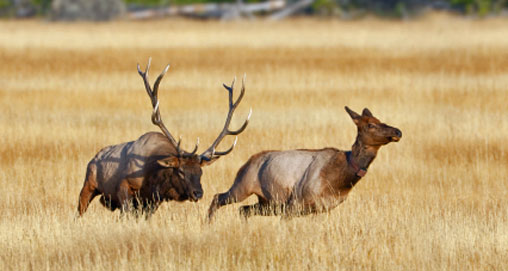
It's pretty basic, but many hunters forget this important fact—you can't shoot 'em if you can't find 'em. Even in the very best elk country, locating a bull to hunt can be time consuming and downright frustrating.
The basic scenario goes something like this. I grudgingly crawl out of my warm sleeping bag well before daylight, and hike in the dark to a vantage point that allows me to both glass open pockets and meadows, and also listen for bulls bugling. Sometimes I get up by 3 a.m. to listen, as bulls often bugle wildly at night, then taper off after the sun's up. If I hear a bull just before or just after daylight, the plan is simple—attack! If not, it's time to get the lead out.
I now move rapidly through the country, sometimes softly cow calling but mostly listening as I go, hoping to hear a bull to hunt. There's no need to waste any time sneaking—you need to cover maximum ground during the "prime time" of the morning's first few hours.
Hot Sign? Cool Your Heels
When you come to an area with hot sign—fresh tracks, droppings, worked-over wallows, —slow down and look and listen for elk. I've heard them walking, cow talking, and often heard the sound of a bull raking his antlers on a nearby tree. Try a soft cow call or, if you’re brave, a bugle. Your goal is to get a bull to sound off. Always be ready, especially when you call. You never know when a bull will come charging in. I've had enough elk bust me when I wasn't ready that I never, ever call without first getting hidden. Be sure to give yourself some time in this area. It may take a bull 20 or 30 minutes to answer your calling. He may also come in silently.
Early one morning in southwestern Montana, I was moving along through some lodgepole stringers when I came upon a freshly-used wallow that was peppered with fresh tracks and steamy droppings. Obviously elk had passed through not long before, so I sat and listened. Nothing. I bugled, softly at first, using grunts and chuckles as the primary sounds. Nothing. Cow calls. Nothing. A loud bugle. Nothing. After 20 minutes, I was getting ready to fold my tent and move on when I thought I heard something. The wind made it tough to hear, but there it was—the sound of a bull elk raking a tree. He had to be close! I went into stealth mode, slowly working toward that sound. Reaching a small brushy mound, I carefully peeked through the brush to see a big, dark-horned 5x5 bull across a shallow ravine, destroying a small pine not 50 yards away. While he was venting his frustrations, I belly-crawled through the brush to within 30 yards. I'm still wondering how I shot over his back.
Another time, my friend Merritt Pride and I were working a timbered ridge when we got a violent response to our calling. We set up and got into a tempo with that bull, when all of a sudden it got deathly quiet. We waited, and waited, and waited. After 15 minutes, I told Merritt I was going to move up and see if I could find that bull. I hadn't taken two steps when Merritt hissed at me. Freezing, I peeked up under the brim of my hat to see a very good 6x6 bull staring me in the face, not 35 yards away. He came in as silent as the proverbial church mouse. I chanted silently to myself, "I'm a bush, I'm a bush!" It didn't work. He was out of there like a shot.
The lesson is this: Bulls don't always respond with loud, aggressive bugling. You have to be ready for anything.
You Don't Have To Call
Don't overlook glassing, or taking a stand in the dark timber itself, when trying to locate bulls to hunt.
Glassing up elk as they move from feeding areas to their beds early in the day is a great way to locate elk, especially at long distances. At the same time, you can be listening for bugling and other elk sounds. Once you find the elk, you can figure out how to hunt them.
If you don't glass up any elk or don't hear them calling, does that mean the area is devoid of animals? Certainly not. Put on your hiking shoes and cover ground. In hot weather, I've had good success finding a waterhole or wallow peppered with fresh sign, then setting a portable tree stand or building a ground blind on the downwind side and sitting there from midday until dark. One hot September week in the Gila unit of New Mexico, I set a stand over a water tank, and climbed aboard under the noonday sun. It was probably 75 or 80 degrees, but I had a good paperback with me and settled in for a long sit. That evening I saw a black bear (with two game department tags in his ears), a pair of foxes, six mule deer does—and eight elk, six cows, one raghorn and one small 6x6 bull. I was hunting for a dandy bull, and passed him up. But I thought to myself, here's my back-up, just in case I can't get in on a granddaddy.
It's also important to hunt all day. Sure, I nap in the afternoon, but I've had enough bulls answer my calling, or watched enough elk come to water holes or wallows while sitting on stand, during the so-called dead period between 10 a.m. and 3 p.m. that I hunt hard all day long.
Be flexible. And never, ever give up.